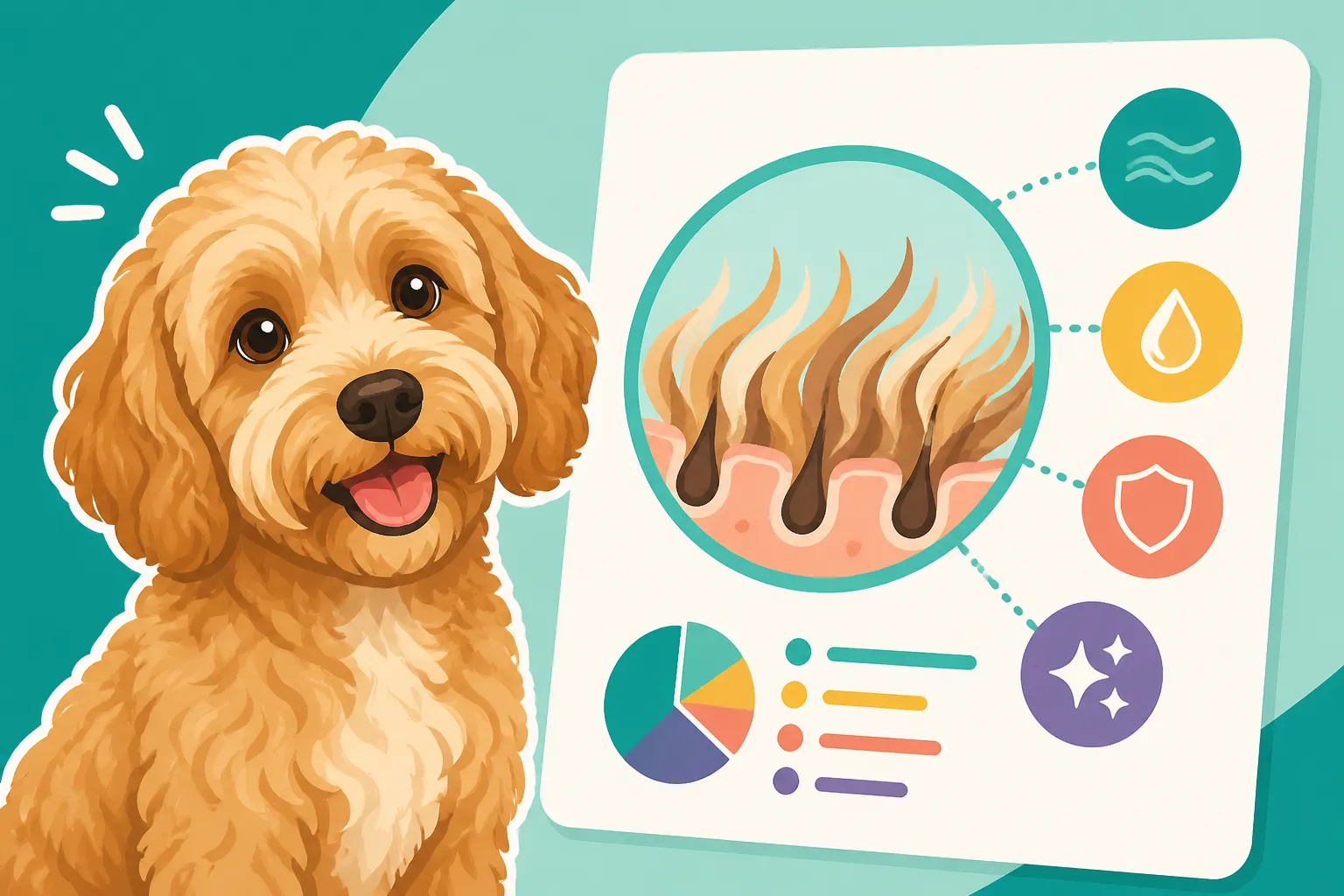
What a Cockapoo Coat Panel Actually Reports
One of the biggest mysteries for new Cockapoo owners, and often a point of frustration, is predicting what your darling puppy's coat will actually look like and, more importantly, how much it will shed. You've heard all the talk about "hypoallergenic" and "low-shedding," but then you see pictures of Cockapoos with vastly different coats, and sometimes even within the same litter! This guide will dive deep into what a genetic coat panel actually reports for your Cockapoo, demystifying the science behind their wonderful, varied coats.
Understanding the Basics of Cockapoo Coat Genetics
Before we delve into the specifics of a coat panel report, it's helpful to understand the foundational genetics that influence your Cockapoo's beautiful fur. Unlike some purebreds with very predictable coats, the Cockapoo, being a crossbreed of a Cocker Spaniel and a Poodle, inherits a fascinating mix of genes that can result in a wide spectrum of textures and shedding levels. Think of it like a genetic lottery, but with a coat panel, you get a sneak peek at the results!
The Furnishings Gene (Rspo2) – The Key to Low Shedding
When people talk about a Cockapoo being "low-shedding" or having that classic "doodle" look, they are almost always referring to the presence of the furnishings gene, scientifically known as Rspo2. This gene dictates whether a dog has the longer hair on its face, eyebrows, and mustache – what we affectionately call "furnishings." Without furnishings, a dog often has a smoother, flatter face, much like a Cocker Spaniel, and will typically shed more like a Spaniel.
A Cockapoo inherits one copy of this gene from each parent. There are two alleles (versions) for furnishings: 'F' for furnished, and 'IC' for improper coat (which means no furnishings).
- FF: The dog has two copies of the furnishing gene. This is what you ideally want for a true low-shedding, furnished coat.
- Fic (or F/IC): The dog has one copy of furnishings and one copy of the improper coat gene. This dog will have furnishings and typically be low-shedding, but it can pass on the improper coat gene to its offspring. This is why a breeder might test, to ensure they're not accidentally producing puppies that shed a lot.
- ICIC: This dog has two copies of the improper coat gene, meaning it lacks furnishings and will have a flatter face and shed more. This is often referred to as an "improper coat" or sometimes a "flat coat" in the doodle world, and it can be a real surprise if you're expecting that classic teddy bear look.
Understanding this gene is crucial because it directly impacts the amount of shedding. A fully furnished Cockapoo (FF or Fic) will generally shed far less than one with an improper coat (ICIC). This is often the first thing people look for on a coat panel. Whether a Furnished Cockapoo Suits an Allergic Home can be a huge factor for families considering this breed.
The Curl Gene (KRT71) – From Wavy to Ringlets
Beyond shedding, the curl of a Cockapoo's coat is another major characteristic that varies wildly. This is primarily influenced by the KRT71 gene, which determines hair texture, ranging from straight to tightly curled. Again, your Cockapoo gets one copy from each parent. The alleles are typically represented as 'C' for curl and 'c' for straight.
- CC: A dog with two copies of the curl gene will usually have a very tight, Poodle-like curl. This type of coat is stunning but requires significant grooming effort to prevent matting.
- Cc: This genotype often results in a wavy coat, which is perhaps the most common and often sought-after Cockapoo coat type. It's a lovely balance, offering some curl without being quite as demanding as the tightest curls.
- cc: Dogs with two copies of the straight gene will have a straighter, perhaps slightly feathered coat, leaning more towards the Cocker Spaniel's texture. While still beautiful, this coat type might also be associated with slightly more shedding, though less than an improper coat.
It’s not uncommon to find a range of curl types within a single litter, especially if both parents are 'Cc' (wavy). This is why a breeder might emphasize a coat panel – it helps them understand the probability of different coat outcomes. The presence and intensity of curl will dramatically affect your grooming routine, so knowing this in advance can save a lot of surprises down the line. The Three Cockapoo Coat Types and Their Upkeep is a topic many new owners grapple with.
The Improper Coat Gene (IC) – Shedding Surprises
While we briefly touched on the 'IC' allele when discussing furnishings, it's worth dedicating a moment to truly appreciate what an improper coat means. An "improper coat" doesn't mean something is wrong with your dog; it simply refers to the absence of furnishings. Genetically, it's expressed as ICIC for the Rspo2 gene. These Cockapoos will have a smooth face, much like a Cocker Spaniel, and typically shed more than their furnished counterparts.
For families specifically seeking a low-shedding dog due to allergies or simply a preference for less hair around the house, an improper coat can be a significant surprise. If a breeder isn't testing for furnishings, they might accidentally produce puppies with improper coats, even if both parents appear furnished. This happens if both parents are 'Fic' (carriers of the improper coat gene). Each puppy from such a pairing has a 25% chance of being ICIC.
An improper coat still comes in different textures (straight, wavy, curly), but the lack of facial furnishings means they won't have that distinctive "teddy bear" look many associate with Cockapoos. They may still be incredibly charming and wonderful companions, but their grooming needs and shedding levels will be closer to that of a Cocker Spaniel. What an Improper Coated Cockapoo Looks Like can be quite different from the typical expectation.
Deciphering Your Cockapoo's Coat Panel Report
So, you've got a coat panel report in your hands. It's full of letters and abbreviations, and it can feel a bit like reading hieroglyphics. But don't fret! Once you understand the basic genetic markers, it becomes a valuable tool for understanding your Cockapoo's unique traits and, for breeders, for making informed decisions.
What Do All Those Letters Mean? (F/f, Cu/cu, IC/ic)
A typical Cockapoo coat panel will report on several key genes, often including:
-
Furnishings (Rspo2): This is usually reported as F/F, F/IC, or IC/IC.
- F/F (or FF): Your Cockapoo has two copies of the furnishing gene and will have full facial furnishings and minimal shedding. This is generally the most desirable result for low-shedding.
- F/IC (or Fic): Your Cockapoo has one furnishing gene and one improper coat gene. It will have furnishings and typically be low-shedding, but it carries the improper coat gene. If bred, it could produce puppies with improper coats if paired with another carrier or an IC/IC dog.
- IC/IC (or ic/ic): Your Cockapoo has two copies of the improper coat gene, meaning it lacks furnishings and will likely shed more. This is the "flat coat" or "improper coat."
-
Curl (KRT71): This is commonly reported as C/C, C/c, or c/c (or sometimes Cu/Cu, Cu/cu, cu/cu).
- C/C (or Cu/Cu): Your Cockapoo has two copies of the curl gene, resulting in a tight, Poodle-like curl.
- C/c (or Cu/cu): Your Cockapoo has one curl gene and one straight gene, resulting in a wavy coat.
- c/c (or cu/cu): Your Cockapoo has two copies of the straight gene, resulting in a flatter or straighter coat.
Some panels might also include other genes that influence coat length (like the FGF5 gene for long vs. short hair, though most Cockapoos are long-haired) or even genes related to coat color and fading, giving you an even more comprehensive picture. Reputable labs like Embark or Paw Print Genetics provide detailed reports that explain each marker, but understanding the core F and C genes is your starting point.
Predicting Your Puppy's Future Coat Type
This is where the magic happens, especially for breeders, but it's also fascinating for owners to look back on. By knowing the genetic makeup of both parents, a breeder can predict the probability of different coat types appearing in a litter.
For example, if both parents are F/IC (furnished carriers), their puppies have:
- 25% chance of being F/F (fully furnished, low shed)
- 50% chance of being F/IC (furnished carrier, low shed but can pass on IC)
- 25% chance of being IC/IC (improper coat, more shedding)
Similarly, for curl, if both parents are C/c (wavy):
- 25% chance of being C/C (tight curl)
- 50% chance of being C/c (wavy)
- 25% chance of being c/c (straight)
This scientific approach takes a lot of the guesswork out of coat prediction. While you can often make an educated guess by looking at an eight-week-old puppy's muzzle and the waviness of its fur, a DNA test provides certainty. It's especially useful for those very curly or very flat-faced puppies where visual assessment might be misleading at a young age. This information helps match the right puppy to the right home, especially if specific grooming commitments or allergy concerns are at play. Whether a Breeder Can Guarantee a Cockapoo's Coat becomes a much clearer discussion with these reports.
Beyond Shedding: Other Coat Traits a Panel Might Include
While furnishings and curl are often the main focus for Cockapoo owners, comprehensive coat panels can reveal a wealth of other interesting genetic information. These additional insights can help you understand subtle nuances of your Cockapoo's appearance and even anticipate certain grooming needs.
For instance, some panels delve into genes that affect coat length, like the FGF5 gene. While nearly all Poodles and Cocker Spaniels carry the gene for long hair, it's good to confirm. Then there are genes influencing texture, beyond just curl, such as genes for coarse versus soft hair. While these might not dramatically change the visual appearance, they can impact how the coat feels to the touch and how easily it mats.
Many panels also include color genetics. This is fascinating for breeders trying to achieve specific coat colors or patterns, but it's also just plain interesting for owners! You might see results for genes like 'E locus' (red/yellow vs. black pigment), 'K locus' (dominant black, brindle, or fawn), 'B locus' (black vs. brown pigment), and 'D locus' (dense vs. dilute pigment, which affects shades like blue or lilac). These genes determine whether your Cockapoo is red, apricot, chocolate, black, or even a dilute version of these colors. Knowing this can help explain why your black puppy's coat might be silvering early or why that gorgeous red has faded over time. Whether a Cockapoo's Adult Coat Comes In a Different Color is a common question, and these tests can offer clues. While not directly related to shedding, these color genes are part of the complete genetic picture that a good coat panel can offer.
Why a Coat Panel Report Matters for Owners and Breeders
Understanding a Cockapoo's coat panel report isn't just a matter of scientific curiosity; it has very real, practical implications for both current and prospective owners, as well as for responsible breeders. It's about transparency, managing expectations, and promoting healthier, more predictable outcomes for these beloved dogs.
Managing Grooming Expectations as a Cockapoo Owner
Let's be honest: Cockapoo grooming is a commitment. Whether your pup ends up with a straight, wavy, or tightly curled coat, it requires regular brushing and professional grooming. But knowing the genetic predisposition of your Cockapoo's coat can significantly help you prepare for that commitment.
If your Cockapoo's coat panel indicates a C/C (tight curl) and F/F (fully furnished) genotype, you know you're in for a high-maintenance grooming routine. This coat type, while often the most desirable for its non-shedding qualities, is also the most prone to matting. You'll need to invest in quality brushes and combs, maybe from an online retailer like Amazon, and schedule professional grooming appointments every 6-8 weeks, if not more frequently. Knowing this upfront allows you to budget time and money accordingly, reducing the shock of unexpected grooming demands.
Conversely, if your Cockapoo has an IC/IC (improper coat) and c/c (straight coat) genotype, you might have less matting to contend with, but potentially more shedding. This means you might need to adjust your cleaning routine at home. It’s a trade-off, and being informed beforehand helps you manage your living environment and expectations. Having the right tools, like a good deshedding brush (easily found on Chewy), can make all the difference. The Weekly Hours Each Cockapoo Coat Type Takes can vary dramatically, and a coat panel helps clarify that.
Making Informed Breeding Decisions
For dedicated Cockapoo breeders, coat panel reports are an indispensable tool for responsible breeding. It moves beyond guesswork and allows for strategic pairings that promote desirable traits and avoid unwanted ones. A breeder committed to the health and predictability of their puppies will always utilize these tests.
The primary goal is often to produce low-shedding, furnished puppies for families seeking that specific characteristic. By testing potential breeding dogs, a breeder can ensure they are pairing dogs in a way that maximizes the chances of F/F or F/IC puppies, and avoids producing IC/IC (improper coated) puppies, especially if their program focuses on the classic "doodle" look. Imagine the disappointment of a family expecting a non-shedding companion only to discover their puppy has a flat, shedding coat!
Furthermore, understanding the curl gene allows breeders to aim for specific coat textures, whether it's the popular wavy coat or a tighter curl. It helps them maintain consistency within their lines and better advise prospective owners on what to expect. Using these genetic tools demonstrates a breeder's commitment to quality, transparency, and the well-being of the breed. It also helps them avoid potential genetic surprises that could lead to disillusioned owners or puppies needing rehoming because their coat wasn't what was advertised. Whether a Breeder Must Test Both Cockapoo Parents is a critical question, and coat panels are part of the answer.
Empowering Your Purchase: What to Ask Your Breeder
As a prospective Cockapoo owner, asking about coat panel reports is one of the most powerful ways you can ensure you're making an informed decision and choosing a responsible breeder. A reputable breeder will not only perform these tests but will also be happy to share and explain the results to you.
When you're speaking with a breeder, don't be shy about asking: "Have the parents of this litter had coat panel DNA tests? Can I see the results for furnishings (Rspo2) and curl (KRT71)?" A breeder who has done their due diligence will likely have these results readily available, perhaps even printed out or linked on their website. They should be able to explain what F/F, F/IC, IC/IC, C/C, C/c, and c/c mean in the context of their specific puppies.
If a breeder seems evasive, claims the tests aren't necessary, or simply says they "know" their dogs won't shed without proof, it should be a red flag. While visual assessment can be a guide, genetic testing provides certainty. This due diligence on your part empowers you to select a puppy with a coat type that genuinely fits your lifestyle and expectations, potentially avoiding future disappointment related to shedding or intense grooming demands. You wouldn't buy a house without an inspection, so why choose a lifelong companion without asking for their genetic blueprint? Asking a Cockapoo Breeder for the FN Certificate (for health) is just as important as asking for coat reports.
Common Misconceptions and Realities of Coat Panels
Despite the scientific clarity that coat panels offer, there are still a few lingering misconceptions about what they can and cannot do. Addressing these helps ensure that both owners and breeders approach these reports with realistic expectations.
The "Hypoallergenic" Myth and Coat Panels
One of the biggest reasons people seek out doodles like the Cockapoo is the desire for a "hypoallergenic" dog. And while coat panels can confirm the presence of furnishings (which leads to low shedding), it's crucial to understand that no dog is truly 100% hypoallergenic. This is a significant reality check.
Allergies to dogs are typically triggered by dander (flakes of skin), saliva, and urine, not just hair. While a low-shedding, furnished coat can significantly reduce the amount of dander and allergens dispersed into the environment, it doesn't eliminate them entirely. A Cockapoo with an F/F or F/IC result on its furnishings panel will shed significantly less than an IC/IC dog, meaning fewer allergen-laden hairs around your home. This is why these coats are often much better tolerated by individuals with mild dog allergies.
However, a coat panel cannot guarantee an allergy-free experience. Someone with severe allergies might still react to even a low-shedding Cockapoo. The panel is a tool to assess shedding potential, which correlates with reduced allergen distribution, but it's not a magical "allergy-proof" certificate. It's always recommended that individuals with allergies spend time with the specific puppy or its parents to gauge their reaction before committing. Whether Any Cockapoo Is Truly Non Shedding is a question that needs a realistic answer.
Coat Panel vs. Visual Assessment: Which is More Accurate?
When looking at a litter of Cockapoo puppies, especially when they're very young, it can be incredibly tempting to try and guess their adult coat. You might notice some have smoother muzzles while others have little fluffy beards starting to emerge. While visual cues can offer clues, especially regarding furnishings, a coat panel DNA test is always more accurate and definitive.
A skilled breeder might be able to make a very educated guess about furnishings by examining a puppy's muzzle and the hair around its eyes at around 6-8 weeks of age. Puppies destined to be fully furnished will often show fuzzier facial hair. However, predicting curl can be much harder. A puppy with a straighter coat at eight weeks might still develop a wavy adult coat, and vice versa. The famous "coat change" that happens around 8-12 months can also throw a wrench in early predictions. A Cockapoo's Coat Through the Ten Month Change is a prime example of why early visual assessments can be misleading.
A DNA coat panel removes all doubt. It tells you, with scientific precision, exactly what genetic markers your Cockapoo carries for furnishings and curl. There's no guessing, no waiting, and no hoping. It's an objective report on the dog's genetic blueprint. For important decisions like breeding or for owners with specific needs (like very low shedding), the DNA test is the gold standard and should always take precedence over a visual assessment alone.
Investing in Your Cockapoo's Coat: Practical Tools and Tips
Now that you understand what a coat panel reports, let's talk about putting that knowledge into practice. Regardless of your Cockapoo's genetic coat type, proper care is essential. It's not just about aesthetics; it's about comfort and preventing painful mats that can lead to skin issues.
Essential Grooming Tools for Every Cockapoo Owner
Having the right tools is half the battle when it comes to maintaining your Cockapoo's coat. A good set of grooming supplies, readily available from online retailers like Chewy or Amazon, can make your weekly routine much smoother.
- Slicker Brush: This is your primary weapon against tangles. Look for one with fine, bent wire bristles. Use it regularly, often daily for curly or wavy coats, to remove loose hair and prevent mats from forming. Always brush in layers, getting right down to the skin.
- Metal Comb: A good quality metal comb with both wide and fine teeth is crucial for finding and working out smaller mats that a slicker brush might miss. After brushing, run the comb through the coat to ensure you haven't left any hidden tangles. Pay extra attention to common matting spots like behind the ears, under the armpits, and around the tail. The Comb That Finds Mats a Slicker Misses is a lesson many new owners learn the hard way.
- Detangling Spray: A good detangling spray can make brushing a much more pleasant experience for both you and your Cockapoo. It helps lubricate the hair, making it easier for the brush and comb to glide through.
- Nail Clippers or Grinder: Don't forget nail care! Keeping your Cockapoo's nails trimmed is important for their comfort and paw health.
- Ear Cleaner: Cockapoos, inheriting those floppy Spaniel ears, are prone to ear infections. A good ear cleaner used regularly (as advised by your vet) can help keep their ears healthy. Whether a Cockapoo's Ears Are Better Than a Cocker's is a nuanced discussion, but care is always paramount.
Even if your Cockapoo has a straighter, less demanding coat, these tools are invaluable for maintaining a healthy and comfortable pet.
Professional Grooming and Home Maintenance Balance
For most Cockapoos, especially those with wavy or curly furnished coats, a balance between professional grooming and diligent home maintenance is key. You can't rely solely on one or the other.
Professional groomers are experts at cutting, shaping, and thoroughly cleaning your Cockapoo's coat. They have specialized tools and techniques to handle even the most stubborn mats and provide a stylish, comfortable clip. Depending on your Cockapoo's coat type and desired length, professional grooming might be needed every 4-10 weeks. For a tightly curled, furnished coat, it's often closer to the 4-6 week mark. What a Cockapoo Groom Costs by Coat Type can vary greatly, so factoring this into your budget is important.
However, professional grooms don't negate the need for home care. In between appointments, daily or every-other-day brushing and combing are essential to prevent matting. If you let mats build up, the groomer might have no choice but to shave your Cockapoo down, which isn't ideal for their comfort or your preferred look. Regular brushing also helps distribute natural oils, keeping the coat healthy and shiny. Think of it as teamwork: you maintain, the groomer refines.
Some Cockapoo owners choose to learn how to do basic trims at home to save money or extend the time between professional grooms. This can be a rewarding experience, but it requires practice and the right equipment. Whether you groom at home or go to a salon, a well-cared-for coat is a happy Cockapoo.
Nutrition's Role in Coat Health
Beyond brushing and clipping, your Cockapoo's diet plays a significant role in the health and appearance of their coat. A shiny, soft, and healthy coat starts from the inside out.
High-quality dog food, whether it's kibble, wet food, or a fresh-food option like Ollie, provides the essential nutrients your Cockapoo needs. Look for foods that list a named meat source (e.g., chicken, lamb, salmon) as the first ingredient. Essential fatty acids, particularly Omega-3 and Omega-6, are vital for skin and coat health. Many quality dog foods include these, often from sources like fish oil or flaxseed. If your dog's coat seems dull or their skin dry, a vet might recommend an Omega supplement.
Adequate hydration is also crucial. Ensure your Cockapoo always has access to fresh, clean water. Just like with humans, dehydration can affect skin elasticity and coat luster. Sometimes, skin and coat issues can be indicative of underlying allergies or nutritional deficiencies, so if you notice persistent problems like excessive scratching, dull coat, or flaky skin, it's always best to consult your veterinarian. Whether a Cockapoo's Skin Is Greasy Like a Cocker's or dry like a Poodle's can influence dietary considerations. A balanced, nutritious diet is one of the easiest ways to support a beautiful coat.
Disclaimer
This article is for general informational purposes only and does not constitute professional advice. Laws, prices and regulations vary by location and change over time. Consult a qualified professional for guidance on your specific situation.