Whether Backcrossing Makes a Cockapoo More Biddable
It’s incredibly common for people new to the world of Cockapoos, or even those considering a second one, to get caught up in the alphabet soup of generations – F1, F1b, F2, and so on. One of the most persistent myths I hear circulating is that backcrossing, particularly to a Poodle, somehow guarantees a more "biddable" dog, making training a breeze. This can lead to a lot of frustration and disappointment if expectations aren't managed. This guide will dive deep into what biddability truly means for a Cockapoo, explore the genetics of backcrossing, and ultimately help you understand what really influences your delightful companion's willingness to learn and work with you.
Deciphering Biddability in the Cockapoo
When we talk about a dog being "biddable," we're not just talking about how quickly they sit or stay. It's a much richer concept, encompassing a dog's natural desire to cooperate with their human, their attentiveness, and their inherent motivation to please. It's that wonderful quality that makes a dog truly a partner in training, rather than a stubborn rebel.
What Does "Biddable" Actually Mean?
At its heart, biddability describes a dog that is keen to engage with you, responsive to your cues, and generally enjoys the process of learning and working together. Think of it as a spectrum: on one end, you have dogs that seem to live to please, always looking to you for direction; on the other, you have more independent spirits who might interpret a command as merely a suggestion, and only if it aligns with their current interests. A biddable dog isn't necessarily a robot, but rather one that finds joy and reward in interaction and successful communication with its owner.
This isn't to say a less biddable dog can't be trained – far from it! It simply means the approach, patience, and consistency required might differ. A highly biddable Cockapoo might pick up What a Cockapoo Puppy Should Learn First in just a few repetitions, eager for your praise. A less biddable one might require more creative motivation, perhaps a higher-value treat, or a more engaging game to keep their focus.
The Influence of Cocker Spaniel and Poodle Traits
The beauty of the Cockapoo lies in its blend of two wonderfully distinct breeds: the Cocker Spaniel and the Poodle. Both bring their own flavors of biddability to the mix.
The Cocker Spaniel, whether American or English, is traditionally known for its eagerness to please and affectionate nature. They were bred to work closely with hunters, flushing game and retrieving, which required a strong bond and responsiveness to their handler. This lineage often instills a natural desire to be near their people and comply with commands, often driven by sheer joy and connection. However, they also possess a strong scent drive and can be easily distracted by interesting smells, which some owners might mistake for a lack of biddability when their nose takes over. Remember that strong hunting drive when your Cockapoo Ignores You Once It Scents Something.
The Poodle, on the other hand, is renowned for its intelligence, problem-solving abilities, and athletic prowess. Poodles excel in obedience, agility, and a myriad of dog sports because they are quick thinkers and generally enjoy mental stimulation. They thrive on having a "job" and often learn complex tasks with surprising speed. While they might not always have the same overt "eager to please" demeanor of a Cocker, their intelligence makes them highly capable and, in their own way, very biddable, especially when the training is engaging and consistent. They often enjoy figuring things out as much as they enjoy the reward itself.
A Cockapoo inherits a unique blend of these traits. Some might lean more towards the Cocker's affectionate compliance, while others might display the Poodle's sharp intellect and independent problem-solving. This delightful variation is part of what makes each Cockapoo so individual.
The ABCs of Cockapoo Generations and Backcrossing
Understanding backcrossing requires a quick primer on how Cockapoo generations are typically categorized. This isn't just arbitrary labeling; it gives us a general idea of the genetic makeup and, by extension, the likely range of physical and temperamental traits.
What Does F1, F1b, and F2 Actually Mean?
These "F" numbers refer to filial generations, essentially indicating how far removed a dog is from its purebred ancestors.
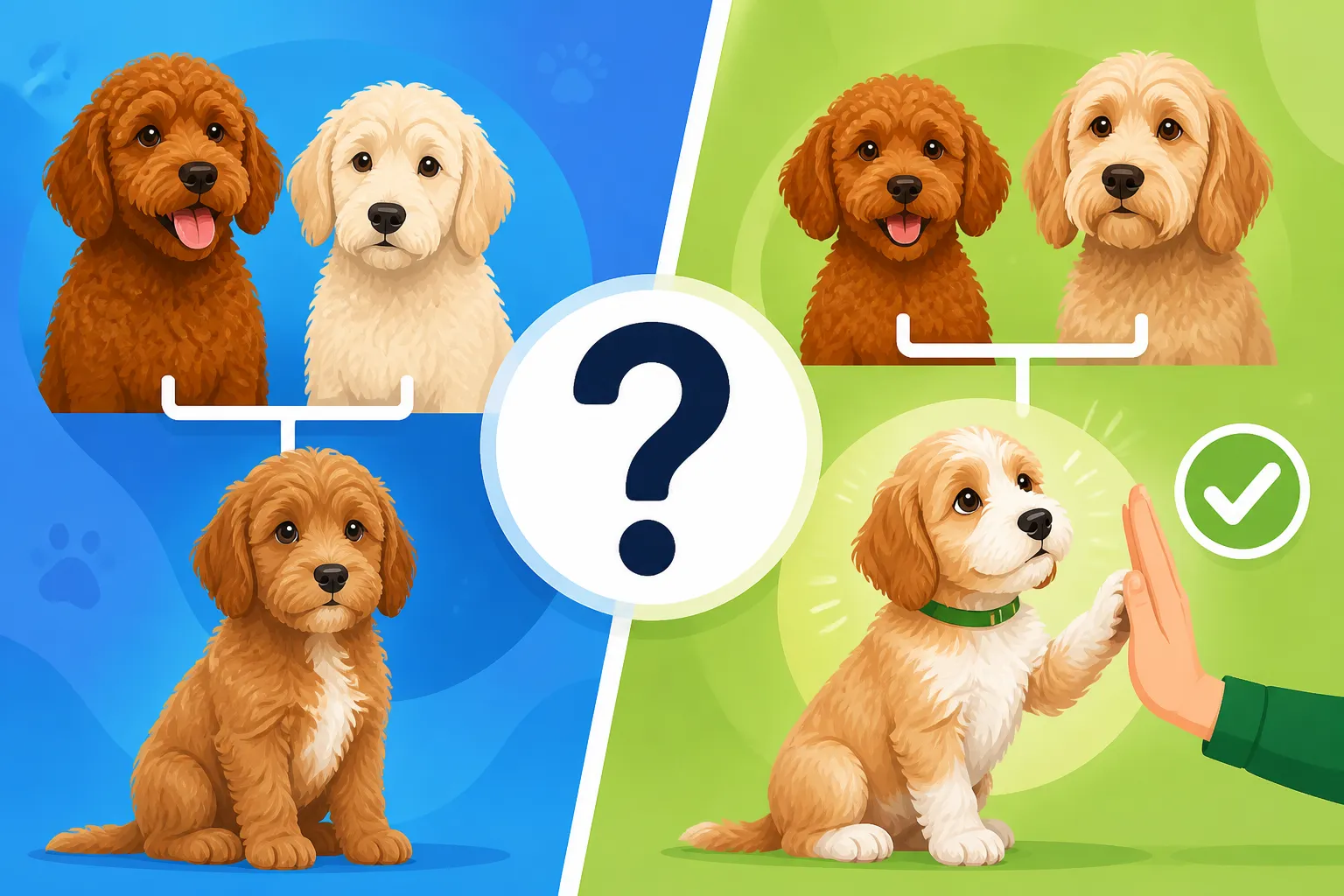
- F1 Cockapoo: This is the first-generation cross. An F1 Cockapoo is the direct offspring of a purebred Cocker Spaniel and a purebred Poodle. They receive 50% of their genes from each parent breed. This generation often exhibits "hybrid vigor," meaning they can be healthier and more robust than either purebred parent due to increased genetic diversity. However, their coat type and temperament can be quite variable within a single litter, as they inherit a wide range of genes from both sides. You might see everything from a fairly straight coat to a loose curl, and temperaments that lean heavily one way or the other.
- F1b Cockapoo: This is where backcrossing comes in. An F1b Cockapoo is the result of breeding an F1 Cockapoo back to one of the original parent breeds. Most commonly, an F1 Cockapoo is bred back to a purebred Poodle. This means the F1b typically carries approximately 75% Poodle genes and 25% Cocker Spaniel genes. The primary reason breeders do this is usually to enhance Poodle traits, particularly the non-shedding, curly coat, making them a more predictable choice for allergy sufferers. Less commonly, an F1 Cockapoo might be bred back to a purebred Cocker Spaniel, which would result in a dog with roughly 75% Cocker genes.
- F2 Cockapoo: An F2 Cockapoo is the offspring of two F1 Cockapoos. In this generation, the genetic recombination is even more varied than in F1s. While both parents are 50/50, their puppies can inherit a much broader spectrum of traits. You might see some puppies in an F2 litter that look and act almost entirely like a Cocker, others almost entirely like a Poodle, and everything in between. This generation is often seen as less predictable than F1 or F1b in terms of coat and temperament.
The Purpose of Backcrossing in Cockapoos
The main driver behind backcrossing is usually to achieve more consistent physical traits, especially regarding the coat. Many people seek Cockapoos specifically for their low-shedding qualities, which come from the Poodle. An F1 generation can be a gamble in this regard, with some puppies inheriting a "flat" or "improper" coat that sheds more like a Cocker. By backcrossing to a Poodle (creating an F1b), breeders aim to increase the likelihood of a curlier, low-shedding coat.
However, genetics are rarely so neatly compartmentalized. While breeders might focus on coat, they are inherently shifting the overall genetic balance. With more Poodle genes, there's a higher probability of other Poodle traits also being more dominant, including aspects of temperament and intelligence. This is where the discussion of biddability comes in. It's less about a direct intention to create a "more biddable" dog and more about a potential side effect of increasing the Poodle genetic contribution.
Does Backcrossing Actually Make a Cockapoo More Biddable?
This is the million-dollar question, and like many things in the world of dog genetics and behavior, the answer isn't a simple yes or no. It's a nuanced interplay of genetic predisposition and environmental factors.
The Genetic Argument for Increased Biddability in F1b Cockapoos
The theory that F1b Cockapoos (especially those backcrossed to a Poodle) might be more biddable often stems from the understanding of Poodle traits. If an F1b Cockapoo carries roughly 75% Poodle genetics, it stands to reason they might exhibit more of the Poodle's characteristic intelligence, attentiveness, and desire for mental engagement. Poodles are highly intelligent and often thrive on having a job to do, making them incredibly receptive to training. A Cockapoo with a stronger Poodle genetic influence might, therefore, be quicker to pick up commands, more focused during training sessions, and generally more inclined to look to their owner for cues.
For example, if you're engaging in something like Scent Work That Satisfies a Cockapoo, a more Poodle-leaning F1b might show a heightened ability to concentrate on tasks and solve scent puzzles, potentially outperforming an F1 or F2 with a stronger Cocker "nose-down" independent drive. They might be less inclined to follow an intriguing scent into the bushes independently, and more inclined to check in with you first. This perceived greater responsiveness can certainly make them feel more biddable to an owner who is consistent with their training.
The Nuance: It's Not a Guarantee
However, it’s crucial to understand that genetics are not a perfect predictive tool, especially in mixed breeds. Even with a 75% Poodle genetic makeup, an F1b Cockapoo is still a mixed breed. Individual variation is immense. You could have an F1 Cockapoo that is incredibly biddable, picking up every command with enthusiasm, and an F1b that is a bit more aloof or independent.
Consider these factors:
- Individual Puppy Temperament: Each puppy, even within the same litter, has a unique personality. Some are bolder, some are shyer, some are more playful, and some are more serious. These inherent temperamental differences often play a much larger role in biddability than their specific generation. A puppy's early experiences and socialization are paramount.
- The Specific Poodle and Cocker Lines: Not all Poodles are created equal, nor are all Cocker Spaniels. The biddability of the parent Poodle or Cocker Spaniel used in the backcross will heavily influence the biddability of the offspring. A Poodle from a line known for strong working drive and focus might produce more biddable F1bs than a Poodle from a more laid-back line, regardless of the percentage of Poodle genes. The same goes for the Cocker side – a show line Cocker may have a different energy and biddability profile than a working line.
- The Goal of the Backcross: As mentioned, the primary goal of F1b breeding is often coat type for allergy sufferers. While temperament is certainly considered by responsible breeders, it's typically secondary to the coat in the decision to backcross. Therefore, a breeder might not be specifically selecting for enhanced biddability, but rather for coat predictability.
In essence, while backcrossing to a Poodle can increase the likelihood of traits associated with biddability, it doesn't guarantee it. It's a statistical probability rather than a certainty.
Factors Beyond Genetics That Drive Biddability
While genetic predisposition plays a role, it is often overshadowed by environmental factors, consistent training, and the bond you build with your Cockapoo. Don't fall into the trap of thinking a specific generation absolves you from putting in the work!
Early Socialization and Puppy Training
This cannot be stressed enough. A well-socialized puppy, regardless of its genetic makeup, is far more likely to be a confident, adaptable, and ultimately more biddable adult dog. Exposing your Cockapoo puppy to a wide variety of sights, sounds, people, and friendly dogs during their critical socialization period (roughly 3-16 weeks) helps them develop into well-adjusted individuals. A dog that is fearful or overwhelmed by new experiences will naturally be less responsive and harder to train.
Formal puppy classes, like those offered by BAXTER & Bella, provide an excellent foundation. These programs focus on positive reinforcement, teaching basic obedience, and building confidence in both the puppy and the owner. Even simple daily exercises, like introducing them to different textures to walk on or meeting new people, make a huge difference.
Consistency, Patience, and Positive Reinforcement
This is perhaps the single most important factor in developing a biddable Cockapoo. Dogs, especially intelligent ones like Cockapoos, thrive on routine and clear communication.
- Consistency: If "sit" means "sit" every single time, with every family member, your dog will quickly understand. If sometimes "sit" is optional, or sometimes it means "lay down," confusion reigns, and biddability diminishes. Your Cockapoo needs you to be their consistent guide, especially when Teaching a Cockapoo to Stop Barking or to walk politely on a leash.
- Patience: Not every dog learns at the same pace. Some days will be better than others. Getting frustrated or angry will only create a negative association with training, making your dog less inclined to engage with you. Remember, they want to please you, but they also need to understand how.
- Positive Reinforcement: Cockapoos respond incredibly well to positive reinforcement – treats, praise, toys, and enthusiastic encouragement. This builds a strong, positive association with training and strengthens your bond. Using a clicker, readily available on Amazon, can be a fantastic tool to mark desired behaviors precisely. Avoid harsh corrections, which can shut down a sensitive Cockapoo and make them wary of interaction.
Engaging Training Methods and Activities
Cockapoos are bright, energetic dogs that need mental stimulation as much as physical exercise. If training is boring, repetitive, or solely focused on strict obedience, even the most genetically biddable Cockapoo might lose interest.
Consider incorporating:
- Scent Work: As mentioned before, Cockapoos have excellent noses from their Cocker heritage and Poodle intelligence makes them great problem solvers. Games like "find it" with hidden treats or scent articles can be incredibly engaging. This taps into their natural instincts and channels their energy productively.
- Agility or Rally Obedience: These sports are fantastic for building focus, teamwork, and confidence. They challenge your Cockapoo both physically and mentally.
- Trick Training: Teaching fun tricks like "roll over" or "wave" keeps training exciting and reinforces your bond. It also proves to your Cockapoo that learning with you is a rewarding experience.
- Interactive Toys: Puzzle toys, often found on Amazon, that dispense treats when solved, can keep their minds busy and prevent boredom, which can lead to destructive behaviors rather than biddability.
A dog that is happy, mentally engaged, and views training as a fun partnership is far more likely to be biddable than one that is bored, under-stimulated, or confused. It's about building a language of mutual understanding and respect.
Here's a quick overview of how generations and other factors interact with biddability:
| Factor/Generation | Genetic Predisposition (Potential) | Environmental/Training Influence | Predictability of Biddability |
|---|---|---|---|
| F1 Cockapoo | Balanced mix of Cocker eagerness & Poodle intelligence. Can vary. | High impact; socialization, consistent training paramount. | Moderate (due to genetic variability) |
| F1b Cockapoo (backcrossed to Poodle) | Higher chance of Poodle intelligence/attentiveness. | High impact; still needs consistent training, socialization. | Slightly higher (if Poodle traits are desired) |
| F2 Cockapoo | Very wide range of traits; can lean heavily towards either parent breed. | High impact; careful handling and training are key. | Lower (due to increased genetic recombination) |
| Individual Puppy Temperament | Innate personality (bold, shy, confident). | Can be shaped, but inherent tendencies remain. | High (a confident pup is often more biddable) |
| Early Socialization | None directly, but allows genetic potential to flourish. | Extremely high; prevents fear/anxiety that hinders biddability. | Very High |
| Consistent Training | None directly. | Extremely high; creates clear communication and builds trust. | Very High |
| Positive Reinforcement | None directly. | Extremely high; makes training enjoyable and rewarding. | Very High |
Ultimately, whether your Cockapoo is an F1, F1b, or F2, their biddability will be a direct reflection of the effort you put into training, socialization, and building a strong, loving bond. Don't rely solely on genetics; instead, focus on creating an environment where your Cockapoo wants to work with you. A well-bred Cockapoo, regardless of generation, will have the foundational intelligence and desire to connect that makes them a wonderful, trainable companion.
Disclaimer
This article is for general informational purposes only and does not constitute professional advice. Laws, prices and regulations vary by location and change over time. Consult a qualified professional for guidance on your specific situation.