Whether a Cockapoo Learns Faster Than a Cocker
A Cockapoo may pick up a cue quickly, yet still ignore it when a bird, scent, or visitor is more interesting. That can make comparisons with a Cocker Spaniel feel confusing: is your dog learning fast, or simply choosing when to respond? This guide explains what influences training speed and how to help a Cockapoo learn reliably without expecting every dog to behave alike.
Do Cockapoos learn faster than Cockers
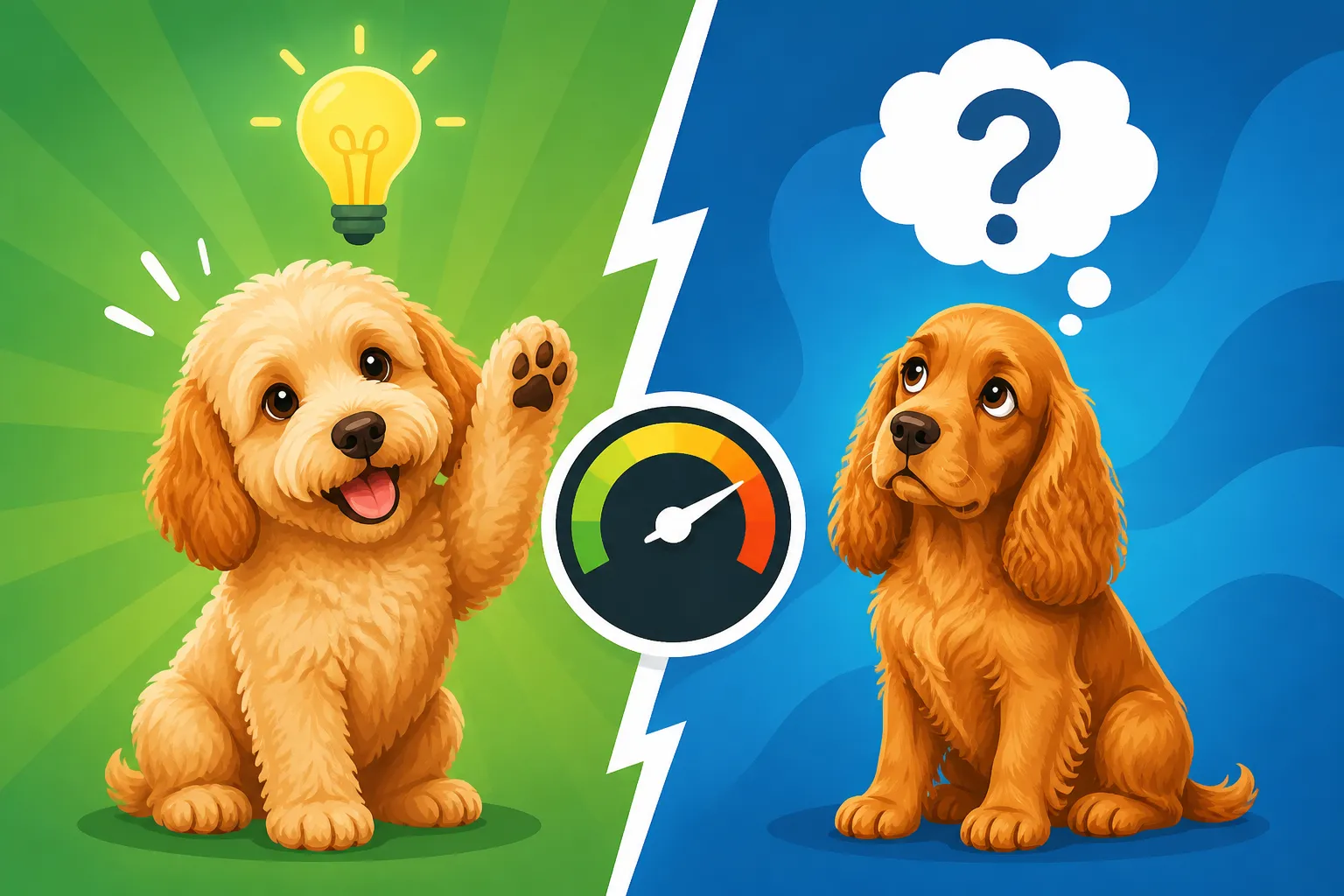
There is no dependable rule that Cockapoos learn faster than Cocker Spaniels. Both can be bright, attentive, and responsive to training, but “learning” can mean different things: understanding a cue, remembering it later, or following it amid distractions. A Cockapoo might master “sit” in the kitchen quickly and then seem to forget it on a busy pavement. That usually says more about the setting and the strength of the distraction than the dog’s intelligence.
A Cocker Spaniel and a Cockapoo may also respond differently to the same lesson. A Cockapoo is a cross between a Cocker and a Poodle, and traits vary from dog to dog. The individual puppy’s temperament, early experiences, motivation, and training environment matter more than a simple breed-to-breed ranking. For context on the traits that may appear in a cross, see What the Cocker Puts Into a Cockapoo and Which Cockapoo Traits Come From the Poodle.
Understand what “fast learning” looks like
A dog that catches on quickly may still need many repetitions to respond consistently. For example, a Cockapoo might learn that the word “down” means lowering its body after a handful of short sessions. But if the dog has only practised in a quiet living room, it may not yet understand that the same cue applies in the garden, near the front door, or beside another dog.
It helps to separate three parts of training:
- Understanding: Your dog connects a cue, such as “come,” with an action.
- Reliability: Your dog performs that action repeatedly in familiar conditions.
- Generalization: Your dog can respond in new places and around distractions.
Owners sometimes call a dog stubborn when it has learned a cue only in one context. Picture a Cockapoo that comes running when called at home but keeps sniffing at the park. The cue may be familiar, while the environment is simply more rewarding. Training needs to build the response gradually in places where the dog can still pay attention.
Why Cockapoos differ from one another
Cockapoos can vary in energy, sensitivity, sociability, and interest in exploring. Generation can contribute to variation, but it cannot tell you exactly what an individual dog will be like. Even puppies in the same litter may differ in how quickly they settle, what motivates them, or how comfortable they feel with new experiences. Whether Generation Changes a Cockapoo's Temperament explores why labels do not guarantee a particular personality.
A puppy that is eager to work for food may seem to learn tricks at remarkable speed. Another may be more motivated by a toy, a chance to sniff, or praise and play with its person. A Cocker Spaniel may show the same range. Instead of assuming one dog is smarter, notice what helps that particular dog engage.
The comparison can also be misleading if one dog has had more practice. A Cocker raised with consistent reward-based training may look more responsive than a Cockapoo that has had little instruction, and vice versa. Training history is not a fixed measure of ability. It is a record of what the dog has been taught and where it has been practised.
What affects a Cockapoo’s training progress
Training speed depends on more than breed. A dog learns most readily when the lesson is clear, the reward matters, and the task is manageable. If a Cockapoo is tired, worried, overexcited, or distracted, it may struggle to focus even if it knows the cue well at home.
The setting matters too. In a quiet room, your dog may notice your voice immediately. In a garden full of smells, or a class with unfamiliar dogs and people, that same voice competes with a lot of new information. Start with a calm environment, then add challenges a little at a time.
Motivation and attention
Rewards do not have to be elaborate. A small treat, a game, praise, or permission to investigate a smell can all be useful, depending on the dog and the moment. If food works well for your Cockapoo, keep rewards small enough for repeated practice and consider setting aside some of its usual daily food for training. Chewy is one place owners may look for treat pouches or small training rewards; whichever source you use, check that treats suit your dog and account for them in its overall feeding routine.
Some dogs are most engaged when training feels like play. Others do better with calm, predictable repetition. If a Cockapoo is losing interest, try shorter sessions, a more valuable reward, or an easier version of the exercise. You do not need to keep repeating a cue louder and louder. A pause and a simpler step can help the dog succeed.
Sniffing can be a powerful reward for a dog with a strong interest in scents. You might ask for a brief “wait,” then release your dog to explore a safe patch of grass. Some Cockapoos are more interested in food, while others work readily for a chance to investigate. Whether a Cockapoo Works Harder for Scent Than Food offers a useful way to think about those different motivators.
Training method and emotional comfort
Clear, reward-based training makes it easier for a dog to understand which behavior earns a good outcome. Mark the behavior with a consistent word such as “yes,” then reward it promptly. If you are teaching “come,” for instance, mark the instant your dog turns toward you, then reward when it reaches you. This helps break a big task into understandable pieces.
Avoid turning training into a test your dog is set up to fail. Calling a puppy away from a thrilling game before it has practised recall in easier situations can weaken the cue. Instead, practise at close range, use a lead or long line where appropriate, and reward generously when the dog responds. If your Cockapoo is distracted, move farther from the distraction or make the exercise easier.
Sensitivity varies. Some dogs become hesitant when a person uses a sharp voice, while others recover quickly. If your dog stops offering behaviors, looks worried, or avoids you during a session, take that as a reason to make the lesson gentler and clearer. Whether a Sharp Word Shuts a Cockapoo Down discusses why pressure can affect a dog’s willingness to engage.
How to help a Cockapoo learn reliably
The practical aim is not to make a Cockapoo learn every cue in record time. It is to teach behaviors the dog can use in daily life and practise them until they hold up in more than one place. A first-time owner may find it helpful to prioritize skills that make home life safer and calmer, rather than rushing through a long list of tricks. What a Cockapoo Asks of a First Time Owner provides more context about the everyday commitment involved.
| Training goal | A useful starting point | How to build difficulty |
|---|---|---|
| Name response | Say the name once in a quiet room and reward a glance | Practise in different rooms, then quiet outdoor spaces |
| Recall | Call from a short distance when your dog is not deeply distracted | Add distance and mild distractions while using a lead or long line |
| Settle | Reward calm moments on a mat or bed | Practise while ordinary household activity continues |
| Handling | Reward brief, gentle touches to paws, ears, or collar | Gradually extend the handling and practise in different settings |
| Loose-lead walking | Reward your dog for staying near you in a low-distraction area | Add short walks in busier places as attention improves |
Use short, achievable practice sessions
Keep sessions brief enough that your dog is still interested when they end. A few minutes of focused practice can be more useful than a long session in which the dog becomes tired or frustrated. For a puppy, everyday moments are training opportunities: reward four paws on the floor when greeting someone, a pause before going through a door, or a glance back during a walk.
Practise one small step at a time. If your goal is a reliable recall, begin indoors or in a fenced area with very little going on. Say the cue once, encourage your dog to come if needed, and reward the response. When the dog is successful repeatedly, vary the distance or location—not both at once. That makes it easier to see which part needs more practice.
A training pouch can make rewards easier to deliver promptly when both hands are needed for a lead. Owners sometimes use Chewy to find practical training accessories such as pouches, but the essential part is not the brand or the equipment. It is having a suitable reward ready so you can reinforce the behavior at the right moment.
Teach useful life skills before adding tricks
A Cockapoo that can wait calmly, accept handling, and return when called is easier to live with than a dog that knows a dozen party tricks but struggles with everyday routines. Begin with name response, recall, loose-lead walking, settling, and comfortable handling. What a Cockapoo Puppy Should Learn First is a helpful companion topic when deciding what to prioritize.
Grooming is one example where small, patient lessons can make a real difference. A Cockapoo may need regular brushing and coat care, so gradually teach the dog to accept a comb, touch around its feet, and brief handling of its ears. Reward calm cooperation and stop before the dog becomes overwhelmed. A grooming session should not be the first time the puppy experiences that kind of contact.
If you want to use treats, toys, or grooming tools as rewards and training aids, keep the dog’s age, size, chewing style, and safety in mind. Chewy may be a convenient place to browse for dog supplies, but choose items that suit your individual dog and supervise anything it chews or plays with.
Common training problems and what to try
A Cockapoo that seems to learn quickly in one situation but struggles elsewhere is not necessarily being difficult. Often, the dog needs more practice under easier conditions, a clearer reward, or a step back from distractions. Keep notes on what happened before the response changed: the location, distance, noise level, and what the dog was focused on.
Your dog knows the cue but ignores it outside
This is especially common with recall. At home, coming to you may be the most interesting option. Outdoors, the dog may be absorbed in a scent or another dog. Rather than repeating the cue several times, make the next attempt easier: shorten the distance, use a long line, or practise in a quieter area. Reward generously when the dog responds, then gradually work toward more distracting settings. For a fuller recall plan, see Building a Recall a Cockapoo Answers.
Do not use recall only to end something enjoyable. If every call means the walk is over or playtime stops, your dog may learn that coming to you has an unpleasant result. Call, reward, and sometimes release the dog back to sniff or play when it is safe. That teaches that responding does not always take away the fun.
A class can help some dogs practise around distractions, but a busy environment is not automatically the right starting point. If your Cockapoo cannot focus in class, try more distance from other dogs, a quieter session, or a simpler exercise. Whether a Cockapoo Concentrates in a Class covers why the class environment can be challenging for some dogs.
Your dog gets overexcited or loses focus
Overexcitement can look like disobedience: jumping, grabbing at treats, barking, or rushing from one activity to another. In that moment, make the task easier and help the dog settle before asking for a more difficult response. A calm pause, a little distance from the exciting trigger, or a simple behavior your dog already knows can reset the session.
For food rewards, use small pieces and deliver them calmly rather than waving them around. If the dog is too excited to take food gently, reduce the stimulation and reward quieter behavior. For dogs that do better with toys or sniffing breaks, build those into the session instead of expecting food to work for every exercise.
It is also worth checking whether the session is too long or the dog needs a break. Puppies in particular may become wiggly or unfocused when tired. Ending on an easy success is better than pushing through until both of you are frustrated.
You are comparing your dog with another dog
It is easy to watch a Cocker Spaniel perform a cue immediately and wonder why your Cockapoo needs more practice. But the comparison may leave out age, training experience, setting, motivation, and temperament. Measure progress against your dog’s own earlier behavior: Does the dog respond more often? Can it stay focused for a little longer? Is it more comfortable with handling?
If you are choosing between breeds or preparing for a new dog, remember that trainability is only one part of daily life. Exercise needs, grooming, companionship, and sensitivity matter too. A Cockapoo can be quick to learn and still need consistent practice, especially around scents and distractions. Individual variation is part of the picture, not a flaw in your dog.
Disclaimer
This article is for general informational purposes only and does not constitute professional advice. Laws, prices and regulations vary by location and change over time. Consult a qualified professional for guidance on your specific situation.