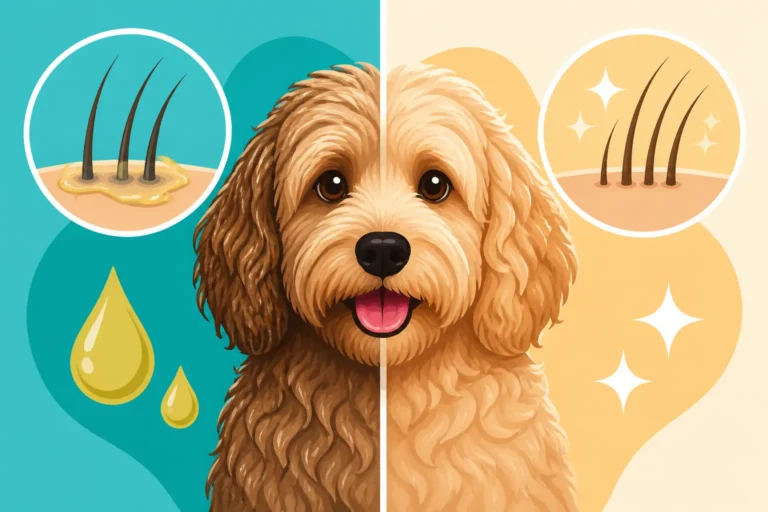
Whether Furnishings Come From the Poodle Only
It’s a common scenario: you’ve fallen head over heels for the adorable, fluffy face of a Cockapoo, complete with that irresistible beard, mustache, and expressive eyebrows. You might have even heard that these charming facial "furnishings" are what make them low-shedding and part of their appeal. But then you start wondering, where exactly do these delightful features come from? Is it solely the Poodle parent that brings the beard to the party, or does the Cocker Spaniel have a say in it too? This guide is here to unravel the genetic mystery behind the Cockapoo’s signature look, helping you understand the origins of those beloved furnishings and what it means for your furry family member.
Understanding Furnishings: The Signature Cockapoo Look
When we talk about a Cockapoo's "furnishings," we're really pinpointing those longer hairs on their face – specifically the eyebrows, mustache, and beard. These aren't just for aesthetics; they're actually a genetic trait that plays a huge role in the low-shedding coats so many Cockapoo hopefuls are looking for. Without furnishings, a dog's face would look smoother, much like a Labrador or a Golden Retriever, lacking that distinctive fluffy doodle charm.
For a lot of prospective owners, the furnished look is intrinsically linked to the idea of a hypoallergenic dog, or at least one that won't leave tumbleweeds of fur rolling across the living room floor. And there’s a good reason for that association. The gene responsible for furnishings also affects the entire coat, making it grow continuously rather than shedding out in cycles like many other breeds. It’s this continuous growth, coupled with the hair-trapping nature of the longer facial hair, that contributes to the much-desired low-shedding quality.
The science behind it all boils down to a specific gene called RSPO2. Dogs either have two copies of the furnishing gene (F/F), one copy (F/f), or no copies (f/f). This gene is dominant, which is a key piece of the puzzle we're about to explore. Understanding this genetic blueprint is crucial, not just for breeders aiming for specific coat types, but for owners who want to know what to expect from their puppy. It helps explain why some Cockapoos are incredibly fluffy and low-shedding, while others might surprise their owners with a more traditional shedding coat, often called an "improper coat."
The Role of the Poodle in Furnishings
Let's cut right to the chase: when it comes to furnishings, the Poodle is the undisputed star of the show. Poodles, whether Toy, Miniature, or Standard, are genetically programmed to have furnishings. This means that every Poodle carries two copies of the furnishing gene (F/F). It's part of what defines their breed standard and gives them that distinct Poodle look – those elegantly sculpted faces with their characteristic beard and eyebrow hair.
Because the furnishing gene is dominant, a dog only needs one copy of it to display the trait. Since Poodles always contribute two copies, their genetic makeup acts as a strong, consistent source of furnishings for any crossbreed. This is fantastic news for Cockapoo breeders and owners, as it sets the stage for a predictable outcome in the first generation. You can almost think of the Poodle as providing the "furnishings guarantee" when they are one of the parents. Their genetic predisposition is so strong that it overrides the unfurnished genetics of the other parent in the initial cross.
This inherent genetic contribution from the Poodle is why the vast majority of first-generation Cockapoos (F1s) will have those lovely beards and shaggy brows. Without the Poodle's genetic input, the Cockapoo wouldn't have the foundation for its iconic look. It’s a direct inheritance that has shaped the breed’s appearance from its very beginnings, making the Poodle's genetic line indispensable for anyone seeking a classic furnished Cockapoo.
The Cocker Spaniel's Contribution (or Lack Thereof)
Now, let's talk about the Cocker Spaniel side of the equation. While Cocker Spaniels are absolutely gorgeous dogs with their silky coats and expressive eyes, they do not naturally possess the furnishing gene. Instead, they typically carry two copies of the non-furnishing gene (f/f). This is why a purebred Cocker Spaniel has a smooth, sleek face without a prominent beard or bushy eyebrows. Their facial hair is much shorter and lies flat against their skin, and their coats shed in a more traditional manner.
So, to directly answer the question: no, furnishings do not come from the Cocker Spaniel side of a Cockapoo’s lineage. The Cocker Spaniel contributes its incredible temperament, its affectionate nature, its beautiful ear feathering, and often its delightful energy, but not the facial furnishings that many people associate with the "doodle" look. The gene for furnishings simply isn't present in the vast majority of Cocker Spaniel lines.
This distinction is incredibly important for breeders and prospective owners alike. If a Cockapoo puppy were to somehow inherit only the Cocker Spaniel's genetic contribution for coat type (meaning two copies of the non-furnishing gene, f/f), it would essentially look like a shedding Cocker Spaniel with a slightly wavier coat, lacking the characteristic beard and mustache. While still a wonderful dog, it wouldn't fit the typical image or low-shedding expectation that many have for a Cockapoo. This is a rare occurrence in F1 Cockapoos, but it becomes a much more relevant consideration in later generations, as we'll discuss shortly.
The F1 Cockapoo: Inheriting a Mix of Genes
The F1 Cockapoo is the first generation cross between a purebred Cocker Spaniel and a purebred Poodle. This is where the magic of genetics really comes into play, and it’s why F1 Cockapoos are often so predictable in terms of their furnishings. You have one parent, the Poodle, contributing two copies of the dominant furnishing gene (F/F), and the other parent, the Cocker Spaniel, contributing two copies of the recessive non-furnishing gene (f/f).
When these two genetic profiles combine, every single puppy in that F1 litter will inherit one furnishing gene (F) from the Poodle and one non-furnishing gene (f) from the Cocker Spaniel. This means all F1 Cockapoos will have the genotype F/f. Because the furnishing gene (F) is dominant, that single copy is enough to ensure the puppy develops furnishings. It’s a pretty neat genetic certainty! This is why, if you see an F1 Cockapoo that doesn't have furnishings, it's highly likely that one of the "purebred" parents wasn't quite as advertised, or there's a misunderstanding about the generation.
This genetic consistency in F1s is a huge draw for people looking for that classic Cockapoo appearance and low-shedding quality. It removes a layer of uncertainty that can sometimes exist in later generations. You can feel pretty confident that your F1 puppy will grow into that adorable, fluffy-faced companion you’re dreaming of.
Why an F1 Cockapoo is Almost Always Furnished
As we've discussed, the dominance of the furnishing gene (F) is the primary reason an F1 Cockapoo is almost always furnished. Think of it like a switch: if you have even one "on" switch (the F gene), the furnishings will develop. Since every F1 puppy gets one "on" switch from their Poodle parent, they will all display furnishings.
This is a common point of discussion among potential owners, especially those who are particularly concerned about shedding due to allergies. The expectation is that a Cockapoo will be low-shedding, and furnishings are a visual indicator of that trait. While no dog is truly 100% hypoallergenic, the presence of furnishings in an F1 generation significantly increases the likelihood of a low-shedding coat, which is often more tolerable for people with mild pet allergies. If you're looking for a dog that will suit an allergic home, understanding Whether a Furnished Cockapoo Suits an Allergic Home is incredibly important, and the F1 generation typically offers the most predictable outcome in this regard.
It's a beautiful example of Mendelian genetics playing out in our furry friends. The Poodle's strong genetic contribution ensures that the defining characteristic of the Cockapoo's face is passed down consistently in the first cross. So, when you pick out that fluffy F1 puppy, you're essentially looking at a guaranteed furnished face, thanks to its Poodle lineage.
What Furnishings Look Like on a Cockapoo
So, what exactly do these furnishings look like on your Cockapoo? Imagine that sweet, often slightly scruffy, teddy bear face that's so characteristic of the breed. That's furnishings in action!
Typically, a furnished Cockapoo will have:
- A distinctive beard and mustache: This is the most noticeable feature. Instead of smooth, short hair around their muzzle like a Cocker Spaniel, a furnished Cockapoo will have longer, often wavy or curly hair that frames their mouth and chin. This is what gives them that adorable "teddy bear" or "scruffy chic" look.
- Bushy eyebrows: Their eyebrows won't lie flat but will grow longer, adding to their expressive faces. These can sometimes need a little trim to prevent them from obscuring their vision.
- Longer hair on their legs and sometimes body: While furnishings are primarily about facial hair, the gene impacts the entire coat, leading to longer hair on the legs and often a more continuously growing coat over their body, as opposed to a shorter, shedding coat.
- A "domed" forehead: Sometimes the longer hair on their head can give the appearance of a more rounded or "domed" forehead, especially when the hair is grown out.
To get a clearer picture, you can learn more about What Furnishings Look Like on a Cockapoo. It’s a look that requires regular grooming to keep neat and tangle-free, but it’s undoubtedly part of what makes the Cockapoo so captivating. Without these furnishings, a Cockapoo might still be delightful, but it would appear more like a traditional Cocker Spaniel with a slightly different coat texture, often surprising owners who expected the classic doodle look.
Beyond F1: Furnishings in Later Generations
While the F1 generation offers a predictable outcome for furnishings, things can get a little more complex in later generations. When you start breeding F1 Cockapoos to other F1s (to get F2), or an F1 to a Poodle (to get F1b), or even an F1 to a Cocker Spaniel (which isn't common for Cockapoos but possible), the genetic dice roll changes.
For example, if you breed two F1 Cockapoos (F/f x F/f), their puppies (F2) have a 75% chance of being furnished (F/F or F/f) and a 25% chance of being unfurnished (f/f). This 25% chance of an "improper coat" is a big deal for breeders who are trying to maintain the low-shedding characteristics that are so desired in Cockapoos. An unfurnished Cockapoo will shed much more like a Cocker Spaniel.
The same principle applies as you move into F1b (F1 Cockapoo bred back to a Poodle), F2b (F2 bred back to a Poodle), and multi-generational (Multigen) Cockapoos. The key is knowing the genetic makeup of both parents for the furnishing gene. If both parents carry at least one copy of the dominant F gene, you're usually safe. However, if a parent is only carrying one copy (F/f), and is bred to another F/f dog, or even worse, an f/f dog, the chances of unfurnished puppies increase. This unpredictability means that breeders of later generations really need to understand genetics and utilize testing to ensure they are producing the desired coat types.
The Importance of Genetic Testing (RSPO2)
This is where genetic testing becomes absolutely invaluable, especially for breeders working with F1b, F2, and multi-generational Cockapoos. Reputable breeders will use DNA tests to determine the RSPO2 gene status of their breeding dogs. This test clearly identifies whether a dog is F/F (two copies of furnishings), F/f (one copy), or f/f (no copies).
Why is this so important? Because it allows a breeder to predict, with a high degree of certainty, what the coat types of their puppies will be. If a breeder knows they have an F/f dog, they will ideally breed it to an F/F dog to ensure all puppies receive at least one F gene and are therefore furnished. Breeding an F/f dog to another F/f dog runs the risk of producing unfurnished puppies, which many buyers are not expecting. Understanding What RSPO2 Testing Tells a Cockapoo Breeder is fundamental to responsible breeding practices.
For prospective puppy buyers, asking a breeder about their genetic testing protocols, specifically for furnishings, is a wise move. It demonstrates that the breeder is committed to producing healthy, predictable puppies and understands the genetic basis of the traits they are advertising. You want to see evidence that they are making informed breeding decisions, not just guessing. There are several reputable labs that conduct these tests, and knowing Which Labs Test a Cockapoo's Coat Genes can help you verify a breeder's claims.
The "Improper Coat" and Furnishings
An "improper coat," often abbreviated as IC, in a Cockapoo refers to a coat that lacks the desired furnishings. This means the dog will have a smooth face, much like a Cocker Spaniel, rather than the fluffy beard and mustache typically associated with a Cockapoo. Genetically, an improper coat occurs when a Cockapoo inherits two copies of the non-furnishing gene (f/f), one from each parent.
As you can imagine, this can be quite a surprise for an owner who was expecting a low-shedding companion. Dogs with improper coats will shed much more than their furnished counterparts. They often have a flatter, more spaniel-like coat texture, even if it has some wave. While still adorable and full of personality, they simply don't have that classic Cockapoo "look" that many people are drawn to. You can see What an Improper Coated Cockapoo Looks Like to understand the visual difference.
For breeders, especially in F2 or later generations, producing puppies with improper coats is generally considered undesirable because it goes against the core expectation of the breed's low-shedding nature. It’s not necessarily a "fault" in terms of health, but it is a fault in terms of meeting the breed's aesthetic and functional purpose. Therefore, many reputable breeders will actively try to avoid producing improper coats by carefully selecting breeding pairs based on RSPO2 genetic testing. Knowing Whether an Improper Coated Cockapoo Is a Fault depends on how you define "fault" – for many, it simply means it doesn't meet the widely accepted image of a Cockapoo. Some breeders may even consider it serious enough to remove such dogs from their breeding program Whether Breeders Cull Improper Coats From Cockapoo Lines.
Practical Implications for Owners and Breeders
Understanding the genetics of furnishings isn't just an academic exercise; it has very real, practical implications for both Cockapoo owners and breeders. From daily care to long-term health considerations, knowing where those furnishings come from helps set expectations and informs decisions.
For owners, it primarily impacts grooming needs and potential allergy concerns. A furnished coat, while lovely, requires dedicated upkeep. An unfurnished coat, while shedding more, might be simpler to maintain in other ways. For breeders, it's about responsible breeding practices, genetic health, and meeting the demands of the market for a specific type of dog. It’s about being transparent and knowledgeable, ensuring puppies go to homes with realistic expectations.
The presence, or absence, of furnishings ultimately shapes a significant part of the Cockapoo experience. It’s a testament to the power of genetics and the importance of informed choices when bringing a furry family member home.
Grooming Differences with Furnishings
If your Cockapoo has those wonderful furnishings, get ready for a significant grooming commitment. That longer facial hair, while cute, is prone to matting and collecting food debris. This is especially true for the beard and mustache. Regular brushing, ideally daily or every other day, is essential to prevent painful mats from forming. These mats can pull on their skin, cause discomfort, and if left untended, can lead to skin infections.
You'll need specific tools, such as a good slicker brush and a metal comb. The metal comb, in particular, is your secret weapon for finding those hidden mats that a slicker brush might miss, especially behind the ears, under the chin, and in the "armpits." For example, the sturdy combs available on Chewy or Amazon can really make a difference. These areas are notorious for tangles because of friction and moisture. Many owners opt for a professional groomer every 6-8 weeks to keep the coat in check, often requesting a "teddy bear clip" to maintain that signature look while keeping the hair at a manageable length. Seeing What a Teddy Bear Clip Looks Like on a Cockapoo can help you communicate your desires to a groomer. If you're tackling grooming at home, remember that patience and positive reinforcement are key. Learning to use The Comb That Finds Mats a Slicker Misses can save you a lot of heartache and your dog a lot of discomfort.
In contrast, an unfurnished Cockapoo (the "improper coat") typically has a much simpler grooming routine. Their shorter facial hair won't mat, and their body coat, while still potentially wavy, sheds more freely. This might mean less brushing, but more actual hair floating around your home. It's a trade-off, and knowing what you're signing up for regarding grooming is crucial for happy cohabitation.
Allergy Considerations and Furnishings
The connection between furnishings and allergy-friendliness is a huge topic for many prospective Cockapoo owners. The belief is that a furnished Cockapoo is "hypoallergenic" or at least significantly low-shedding. And there's a good deal of truth to that. Furnishings are directly linked to the continuously growing coat type that sheds minimal dander, which is the primary allergen for most people.
Because the Poodle, the source of furnishings, is known for its non-shedding coat, the presence of these genes in a Cockapoo is a strong indicator of a similar coat type. This means less loose hair and dander floating in the air and settling on furniture, which can make a big difference for individuals with mild to moderate pet allergies.
However, it's vital to remember that no dog is truly 100% hypoallergenic. Dogs produce dander, saliva, and urine, all of which contain allergens. Even a perfectly furnished Cockapoo will produce some dander. The term "hypoallergenic" simply means "less allergenic," not "non-allergenic." It's also worth noting that Whether the Cocker Half Ruins the Allergy Claim is a valid concern, as the Cocker Spaniel side contributes a shedding coat type. But because of the dominant nature of the furnishing gene, the Poodle's contribution usually wins out in an F1 cross, giving the desired low-shedding qualities. For more on this, you might be interested in Whether Any Cockapoo Is Truly Non Shedding.
If allergies are a major concern, meeting the puppy and its parents (if possible) is often recommended to gauge your reaction. Understanding the coat genetics (specifically the RSPO2 gene status) of the puppy's parents can provide a good prediction of how low-shedding the puppy will be, making it a valuable piece of information for any allergy-sensitive home.
Furnishing Gene Inheritance Overview
To help visualize how the furnishing gene is passed down, here's a simple table outlining the possible genetic combinations and their outcomes for coat furnishings:
| Poodle Parent (Furnishings) | Cocker Parent (Furnishings) | Cockapoo Puppy (F1) Genetic Status | Cockapoo Puppy (F1) Phenotype (Appearance) |
|---|---|---|---|
| F/F (Always Furnished) | f/f (Always Unfurnished) | F/f | All puppies will be Furnished |
| Cockapoo Parent 1 Genetic Status | Cockapoo Parent 2 Genetic Status | Possible Puppy Genetic Outcomes | Probability of Furnished Puppy | Probability of Unfurnished Puppy |
|---|---|---|---|---|
| F/F (Furnished) | F/F (Furnished) | All F/F | 100% | 0% |
| F/F (Furnished) | F/f (Furnished) | 50% F/F, 50% F/f | 100% | 0% |
| F/f (Furnished) | F/f (Furnished) | 25% F/F, 50% F/f, 25% f/f | 75% | 25% |
| F/F (Furnished) | f/f (Unfurnished) | All F/f | 100% | 0% |
| F/f (Furnished) | f/f (Unfurnished) | 50% F/f, 50% f/f | 50% | 50% |
| f/f (Unfurnished) | f/f (Unfurnished) | All f/f | 0% | 100% |
As you can see, the Poodle's F/F contribution in an F1 cross ensures all puppies are furnished. However, once you start breeding F/f Cockapoos together, the possibility of an unfurnished puppy (f/f) emerges. This is why thorough genetic testing and understanding What a Cockapoo Coat Panel Actually Reports are paramount for breeders to make informed decisions and avoid surprises in later generations.
In conclusion, the distinctive furnishings that give the Cockapoo its adorable, low-shedding appeal originate almost entirely from the Poodle side of its lineage. The Cocker Spaniel, while contributing many wonderful traits, does not carry the gene for these facial hairs. This genetic reality is a cornerstone of what makes a Cockapoo a Cockapoo, influencing everything from their appearance to their grooming needs and their suitability for homes with allergy sufferers.
Disclaimer
This article is for general informational purposes only and does not constitute professional advice. Laws, prices and regulations vary by location and change over time. Consult a qualified professional for guidance on your specific situation.