Whether a Cockapoo Announces Every Visitor
It's incredibly frustrating when you're trying to enjoy a quiet moment at home, or perhaps have friends over, and your sweet Cockapoo suddenly transforms into an alarm siren, barking incessantly at every car door slam, rustle of leaves, or, worst of all, an actual visitor at the door. You just want a peaceful home, and you wonder if this constant announcement system is just part of having a Cockapoo. This guide will help you understand why your Cockapoo might be barking at visitors and, more importantly, what you can do to manage and reduce this behavior, bringing a little more calm back into your life.
Understanding Your Cockapoo's Barking Instincts
Cockapoos are a wonderful blend of two intelligent and often vocal breeds: the Cocker Spaniel and the Poodle. It's no wonder that many Cockapoos find their voice and aren't shy about using it, especially when new people arrive on their territory. Understanding the roots of this behavior can help you approach it with more empathy and effective training.
The Cocker Spaniel Influence: Alertness and Sound Sensitivity
From their Cocker Spaniel side, Cockapoos often inherit a keen sense of awareness of their surroundings. Cocker Spaniels were originally bred as hunting dogs, specifically for flushing game, and part of their job was to be attentive and responsive to stimuli in their environment. This means they are often quick to notice changes – a car pulling up, footsteps on the porch, or a knock at the door – and may feel it's their duty to alert their "pack" (you!) to these changes.
Think about it from their perspective: they hear an unfamiliar sound or see a shadow, and their instinct kicks in. They're not necessarily being aggressive; they're simply performing a duty ingrained in their ancestry. This sensitivity to sound can sometimes manifest as barking at things you might barely register, like the mail truck turning the corner or kids laughing down the street. It's a testament to their attentiveness, even if it's not always convenient. They're telling you, "Hey, something's happening!" or Whether a Cockapoo Barks More Than a Cocker.
The Poodle's Watchdog Tendencies: Intelligence and Vocalization
Then we have the Poodle influence, which adds another layer to the vocal equation. Poodles, particularly the smaller Miniature and Toy varieties often used in Cockapoo breeding, can be surprisingly excellent watchdogs. They are highly intelligent and observant, and they learn very quickly what gets a reaction from you or changes the environment around them. If barking at the doorbell consistently leads to you rushing to the door, giving them attention (even if it's scolding), or creating a flurry of activity, they quickly learn that barking is an effective communication tool.
Their intelligence also means they can be quite perceptive about social dynamics. If they perceive a visitor as an intruder or a disruption to their routine, they might voice their displeasure or concern. This isn't necessarily a bad thing; it shows they're tuned into their home environment. However, combined with the Cocker's alertness, it can create a rather enthusiastic "welcome" committee for anyone who approaches your home. They’re smart enough to connect the dots: sound/sight of visitor = bark = human action.
Nature vs. Nurture: Genetics and Early Experiences
It's a delicate dance between what your Cockapoo is born with and what they learn from their environment. Genetically, some Cockapoos will naturally be more prone to vocalization than others, just like some people are more naturally chatty. You might see this in littermates; one is quiet and reserved, while another is a little sound machine. This genetic predisposition sets a baseline.
However, nurture plays a massive role. A Cockapoo puppy exposed to lots of different sounds and people in a positive, calm way during their critical socialization period (roughly 3 to 16 weeks of age) is more likely to be less reactive to novelty later in life. Conversely, a puppy kept in a very quiet environment might be overwhelmed and vocal when suddenly faced with the hustle and bustle of a busy household and frequent visitors. Your reactions as an owner are paramount; if you inadvertently reinforce barking by giving attention, you're teaching them that it works. This is part of The Thing Cockapoo Buyers Find Out Too Late if not prepared for.
Common Triggers for Cockapoo Visitor Barking
Understanding why your Cockapoo barks at visitors is one thing, but pinpointing the triggers can help you develop targeted strategies. For a Cockapoo, the arrival of a visitor isn't just one event; it's a series of sensory inputs that can build up to a crescendo of barking.
The Unexpected Arrival: Doorbell and Knock Excitement
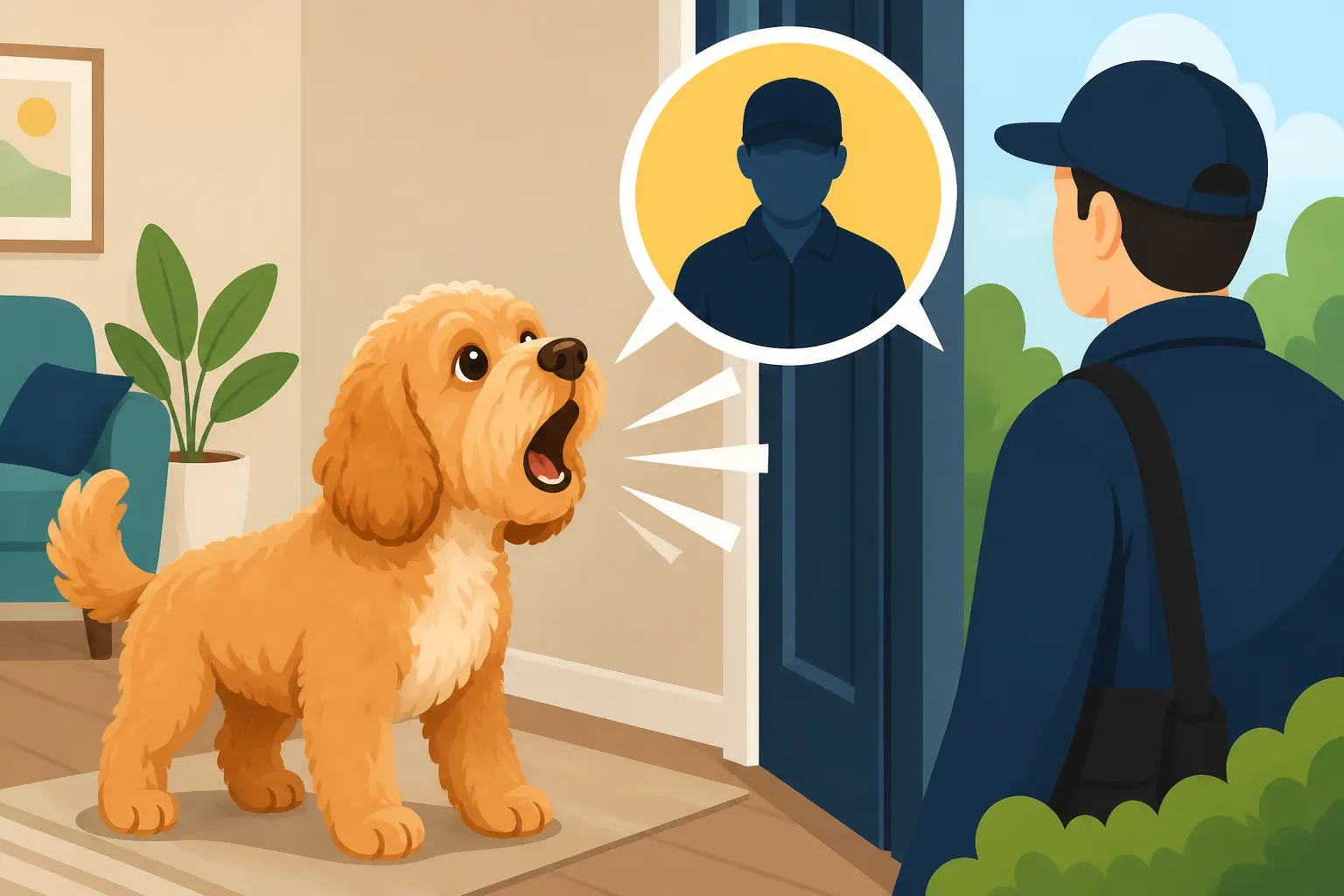
This is probably the most classic scenario. The sudden, often jarring sound of a doorbell or a knock at the door is a potent trigger for many dogs, including Cockapoos. It’s an abrupt interruption to the peace, and it signals an immediate change in the environment. For a dog, this sound often means a new, unpredictable element is about to enter their territory.
Consider the doorbell: it’s loud, it’s distinct, and it almost always precedes someone coming into the house. Your Cockapoo isn't just reacting to the sound itself; they're reacting to the strong association they've built over time. They anticipate the arrival, and that anticipation, coupled with their natural alert instincts, can result in a flurry of excited or anxious barking. It's their way of saying, "Intruder alert! Or maybe just… new person alert! Someone's here!" This kind of excitement can make Whether a Cockapoo Greets Everyone at the Door a real challenge.
Visual Stimuli: Seeing People Approach
Even before the doorbell rings or the knock sounds, many Cockapoos are already on high alert because they've seen the visitor approaching. If your home has windows with a clear view of the street, sidewalk, or front door, your Cockapoo is likely doing their own form of neighborhood watch. They might spot someone walking up the driveway, getting out of a car, or even just passing by your gate.
This visual cue can trigger a warning bark long before the person reaches the door. For some Cockapoos, it's a combination of curiosity and territorial instinct. They're observing, assessing, and deciding whether this person is part of the familiar "pack" or an unknown entity. The sight of an unfamiliar silhouette or movement can easily initiate a string of barks, especially if they have a strong guard dog tendency from their Poodle heritage, or the inherent awareness from their Cocker side.
Sounds Beyond the Door: Footsteps and Voices
It’s not always the direct sound of the doorbell or the sight of someone right at the door. Cockapoos, with their excellent hearing, can pick up on much subtler cues. This might include the sound of an approaching car, footsteps on the path, voices in the hallway of an apartment building, or even the jingle of keys. These sounds, which we might filter out as background noise, are clear signals to your Cockapoo that an arrival is imminent.
The problem here is that these subtle sounds give your dog more time to get worked up. They might start with a low growl or a soft woof, which then escalates into full-blown barking as the sounds get closer and the anticipation builds. It's a pre-emptive announcement system that, while well-intentioned on their part, can be utterly exhausting for you. Managing this often means addressing their sensitivity to external noises, which can be tough if Whether a Cockapoo Copes in a Loud House is already a challenge for them.
Strategies to Manage and Reduce Visitor Barking
While you might not be able to eliminate all visitor barking – after all, a dog's a dog! – you can certainly manage and significantly reduce the intensity and duration of the barking. It's all about proactive training, environmental management, and consistent reinforcement.
Proactive Training and Desensitization
One of the most effective ways to tackle visitor barking is through proactive training and desensitization. This involves teaching your Cockapoo alternative behaviors and gradually reducing their reactivity to triggers.
First, teach a solid "quiet" command. This isn't about scolding, but about giving them an alternative behavior. When your dog barks, let them get one or two barks out (acknowledging their alert), then say "quiet" and immediately reward them with a high-value treat when they stop. The pause doesn't have to be long at first; even a second of silence is a win. Gradually increase the duration of silence required before the treat. Consistency is key here.
Next, desensitize them to the doorbell or knock. This is where you practice without the pressure of an actual visitor. Have a family member or friend help you. Start by having them lightly tap the door or softly ring the bell. As soon as the sound happens, before your Cockapoo can react, give them a super-tasty treat. Repeat this many times over several sessions, gradually increasing the intensity of the sound. The goal is to change their association from "doorbell = alarm!" to "doorbell = yummy treat!" Whether a Marker Word Beats a Clicker on a Cockapoo is an interesting discussion, but for this, I'd lean towards a clear verbal cue like "quiet" followed by a treat.
You can also incorporate a designated "go to place" command. Teach your Cockapoo to go to their mat, bed, or crate when they hear the doorbell. Reward them generously for staying there calmly. This gives them a job to do and keeps them out of the direct line of greeting the visitor, reducing their need to bark. Online training platforms like BAXTER & Bella offer excellent resources and step-by-step guides for teaching these kinds of essential commands from home, which can be invaluable for busy owners.
Environmental Management and Distraction
Sometimes, the best offense is a good defense – by managing your environment, you can prevent many barking incidents from even starting.
- Block the view: If your Cockapoo barks at people walking by the windows, consider using frosted film, closing blinds or curtains, or even placing furniture strategically to block their line of sight. If they can’t see the trigger, they're less likely to react.
- Create a safe, quiet zone: When you know visitors are coming, consider putting your Cockapoo in a designated quiet space, like a crate in a different room, with a long-lasting chew or a puzzle toy. This gives them a positive outlet for their energy and keeps them from getting overstimulated. A chew toy or a KONG filled with frozen peanut butter, readily available on Amazon, can provide a significant distraction.
- Use white noise: A fan, radio, or white noise machine can help mask external sounds that might trigger barking. This is especially helpful if your Cockapoo is reactive to distant footsteps, voices, or other subtle cues.
- Leash control: When expecting guests, have your Cockapoo on a leash before they arrive. This allows you to calmly guide them to their "place" or away from the door without a frantic chase, making the whole process less stressful for everyone. This can be particularly useful if you are working on Building a Cockapoo's Tolerance for Being Alone and want them to settle away from the door.
Consistency and Positive Reinforcement
The bedrock of any successful training program, especially for sensitive and intelligent breeds like Cockapoos, is consistency and positive reinforcement. Every member of the household needs to be on the same page, responding to barking and visitors in the exact same way. If one person allows barking and another scolds it, your Cockapoo will become confused and the behavior will likely persist.
Always reward calm behavior. If your Cockapoo hears a knock and only offers a single "woof" before looking at you for guidance, reward that immediately. If they stay on their mat while a visitor enters, praise them lavishly and give them a treat. You want to make being quiet and calm more rewarding than barking. Remember, you're not trying to punish them for being a dog; you're teaching them a more appropriate way to express themselves and react to new situations. For first-time owners, understanding What a Cockapoo Asks of a First Time Owner often includes a commitment to consistent training.
A useful table outlining approaches:
| Approach Type | Description | Key Actions | Benefits |
|---|---|---|---|
| Proactive | Addresses the root cause and teaches alternative behaviors before the trigger occurs. Focuses on changing the dog's emotional response. | Desensitization to doorbell/knock, teaching "quiet" command, "go to place" training, positive reinforcement for calm behavior. | Creates a more confident and less reactive dog; builds a strong bond through positive training; leads to long-term behavior change. |
| Reactive | Deals with the barking as it happens. Often involves interrupting the behavior or redirecting. | Interruption (e.g., clapping hands, firm "no"), redirecting with a toy, physically moving the dog away from the door. | Can stop immediate barking; provides a temporary solution. |
| Environmental | Modifies the physical space to prevent or minimize exposure to triggers. | Closing blinds/curtains, using baby gates, crate training during arrivals, playing white noise, providing puzzle toys. | Reduces opportunities for barking; manages dog's arousal levels; can be implemented quickly. |
While reactive measures can sometimes stop barking in the moment, they rarely address the underlying cause and can even increase anxiety if not done carefully. A combination of proactive and environmental management strategies, with a strong emphasis on positive reinforcement, is usually the most effective path forward for Teaching a Cockapoo to Stop Barking.
When to Seek Professional Help
While many Cockapoo owners can make significant progress with consistent home training, there are times when barking at visitors becomes more than just an annoyance; it can be a sign of deeper issues that warrant professional intervention.
Recognizing Problematic Barking
How do you know if your Cockapoo's barking is "normal" alert barking or something more concerning? A good rule of thumb is to look at the intensity, duration, and context of the barking, as well as your dog's overall demeanor.
Normal alert barking usually involves a few barks to signal an arrival, then your dog might settle down once they see you've "got it." They might be excited, but not overly distressed. Problematic barking, on the other hand, might look like:
- Excessive duration: Barking that continues for minutes on end, even after the visitor is inside and settled, or after you've acknowledged the arrival.
- High intensity and distress: The barking is frantic, coupled with pacing, panting, destructive behavior, or signs of fear (tucked tail, flattened ears, trembling). This could indicate anxiety or fear-based reactivity.
- Aggression or threat displays: Barking accompanied by lunging, growling, snapping, or attempts to bite, even after the visitor has entered. This is a serious concern and needs immediate attention.
- Inability to be redirected: Your Cockapoo is so focused on the visitor that they ignore all commands, treats, or attempts to distract them.
- Impact on quality of life: The barking is making your home life miserable, stressing your dog, or causing tension with neighbors.
If you suspect your Cockapoo's barking stems from anxiety, fear, or aggression, rather than just simple excitement or alerting, it's definitely time to get help. This level of reactivity isn't always about needing more exercise, though Whether a Cockapoo Needs a Sport to Be Manageable certainly helps with overall calmness.
Consulting a Certified Professional
When home remedies and general training aren't cutting it, reaching out to a certified professional dog trainer or a veterinary behaviorist is the wisest course of action. They have the expertise to assess the specific nuances of your Cockapoo's behavior and create a tailored plan.
A certified professional dog trainer (look for credentials like CPDT-KA or KPA CTP) can observe your Cockapoo in action, identify the specific triggers and motivations behind the barking, and teach you advanced behavior modification techniques. They can help you refine your "quiet" command, work on desensitization in a structured way, and implement management strategies that fit your household. They often work with positive, force-free methods that are highly effective for sensitive breeds like Cockapoos.
A veterinary behaviorist (a veterinarian with specialized training in animal behavior, often DVM, DACVB) is the best choice if the barking seems rooted in severe anxiety, fear, or aggression, or if you suspect an underlying medical issue could be contributing to the behavior. They can rule out any physiological causes for increased reactivity (sometimes pain or discomfort can make dogs more irritable or vocal) and, if appropriate, discuss medication alongside behavior modification to help manage extreme anxiety. Sometimes, seemingly behavioral issues can have a medical component, so it's always good to consider a full check-up with your vet first.
Remember, seeking professional help isn't a sign of failure; it's a sign that you're committed to your Cockapoo's well-being and to fostering a more peaceful home for everyone.
Disclaimer
This article is for general informational purposes only and does not constitute professional advice. Laws, prices and regulations vary by location and change over time. Consult a qualified professional for guidance on your specific situation.