Whether an F1b Cockapoo Looks More Poodle
An F1b Cockapoo often looks more Poodle-like than an F1, especially in coat texture and facial furnishings, but the label is not a promise about appearance. The exact parents, inherited coat genes, and how a breeder uses “F1b” all matter. If you are trying to picture the dog you may bring home, this guide explains what the generation can suggest, what it cannot guarantee, and what to ask before choosing a puppy.
What F1b means in a Cockapoo
“F1b” usually describes a first-generation Cockapoo bred back to one of its parent breeds. Most commonly, an F1 Cockapoo is bred to a Poodle, which can make the resulting puppies roughly three-quarters Poodle by ancestry. But breeders may use generation labels differently, so it is worth confirming the specific pairing rather than relying on the letters alone.
An F1 Cockapoo is generally the offspring of a Cocker Spaniel and a Poodle. The “b” in F1b refers to a backcross, but it does not, by itself, tell you which parent breed the dog was crossed back to. An F1 Cockapoo crossed back to a Cocker Spaniel may be described as F1b, too, and could look quite different from one crossed to a Poodle.
For a deeper explanation of the labels, see What the Cockapoo Clubs Mean by F1 and F1b. If a breeder uses a label without clearly identifying both parents, ask for the actual pairing and the parents’ breed and generation information. That plain-language answer is more useful than a generation code on its own.
Why an F1b can appear more Poodle-like
When the backcross parent is a Poodle, an F1b puppy has a greater proportion of Poodle ancestry on paper than an F1 puppy does. That can make Poodle-like traits more likely to show, including a curlier coat, a narrower muzzle, or pronounced facial furnishings such as a beard and moustache.
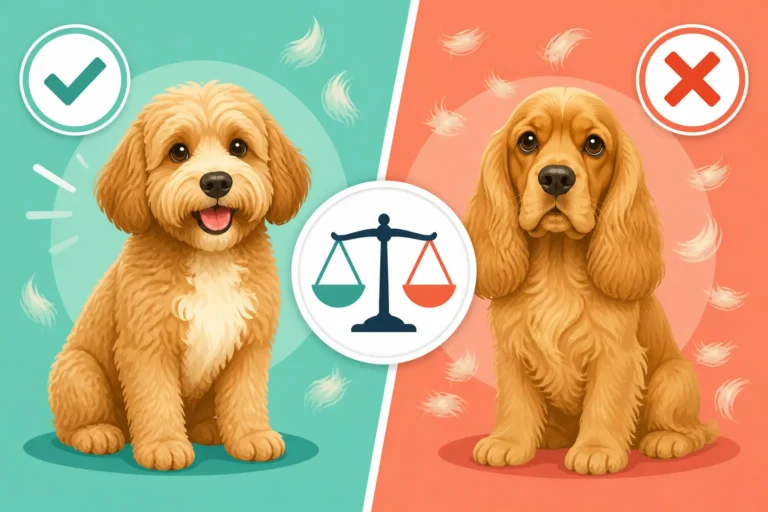
Still, ancestry percentages do not translate neatly into a matching percentage of appearance. A puppy that is genetically closer to a Poodle can inherit a looser wave, a broader face, or other features associated with its Cocker side. Littermates can also look surprisingly different, even with the same parents.
Imagine two puppies from one litter: one has a tight curl and a narrow, bearded face, while its sibling has a softer wave and a more Spaniel-like expression. That variation does not automatically mean one puppy is “more F1b” than the other. It is part of the unpredictability of combining two breeds with different coat and body traits.
Why the backcross parent matters
If the F1 parent is crossed back to a Poodle, the litter may lean more toward Poodle traits overall. If it is crossed back to a Cocker Spaniel, the puppies may lean more toward Cocker traits. Even then, “lean” is not the same as “will look exactly like.” Each puppy receives a different combination of inherited genes.
Ask the breeder to describe the parents and, ideally, show you clear photographs of them as adults. A puppy’s appearance can be hard to interpret when its coat is short, soft, or still changing. Seeing the parents gives you more context, though it still cannot predict every detail of an individual puppy.
Generation is only one part of the picture. The particular parents, the traits they carry, and the variation in the litter all matter. That is why Whether a Multigen Cockapoo Is Predictable is a useful related question: additional generations do not automatically make every puppy look alike or make the outcome certain.
Which features may look more like a Poodle
The coat is usually the first feature people have in mind when they ask whether an F1b Cockapoo looks more Poodle. It is also the feature that can lead to the biggest misunderstandings. A curlier coat may be more likely in some Poodle backcross pairings, but generation alone does not guarantee a tight curl, a low-shedding coat, or a particular grooming routine.
Coat texture, curl, and furnishings
An F1b Cockapoo may have a curlier or more consistently furnished coat than an F1, particularly when the F1 parent is crossed with a Poodle. But Cockapoos can have straight, wavy, or curly coats, and a puppy’s coat can change as it matures. A soft puppy coat is not a reliable preview of the finished adult coat.
Furnishings are the longer hairs around the muzzle and eyebrows that give many Cockapoos their characteristic bearded look. They are often associated with Poodle-type coats, but a furnished face does not prove that a dog will have a tight curl or shed very little. Those traits are related to different genetic influences, so one visible feature should not be used as a stand-in for the whole coat picture.
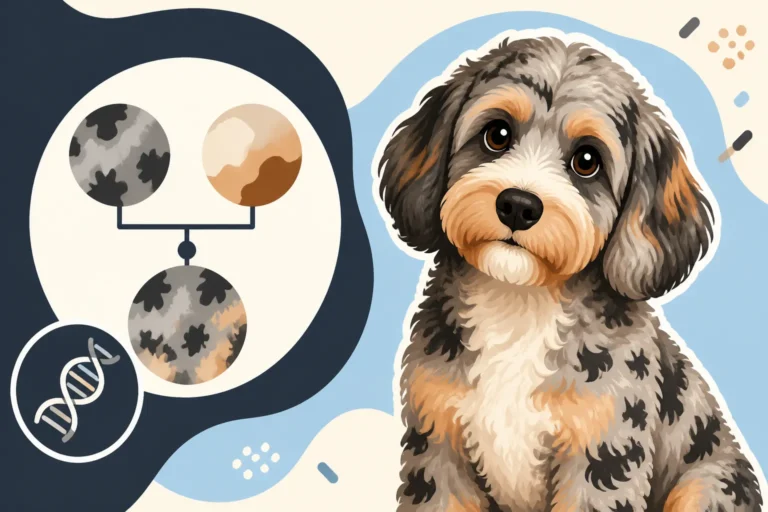
If you are comparing puppy coats, the genetic details may help explain what a breeder can and cannot predict. What KRT71 Says About a Cockapoo's Curl covers a gene associated with curl, while Whether a Cockapoo Needs Furnishings to Be Low Shedding looks at why furnishings and shedding are not interchangeable claims.
Face, body, and expression
A Poodle-backcross puppy may have a narrower muzzle, a more defined beard, or a lighter-looking coat than a puppy with stronger Cocker features. Yet Cockapoos do not come with a single fixed face shape. One may look distinctly Poodle-like, while another has rounder eyes, a broader head, or longer, more Spaniel-like ears.
Body shape varies, too. Some Cockapoos have a fine-boned, leggy look; others are sturdier or more compact. Size and build depend on the actual parents as well as their breed types and sizes, so the F1b label alone does not tell you whether the adult dog will be small, medium, or large. For an overview of the different size categories, see The Four Cockapoo Sizes.
Temperament is not reliably determined by whether a dog looks more like one breed. A puppy that resembles a Poodle is not automatically calmer, easier to train, or less attached to its people. Individual personality, early experiences, and the characteristics of the parents all play a role. Appearance can offer clues about inherited traits, but it should not be treated as a complete forecast of adult behavior.
| Feature | What an F1b pairing may suggest | What it cannot guarantee |
|---|---|---|
| Coat texture | A curlier or more Poodle-like coat may be more likely when crossed back to a Poodle | A tight curl, low shedding, or a particular coat-care schedule |
| Facial furnishings | A beard and longer eyebrow hair may appear | That the coat will be low shedding or allergy-friendly |
| Face shape | Some puppies may have a narrower, more Poodle-like muzzle | A specific adult expression or head shape |
| Body and size | The parents’ sizes offer useful clues | A precise adult weight or size class |
| Temperament | The parents’ behavior can provide context | A guaranteed personality based on generation or appearance |
What an F1b label cannot tell you about the coat
People often hope “F1b” will settle the question of shedding or allergies. It cannot. An F1b puppy may shed less than some dogs, but coat appearance alone is not a dependable way to promise how much hair you will find on the sofa or how a person with allergies will respond.
A curlier coat can hold loose hair within the coat, which may make shedding less obvious around the home. That does not mean the dog does not shed, and it does not remove the need for regular brushing. Loose hair can become trapped in curls and contribute to tangles or mats, especially behind the ears, under the collar, in the armpits, and around the legs.
If allergies are part of your decision, spend time with adult dogs from the breeder’s lines if possible and think of that as exposure, not a guarantee. People react differently, and a puppy’s coat may change as it grows. Whether Any Cockapoo Is Truly Non Shedding explains why “non-shedding” is too absolute a promise for this cross.
Puppy coats can change
At eight weeks, a Cockapoo’s coat may feel soft and fluffy without revealing its adult texture. As the puppy grows, the coat can become wavier, curlier, straighter, or denser. A change in color is possible too. The timing and extent of these changes vary, so a puppy’s first appearance should not be treated as its final look.
This can be frustrating for families who choose a puppy based on a particular coat expectation. You may bring home a puppy that appears loose-coated, only to find that tangles become more frequent as the coat matures. Or a puppy with a promising curl may end up with a looser wave. A Cockapoo's Coat at Eight Weeks and Whether a Cockapoo's Coat Is Final at Three offer more detail on how the coat can develop.
A responsible breeder should be comfortable explaining uncertainty. Be cautious if someone promises a specific adult coat, color, shedding level, or allergy outcome based only on the F1b label. It is more reassuring to hear what the breeder has observed in related litters and where the outcome is still unpredictable.
Grooming needs are not decided by generation
A curlier coat can need frequent brushing because curls and waves can tangle together. A straighter coat may be easier to comb in some areas, but it can still mat, particularly if it is long or dense. The most useful grooming clues are the puppy’s coat texture, the parents’ coats, and how much daily care you are realistically prepared to provide.
Before bringing a puppy home, ask the breeder to demonstrate how to brush down to the skin rather than only smoothing the top layer. A metal comb can help reveal small tangles that a slicker brush may glide over. If you buy supplies through Chewy or another retailer, choose tools suited to the coat in front of you and ask your groomer to check that the brush and comb reach through the coat without irritating the skin.
It also helps to introduce handling early: brief, calm sessions with paws, ears, face, and brushing can make future grooming less stressful. If you would like to understand how upkeep can vary by coat type, see Whether Coat Type Changes the Groom Interval. The right schedule depends on the individual dog and the length and condition of its coat, not just its generation label.
How to choose an F1b Cockapoo with realistic expectations
The most useful question is not simply “Is this puppy F1b?” It is “What are the parents, what traits have they passed to previous puppies, and what do you know about this puppy’s likely care needs?” A good conversation should make room for uncertainty instead of turning a generation label into a guarantee.
Questions to ask the breeder
Start by asking which breed the F1 Cockapoo was crossed back to. Ask whether the breeder has information about the parents’ coat texture, furnishings, shedding, adult size, and temperament. If the breeder has raised previous litters from the same pairing, ask how those puppies developed as adults, not just how they looked at eight weeks.
You can also ask what health and coat-related testing was done, and whether you can review the results. A test report may help explain particular inherited traits, but it cannot promise the exact appearance of every puppy. Ask the breeder to explain what a result means in everyday terms rather than relying on a label you are expected to interpret yourself.
Look carefully at the language used in the advertisement. “F1b” describes a breeding generation; it does not automatically mean “hypoallergenic,” “non-shedding,” “perfect for allergies,” or “easy to groom.” If a breeder promises all of those outcomes, ask how they reached that conclusion and whether they can point to adult dogs from the same lines. Whether a Breeder Can Guarantee a Cockapoo's Coat explores why such promises deserve careful questions.
Match the puppy to your home, not just your preferred look
If you love the Poodle-like appearance, be honest with yourself about the work that can come with a curly or dense coat. Regular brushing, professional grooming, and keeping the coat free of mats are part of ownership for many Cockapoos. The practical question is not only whether you like the puppy’s face, but whether you can maintain the coat it may grow into.
If you are choosing because you want less hair around the house, remember that visible shedding and grooming effort are separate issues. A coat that releases less loose hair onto furniture may still require substantial brushing and clipping. And if a family member has allergies, spending time around dogs from those lines is more informative than relying on generation or a breeder’s assurance alone.
For a better sense of the range of traits that can appear in the cross, What a Cockapoo Inherits From Each Parent is a helpful next read. The most contented owners tend to be the ones who choose for a combination of temperament, health, household fit, and manageable care—not a coat description that sounds perfect on paper.
Plan for the coat you get
Once your puppy is home, establish a simple routine before tangles become a daily battle. Brush in short, positive sessions and check common trouble spots, especially behind the ears, beneath the harness, and along the legs. If you discover a tight mat, avoid tugging at it; a groomer can advise whether it can be safely loosened or needs to be clipped out.
Keep notes on how the coat changes over time. That can help you and your groomer decide when a shorter trim is more comfortable and how often to book appointments. Chewy can be a convenient place to restock basic grooming supplies, but the tool matters less than using it gently and checking that you can comb through to the skin.
If you are still deciding between puppies, focus on what the breeder can substantiate: the parent pairing, health information, observed coat traits, and a realistic discussion of uncertainty. An F1b Cockapoo bred back to a Poodle may indeed look more Poodle-like, but every puppy is an individual. Choose with that variation in mind, and you are less likely to feel blindsided when the puppy coat gives way to the adult one.
Disclaimer
This article is for general informational purposes only and does not constitute professional advice. Laws, prices and regulations vary by location and change over time. Consult a qualified professional for guidance on your specific situation.