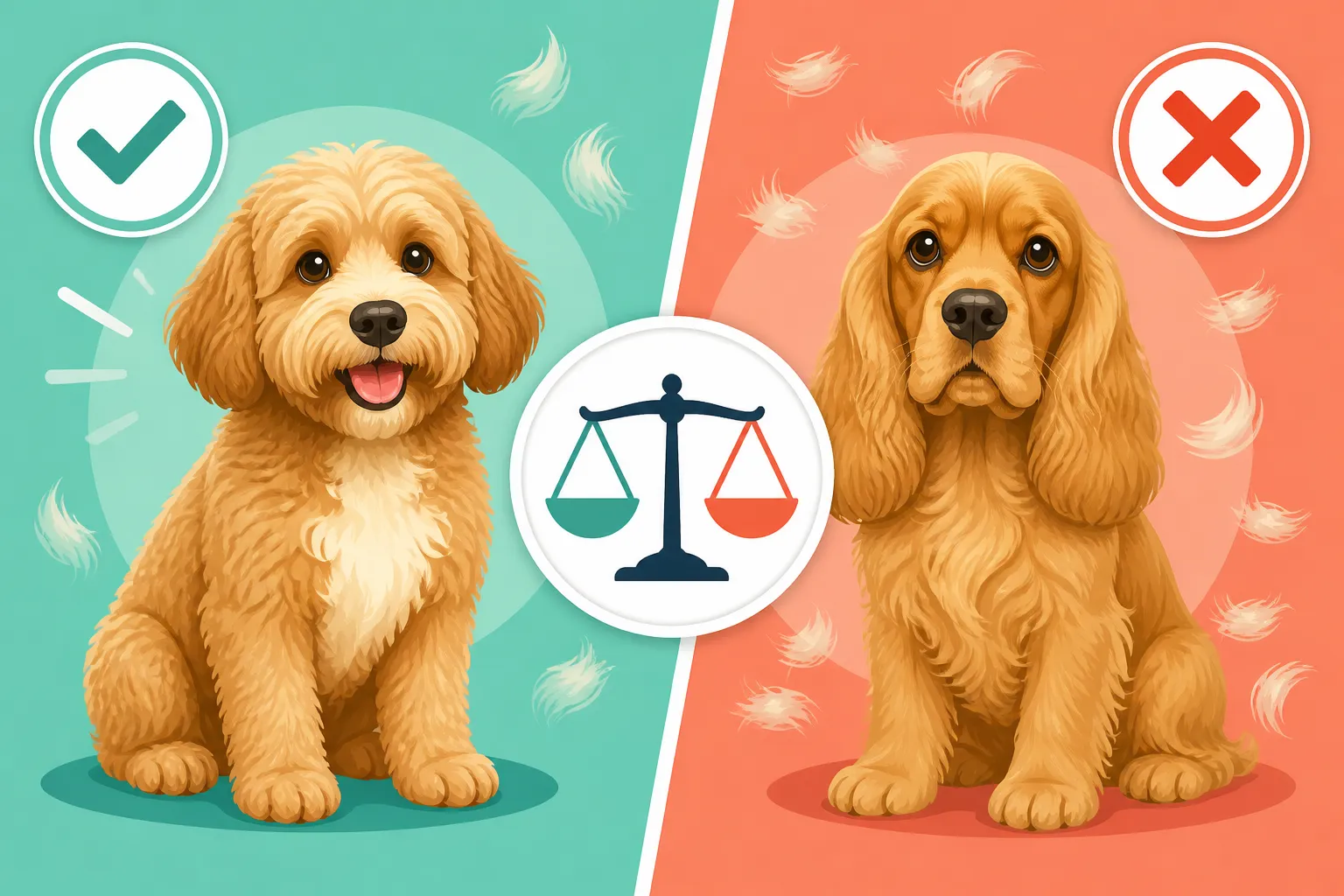
Whether a Cockapoo Sheds Less Than a Cocker
A Cockapoo may shed less than a Cocker Spaniel, but it is not a dependable rule. Some inherit a coat that holds loose hair, while others shed noticeably—sometimes much like a Cocker. This guide explains what affects shedding, what you can learn from a puppy’s coat, and how to manage hair and grooming without relying on a “low-shedding” promise.
Do Cockapoos Shed Less Than Cocker Spaniels
Why the answer depends on the individual dog
A Cockapoo is a cross between a Cocker Spaniel and a Poodle, so its coat can take after either parent—or land somewhere in between. A Cocker typically has a shedding coat, while Poodles are known for coats that tend to retain loose hair rather than dropping it around the home. A Cockapoo may inherit more of one parent’s coat traits, but the cross alone cannot tell you exactly how much hair an individual dog will shed.
That’s why two Cockapoos from the same litter can seem quite different. One may leave a light dusting of hair on the sofa, while its littermate leaves less visible hair but needs frequent brushing because loose hairs become caught in the coat. Even dogs that look similar can differ in coat texture, density, and how readily loose hairs fall free.
Cocker Spaniels also vary. An individual Cocker’s coat, grooming routine, health, and the amount of hair it naturally releases all affect what an owner sees at home. So when someone says their Cockapoo sheds less than a Cocker, that may be true for their particular dogs, but it is not a promise you can apply to every Cockapoo. For a broader look at the comparison, see Cockapoo or Cocker Spaniel for a Family.
Shedding can look different even when loose hair is present
With a short or straighter coat, loose hairs may drop onto clothing, bedding, and floors where they are easy to spot. A wavy or curly coat can hold onto more of those hairs. That can make the house look cleaner between brushings, but it also means loose hair may stay tangled in the coat and contribute to mats.
This difference can be frustrating: an owner may think a Cockapoo barely sheds, then discover clumps of caught hair when brushing behind the ears or under a harness. The dog may still be shedding; the coat is simply holding on to more of what comes loose. The distinction between low visible hair around the house and genuinely low shedding is worth keeping in mind.
Cockapoos are not reliably non-shedding, and no coat type guarantees a hair-free home. If shedding is a major concern, it can help to meet adult dogs from the breeder’s lines and ask owners about what they actually find on their floors and furniture. That conversation is more useful than assuming every Cockapoo will inherit the same coat.
How Coat Type Affects Cockapoo Shedding
Straight coats may show more loose hair around the home
A straight-coated Cockapoo may have a coat that resembles the Cocker parent more than the Poodle parent. Depending on the dog, loose hairs can be easier to see on furniture or clothing than they would be on a curlier coat. Straight coats still need regular brushing: they can tangle, especially where feathering rubs against the legs, ears, or collar.
A straight coat does not automatically mean heavy shedding, just as a curly coat does not mean no shedding. Coat appearance gives you clues about texture and upkeep, but it cannot precisely predict how much hair an individual dog will lose. For more about this coat type, read The Straight Coated Cockapoo.
Wavy and curly coats can hold loose hairs
A wavy Cockapoo’s coat may be a middle ground in appearance, but “middle ground” does not mean predictable shedding. Some dogs release more loose hair than others, and hair that does come loose may remain caught in waves until brushing removes it. Regular, thorough combing helps reduce tangles and lets you notice skin changes or small mats before they become painful.
A tight curl can hold loose hair close to the body, which may reduce the amount you notice around the house. The trade-off is that curls can mat close to the skin if brushing is rushed or limited to the visible top layer. A slicker brush may make the surface look smooth while knots remain underneath, so using a comb to check down to the skin matters. Explore The Wavy Coated Cockapoo and The Tight Curled Cockapoo for more on how those coat types differ.
Coat genes and generations do not give a simple guarantee
Cockapoo generations, such as F1 or F1b, describe a dog’s ancestry. They may offer context about the cross, but they do not provide a certain answer about how much that particular dog will shed. Even within a generation, puppies can inherit different combinations of coat traits.
Likewise, a fluffy puppy is not automatically destined to shed less. Puppy coats change as dogs mature, and the adult coat may have a different texture, density, or grooming routine. A breeder may be able to discuss the parents’ coats and the results they have seen in related litters, but a prediction is not a guarantee. See Whether an F1 Cockapoo's Coat Is a Coin Flip and Whether Shedding Can Be Seen in a Cockapoo Puppy for more on the limits of early clues.
| Coat type | What you may notice at home | Common care consideration |
|---|---|---|
| Straighter | Loose hairs may be easier to spot on furniture and clothes | Brush regularly and check feathering for tangles |
| Wavy | Some loose hairs may remain caught in the coat | Comb thoroughly, including beneath the top layer |
| Tightly curled | Less visible loose hair may fall around the home | Mats can form close to the skin without careful brushing |
What a Cockapoo Coat Means for Allergies and Housekeeping
Low shedding does not mean allergy-safe
People sometimes choose a Cockapoo because they hope a Poodle-influenced coat will be easier on allergies. Unfortunately, shedding and allergic reactions are not the same thing. Allergens can be present in skin flakes, saliva, and other materials, and people can react differently to different dogs—even dogs of the same breed or cross.
A Cockapoo that leaves less hair around the living room may still trigger symptoms for someone with dog allergies. If an allergic person lives in the home, spend time around the individual dog before making a commitment if that is practical. A short visit may not predict every reaction, but it is a more realistic check than relying on a breed label or a seller’s “hypoallergenic” claim. For more context, see Whether a Cockapoo Is Truly Non Shedding and Whether a Cocker Half Ruins the Allergy Claim.
Make cleanup realistic rather than chasing a hair-free home
If your Cockapoo sheds, a few practical habits can make it easier to manage. Brush the dog in a spot that is simple to clean, wash bedding regularly, and keep a lint roller or pet-hair tool where you usually get dressed. A washable throw on a favorite chair can also be easier to clean than repeatedly trying to remove every hair from the upholstery.
A home routine works best when it fits your actual week. If brushing happens only when the coat looks tangled, it may already be difficult for the dog and unpleasant for you. A short, calm session several times a week can be more manageable than a long session after mats have formed. A brush, comb, or grooming product can be sourced through a pet retailer such as Chewy, but choose tools suited to your dog’s coat and ask a groomer or veterinarian if you are unsure.
Know when shedding needs more than grooming
A change in shedding is worth paying attention to, especially if it appears suddenly or comes with bald patches, redness, persistent scratching, sores, odor, or skin that looks irritated. Those signs do not tell you what the cause is, but they are reasons to contact a veterinarian rather than simply switching brushes or bathing more often.
Season, stress, diet, parasites, and health conditions can all affect a dog’s coat. A groomer can help identify matting or coat-care problems, but a veterinarian is the right person to assess skin symptoms or a marked change in hair loss. Keeping notes about when the change started and where it is happening can make the appointment more useful.
Managing Shedding and Coat Care in a Cockapoo
Build a brushing routine around the coat
Start gently, especially if your Cockapoo is new to brushing. Let the dog investigate the brush, reward calm behavior, and work in short sections rather than pulling through knots. Pay particular attention to friction areas: behind the ears, beneath the collar or harness, around the armpits, and where the legs meet the body.
For a long or dense coat, brushing only the top layer can leave tangles hidden underneath. A comb can help check whether you have reached down to the skin without scraping or tugging. If a mat is tight, pulling at it can hurt. A professional groomer can advise whether it can be safely worked out or whether clipping is kinder for the dog.
The right routine depends on the individual’s coat, length, and activity. A dog with a longer, curlier coat may need more frequent attention than one kept in a shorter clip. For a closer look at the relationship between coat and upkeep, read Whether Coat Type Changes the Groom Interval.
Keep grooming and shedding expectations separate
A haircut can make coat care easier, but it does not change the dog’s inherited shedding pattern. Shortening the coat may make brushing quicker and reduce how much hair gets tangled in the coat, yet the dog can still shed. It can also make loose hairs more visible on some fabrics because shorter hairs may be harder to pick out.
Professional grooming can be helpful for owners who struggle to keep up with brushing or who want a coat length that is easier to maintain. Between appointments, home brushing still matters; a groomer cannot prevent mats from forming during the weeks between visits. If you are buying a comb, brush, or coat-care product through Chewy or another retailer, compare the tool’s intended coat type and follow product directions. Avoid using products meant for people unless your veterinarian says they are appropriate for your dog.
Ask focused questions before bringing a puppy home
If shedding is a deciding factor, ask the breeder clear, specific questions rather than asking only whether the puppies are “low shedding.” You might ask what the parents’ coats are like, how much hair adult dogs from previous litters leave around the home, and how their coats changed as they matured. If possible, spend time with the adult dogs and talk with their owners about the brushing and grooming they actually do.
It is also sensible to ask what health testing and care the breeder provides, and to assess temperament, living conditions, and support alongside coat predictions. A breeder who is candid about variation is more helpful than one who promises that a puppy will never shed. If allergies are part of the decision, arrange time around the dog before adopting or purchasing when possible, and do not treat a coat prediction as a substitute for that experience.
The honest expectation is that a Cockapoo may shed less visibly than a Cocker Spaniel, particularly if it inherits a coat that holds loose hair. But individual dogs vary, and the hair that stays in the coat still needs regular removal through brushing and grooming. If you can live with some uncertainty, plan for routine coat care and assess the puppy in front of you rather than relying on the Cockapoo label alone.
Disclaimer
This article is for general informational purposes only and does not constitute professional advice. Laws, prices and regulations vary by location and change over time. Consult a qualified professional for guidance on your specific situation.