What a Phantom Cockapoo Looks Like
A phantom Cockapoo can look like a dog wearing carefully placed tan “eyebrows,” cheek patches, chest markings, and lighter socks over a darker coat. But curls, puppy coat changes, and fading can make those markings hard to spot—or alter their contrast as the dog grows. This guide explains what the pattern looks like and how to tell it apart from other coat colors.
What phantom markings look like on a Cockapoo
The classic phantom pattern
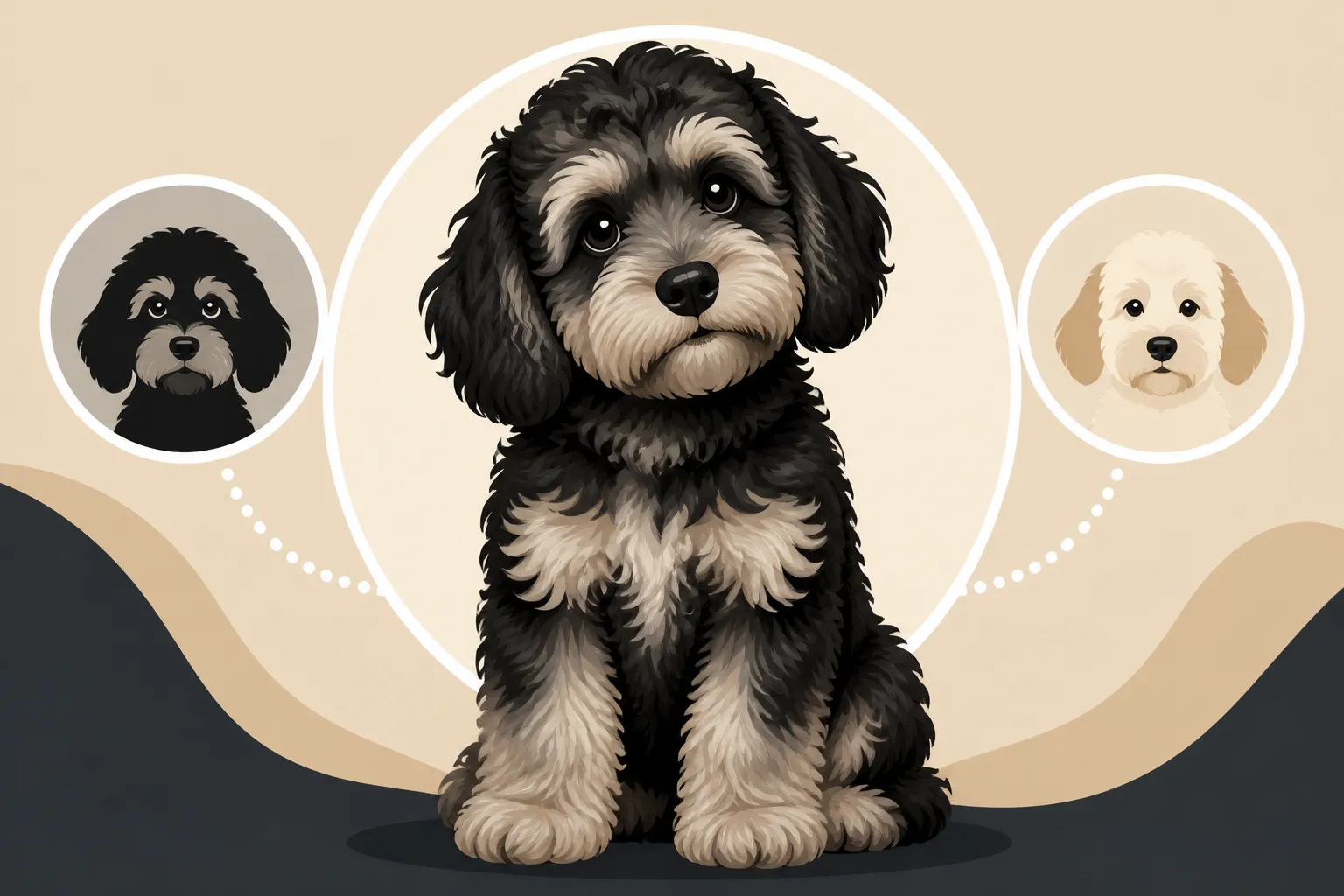
“Phantom” describes a coat pattern, not a separate Cockapoo type or a coat texture. A phantom dog has a darker base color with lighter markings in particular places. The most recognizable points are above the eyes, on the sides of the muzzle, across the chest, on the lower legs, and beneath the tail.
Those lighter patches are often tan, cream, or a warm reddish shade, while the base may be black, brown, or another dark color. The contrast can be striking: a dark, curly face with two pale spots above the eyes may give the impression that the dog has eyebrows. On a Cockapoo, though, the markings might be subtle or partly hidden by long facial hair and curls.
The pattern doesn’t mean every pale patch is a phantom marking. A dog may have a white chest or toes as well as point markings, and the placement and appearance of those areas can vary. It’s useful to look at the whole coat, rather than decide from one patch or a quick photo. For a broader look at possible Cockapoo colors, see The Colors a Cockapoo Comes In.
Phantom, parti, merle, and sable are different patterns
A parti Cockapoo has large areas of white alongside another color. A phantom Cockapoo, by contrast, is identified by lighter markings in characteristic places over a darker base. A dog can have more than one kind of marking, so a bit of white does not automatically rule out a phantom pattern.
Merle typically creates a mottled or marbled appearance, with irregular patches of diluted color. That is different from the more placed, point-like markings associated with phantom coats. If a puppy has scattered pale and dark areas, it may be worth asking the breeder how they describe the pattern and what they know about the parents’ coats, rather than relying on a label in an advertisement.
Sable can also be confused with phantom, especially in a puppy whose coat is still changing. Sable coats may have darker-tipped hairs over a lighter ground color, giving the coat an overall shaded appearance. Phantom markings are generally more recognizable as distinct areas on the face, legs, chest, and underside of the tail. A coat can be hard to classify from a single image, particularly when it is curly, freshly clipped, or photographed in poor light.
| Pattern | What you may notice | How it differs from phantom |
|---|---|---|
| Phantom | Lighter points over a darker base, often above the eyes, on the muzzle, chest, legs, and under the tail | Markings tend to appear in particular locations |
| Parti | Broad white areas alongside another color | The defining feature is white spotting, not a set of tan points |
| Merle | Irregular mottled or marbled areas | The pattern is usually more scattered than classic phantom points |
| Sable | Dark-tipped hairs or an overall shaded look | The coat may look blended rather than marked in distinct points |
How the pattern can look as a Cockapoo grows
Puppy markings can be easy to miss
A young Cockapoo’s markings may not be as obvious as they’ll appear later. Puppy coats are soft and often fluffy, and the hair around the eyes, muzzle, and paws can cover the places where lighter points would be easiest to see. A puppy’s lighting, grooming, and coat length can also change how much contrast shows in a photograph.
Imagine a dark puppy with faint cream spots above its eyes. In one photo, those markings may stand out; in another, the fur around the face may make the dog look nearly one color. That difference does not necessarily mean the pattern has appeared or disappeared overnight. It may simply be easier to see when the coat is parted, dry, or trimmed shorter around the face.
When viewing a puppy, look for the pattern on more than one part of the body. Check the area above each eye, the muzzle, chest, lower legs, and underside of the tail. Ask whether the breeder has photos of the puppy’s coat in natural light and whether they can show pictures of the parents. Coat appearance can be useful context, but it cannot promise exactly how the puppy will look as an adult. Whether Two Cockapoo Littermates Look Alike explores why puppies from one litter can still develop noticeably different appearances.
Color and contrast may shift with age
Cockapoo coats can change as puppies mature. Some dogs’ dark coats soften or lighten, while others retain strong contrast between the base and their lighter points. The amount and timing of change vary, so a puppy’s first coat is not always a reliable preview of its adult coloring.
A phantom pattern can remain recognizable even when the colors become less dramatic. For example, dark brown may fade toward a lighter brown, or the lighter points may become less distinct against the base. In another dog, the markings may stay clear. A change in contrast doesn’t by itself indicate a health problem; it is an appearance change that owners may notice gradually across the puppy-to-adult coat transition.
If you’re comparing puppy photos with adult-dog photos, use similar lighting and angles when possible. Indoor lighting, shadows, a wet coat, and recent clipping can all make a color appear different. These practical details are why claims about a puppy’s final shade should be treated cautiously. For more on changing colors, read Whether a Cockapoo Puppy's Color Holds and Whether a Cockapoo's Color Fades With Age. The broader coat timeline is covered in Whether a Cockapoo's Coat Is Final at Three.
What influences a phantom Cockapoo’s appearance
Coat texture can hide or reveal the markings
A Cockapoo’s coat may be straight, wavy, or curly, and texture affects how visible the color pattern looks. Long curls can overlap and cast shadows, especially around the eyes and muzzle. A shorter trim may make the lighter points easier to spot, but it does not create the pattern; it simply changes how much of the coat is visible.
A freshly groomed dog can also look quite different from the same dog several weeks later. Hair around the feet and face may grow over the markings, while a shorter body clip can make the coat seem more sharply defined. This is one reason photos of Cockapoos can be misleading when they are used to compare color: different coat lengths can exaggerate or soften the apparent contrast.
For day-to-day care, focus on keeping the coat comfortable and free of tangles rather than trying to preserve a particular look. If you’re putting together basic grooming supplies, a retailer such as Chewy may be one place to compare brushes and combs; choose tools that suit your dog’s coat and ask a groomer to demonstrate safe brushing. Regular combing helps you see the skin and coat clearly, but avoid brushing aggressively in an attempt to uncover markings.
Genetics can shape color, but appearance is not a simple promise
A coat pattern is influenced by inherited traits, and a puppy receives genetic material from both parents. That makes the parents’ colors and patterns useful clues, but they are not a guarantee that every puppy will look like either parent. Littermates can inherit different combinations and end up with different coats, even when they share the same mother and father.
A breeder may use genetic testing to learn about particular coat traits. A test report can add information, but it does not mean every detail of an adult dog’s appearance can be predicted with certainty. Coat texture, color changes, grooming, and the way markings show through the hair all affect what an owner sees. A DNA result should be read as information about the traits tested, not as a complete visual forecast.
If you’re choosing a puppy, ask the breeder to explain what they mean by “phantom” and whether they’re describing a visible pattern, a predicted pattern, or a result from testing. You can also ask for clear photographs of the parents and puppies, ideally taken in natural light. The questions What a Cockapoo Coat Panel Actually Reports and Whether a Cockapoo Breeder Can Guarantee a Cockapoo's Coat can help set realistic expectations. If you’re comparing coat predictions, Whether a Cockapoo's Curl Can Be Predicted at Birth also explains why appearance traits may not be certain from puppyhood.
Choosing and caring for a phantom Cockapoo
Look beyond the color label
Phantom markings can be eye-catching, but color is only one small part of choosing a dog. A label in a listing may not tell you how the puppy will look as an adult, how much grooming the coat will need, or what the dog’s personality will be like. Two puppies described as phantom may have different base colors, different levels of contrast, and different coat textures.
When meeting a puppy, notice how it responds to people and its surroundings, and ask about the parents’ health and temperament. A responsible breeder should be able to talk through the puppy’s care and background rather than relying on coat color as the main selling point. If a seller insists that a particular shade guarantees a specific personality, low-shedding coat, or health outcome, treat that claim with caution. Color alone does not tell you those things.
You might also ask for photos taken at different ages, if available. They can show how the breeder’s dogs’ coats have changed over time, though they still cannot promise that your puppy will mature identically. The goal is not to eliminate every uncertainty—mixed-breed coats can vary—but to understand what is known and what remains a guess.
Keep the coat healthy without chasing a perfect pattern
A phantom Cockapoo needs grooming suited to its coat, just like any other Cockapoo. Curly or wavy hair can tangle and mat, especially behind the ears, under the collar, around the legs, and where a harness rubs. Gentle, regular combing and routine grooming help keep the coat manageable. The exact routine depends on the individual dog’s texture and length.
Color does not usually call for special shampoo or treatments. Use products intended for dogs and follow guidance from your veterinarian or groomer if your Cockapoo has sensitive skin. A retailer such as Chewy can help you compare everyday coat-care items, but a product marketed for brightening or enhancing color is not necessary to maintain a phantom pattern. Avoid home remedies or human hair products, which may irritate a dog’s skin.
If you use Chewy or another retailer to shop for grooming basics, choose a comb that reaches through the coat rather than only skimming the top. Ask a groomer to show you how to part the hair and check for tangles close to the skin; a fluffy surface can hide a mat underneath. Good coat care makes the markings easier to see, but the dog’s comfort matters more than keeping a particular pattern sharply defined.
A phantom Cockapoo is best understood by the placement of its lighter points against a darker base, not by one exact shade or hairstyle. Those markings may be bold, subtle, or partly hidden by curls, and the coat can shift as the dog matures. Take the color as an appealing feature, while making your choice based on the puppy’s health, temperament, background, and the care you can provide.
Disclaimer
This article is for general informational purposes only and does not constitute professional advice. Laws, prices and regulations vary by location and change over time. Consult a qualified professional for guidance on your specific situation.