How Common a Parti Cockapoo Is
A parti Cockapoo has a white coat marked with patches of another color, a look that can make a puppy stand out in a litter. But it’s hard to say exactly how common parti Cockapoos are: there’s no single registry or reliable population survey tracking coat patterns across all Cockapoos. Here’s what the pattern means, how it can appear, and what you can realistically expect as a puppy grows.
What makes a Cockapoo parti
Parti describes a pattern, not a separate kind of Cockapoo
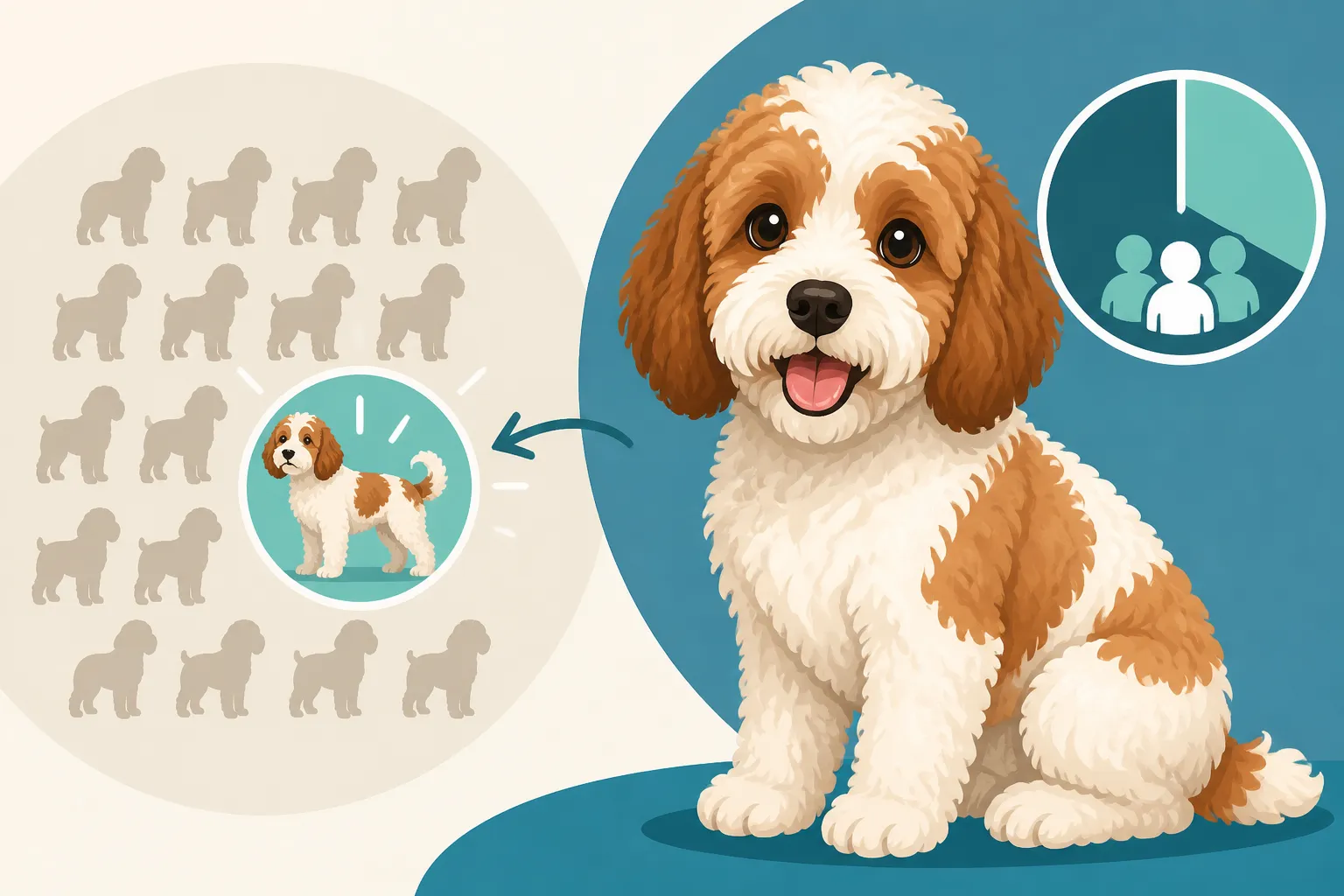
“Parti” usually describes a dog with a predominantly white coat and patches of another color. A parti Cockapoo might have brown patches on white, black patches on white, or another combination. The patches can be large and clearly defined, or smaller and more scattered. The amount of white and the size and placement of the colored areas vary from dog to dog.
Parti is a coat pattern, not a breed, size, temperament, or health category. A parti Cockapoo is still a Cockapoo, and the pattern doesn’t tell you whether the dog will be toy, miniature, or maxi sized. It also doesn’t indicate that the dog will be calmer, more energetic, or easier to train. Those traits depend on many factors, including the parents, the individual dog, and its experiences.
The term can be used inconsistently, especially in mixed-breed dogs. One breeder might call a mostly white puppy with a few dark markings parti, while another might describe a dog with extensive white as parti-color. If you’re comparing puppies, ask the breeder to explain what they mean and look at clear photographs of the puppy and parents. The Colors a Cockapoo Comes In gives a broader look at the range of colors and patterns Cockapoos may have.
Parti is different from merle, roan, and phantom
Coat-pattern names are easy to mix up. Parti generally refers to white areas alongside patches of another color. Merle, by contrast, creates a mottled or marbled effect within areas of color. Roan usually describes a mix of colored and white hairs that gives part of the coat a speckled appearance, rather than large, clean patches. Phantom describes a particular arrangement of contrasting markings, not a white-and-patched pattern.
A dog can also have white markings without being described as parti. A small white chest patch or white toes on an otherwise solid-colored dog may simply be called white markings. Where breeders draw the line can vary, so the label alone may not tell you exactly what a puppy looks like.
If a listing uses several pattern names, ask for photographs in natural light and a written description of the markings. Close-up pictures can make small patches look extensive, while dim lighting can disguise the difference between a solid color and a mottled one. Where a Merle Cockapoo's Color Comes From and Whether a Roan Cockapoo Comes From the Cocker explain two patterns that are often confused with parti.
How common are parti Cockapoos
There is no dependable percentage
There isn’t a trustworthy, widely accepted percentage for how many Cockapoos are parti. Cockapoos are not a single closed population with one central record of every puppy born, and coat-pattern information isn’t consistently collected across breeders, clubs, or registries. Without that kind of record, claims such as “one in every few litters” should be treated as an individual breeder’s experience, not a general statistic.
What you may see online is shaped by which breeders advertise, which puppies are available at a particular moment, and which photos attract attention. A pattern that appears frequently in search results may not be common across Cockapoos as a whole. The reverse is true as well: a pattern that is rarely advertised in your area may still appear in litters elsewhere.
It’s more accurate to say that parti Cockapoos do occur, but their availability varies by breeding lines and by the parents’ inherited coat traits. A breeder who produces parti puppies regularly may have a different impression of their frequency from a breeder whose dogs rarely carry the relevant patterning. Whether the Cockapoo Is a Designer Dog or a Breed explains why Cockapoos don’t have one universally managed population from which a precise coat-pattern count could easily be drawn.
Why one breeder’s experience can look different from another’s
Cockapoos can be bred from different Cocker Spaniel and Poodle lines, and those parent dogs do not all have the same coat colors or pattern histories. Some lines may be more likely than others to produce puppies with extensive white markings. That does not mean a breeder can produce parti puppies at will: the outcome depends on the inherited traits of the specific parents.
Generation labels, such as F1 or F1b, don’t guarantee a parti coat. They describe a breeding relationship, not a predictable color result. Even when a puppy’s parents have attractive or unusual coats, the puppies in the same litter can have noticeably different patterns. What the Cockapoo Clubs Mean by F1 and F1b explains what those generation terms do—and do not—tell you.
The number of parti puppies you encounter can also depend on where you live and how far you are willing to travel. If only a small number of breeders in your region produce Cockapoos, your local choice may be limited even when the pattern appears in other areas. For a realistic sense of availability, ask breeders about their own past litters and planned pairings, but don’t treat their experience as a breed-wide statistic.
How parti coloring is inherited
The pattern depends on the parents’ inherited traits
A puppy’s coat pattern comes from genes inherited from both parents. In dogs, white spotting is associated with inherited traits that affect where pigment appears in the coat, but the visible result can vary. A puppy may have extensive white, a few smaller white areas, or a pattern that looks quite different from either parent at first glance.
A parti Cockapoo doesn’t necessarily need two parti-looking parents. A parent can carry inherited traits that are not obvious from its own coat, and the puppies’ appearance depends on the particular combination they inherit. At the same time, two parents with white markings do not guarantee that every puppy will have a parti pattern. Coat inheritance is not as simple as matching two photographs and predicting an exact result.
This is one reason to be cautious when a breeder promises a particular pattern. A knowledgeable breeder can discuss the parents’ coats, family history, and any testing relevant to coat traits, but a coat label or a pairing alone cannot guarantee precisely where a puppy’s patches will fall. Whether a Breeder Can Guarantee a Cockapoo's Coat explores what breeders can reasonably predict and where uncertainty remains.
A litter can contain several different-looking coats
Littermates share parents, but they don’t necessarily look alike. One Cockapoo puppy may have broad brown patches on a white background, another may be mostly brown with a small white chest, and a third may be a largely solid color. Differences can occur in coat color, markings, texture, and the amount of white.
This variation can surprise people who assume a litter will look uniform because the puppies have the same mother and father. If appearance is important to you, ask to see the whole litter rather than only the puppy being advertised. It can also help to ask whether the breeder has photographs of earlier litters from the same parents or closely related dogs. Those pictures may provide context, but they still can’t promise the exact appearance of a future puppy.
A litter containing different coat types or patterns is not automatically a sign that anything is wrong. It reflects the variety possible in a mixed-breed dog. Whether a Cockapoo Litter Can Contain Every Coat Type and Whether Two Cockapoo Littermates Look Alike offer more context on why siblings can look so different.
| What you’re asking | What you can reasonably learn | What it cannot guarantee |
|---|---|---|
| Is a puppy parti? | Whether its current coat has a white background with patches of another color | How its adult coat will look in every detail |
| Are the parents parti? | Their visible patterns and markings | That their puppies will all be parti |
| Is the puppy an F1 or F1b? | The puppy’s generation relationship | A particular color or pattern |
| Do littermates have different coats? | The range of appearances in this litter | The appearance of a future litter |
| Can a breeder predict the pattern? | What is plausible based on the parents and family history | Exact patch size, placement, or final color |
Choosing a parti Cockapoo and caring for its coat
Ask useful questions instead of relying on a color promise
If you’re looking for a parti Cockapoo, ask the breeder to describe the puppy’s current markings in plain language. Find out which areas are white, where the colored patches sit, and whether the puppy’s coat has changed since birth. Ask for recent photographs taken in good light, ideally including the puppy standing and moving rather than only close-up portraits.
It’s also sensible to ask about the parents’ health testing and temperament, how the puppies are raised, and what support the breeder provides. Coat pattern is one part of choosing a puppy, but it shouldn’t take priority over health, sound early socialization, and a responsible breeding setup. Be wary of anyone who guarantees a precise adult pattern or uses color as a reason to avoid answering ordinary questions about the dogs’ care and background.
Remember that puppy photos show a coat at one stage in development. Cockapoos can change in color and texture as they mature, and a puppy’s markings may look different as its coat grows. Whether a Cockapoo Puppy's Color Holds covers how color can shift over time, while Whether a Multigen Cockapoo Is Predictable discusses why later-generation breeding does not automatically make appearance certain.
Parti coats need the same grooming routine as other Cockapoo coats
Parti coloring doesn’t require a special grooming method. The practical work depends more on the coat’s texture and length than on whether it is white, brown, black, or patched. A wavy or curly coat can tangle and mat if it isn’t brushed and combed regularly, especially behind the ears, under the collar, around the legs, and where a harness rubs.
White areas may make dirt or staining more noticeable, particularly around the muzzle and paws. That can be frustrating if your dog comes in from a muddy walk looking less than freshly groomed. Gentle, dog-appropriate cleaning and regular coat care are more useful than harsh products or frequent full baths, which may irritate skin or dry out the coat. Ask your groomer or veterinarian for advice if you notice persistent staining, redness, itching, or an unusual smell.
For basic home care, choose a brush and comb that suit the individual coat, and get your Cockapoo comfortable with short grooming sessions early. You can compare grooming tools at a local pet shop or through retailers such as Chewy, but choose for the coat and the dog’s comfort rather than for the parti label. Chewy is one option for browsing brushes, combs, and other basic supplies; a groomer can help you work out which tools are appropriate for your dog. If you order supplies from Chewy, check that the product is intended for dogs and follow its directions.
Disclaimer
This article is for general informational purposes only and does not constitute professional advice. Laws, prices and regulations vary by location and change over time. Consult a qualified professional for guidance on your specific situation.