Whether a Cockapoo Is Too Busy for Small Children
A Cockapoo can be a loving family dog and still feel like a lot around small children. Jumping, mouthing, barking, and puppy energy can turn an ordinary morning into a juggling act. This guide explains which Cockapoo traits may challenge life with toddlers, how age and temperament change the picture, and what families can do to keep both child and dog safe.
Why a Cockapoo can feel too busy for small children
Cockapoos are often affectionate, playful, and eager to be involved in whatever their people are doing. Those qualities can be lovely with children, but they can also mean a dog that rushes toward activity, struggles to settle, or gets overexcited when a child squeals or runs. “Busy” does not necessarily mean badly behaved; it may simply mean the dog needs help learning how to cope with the household’s pace.
Excitement can look like roughness
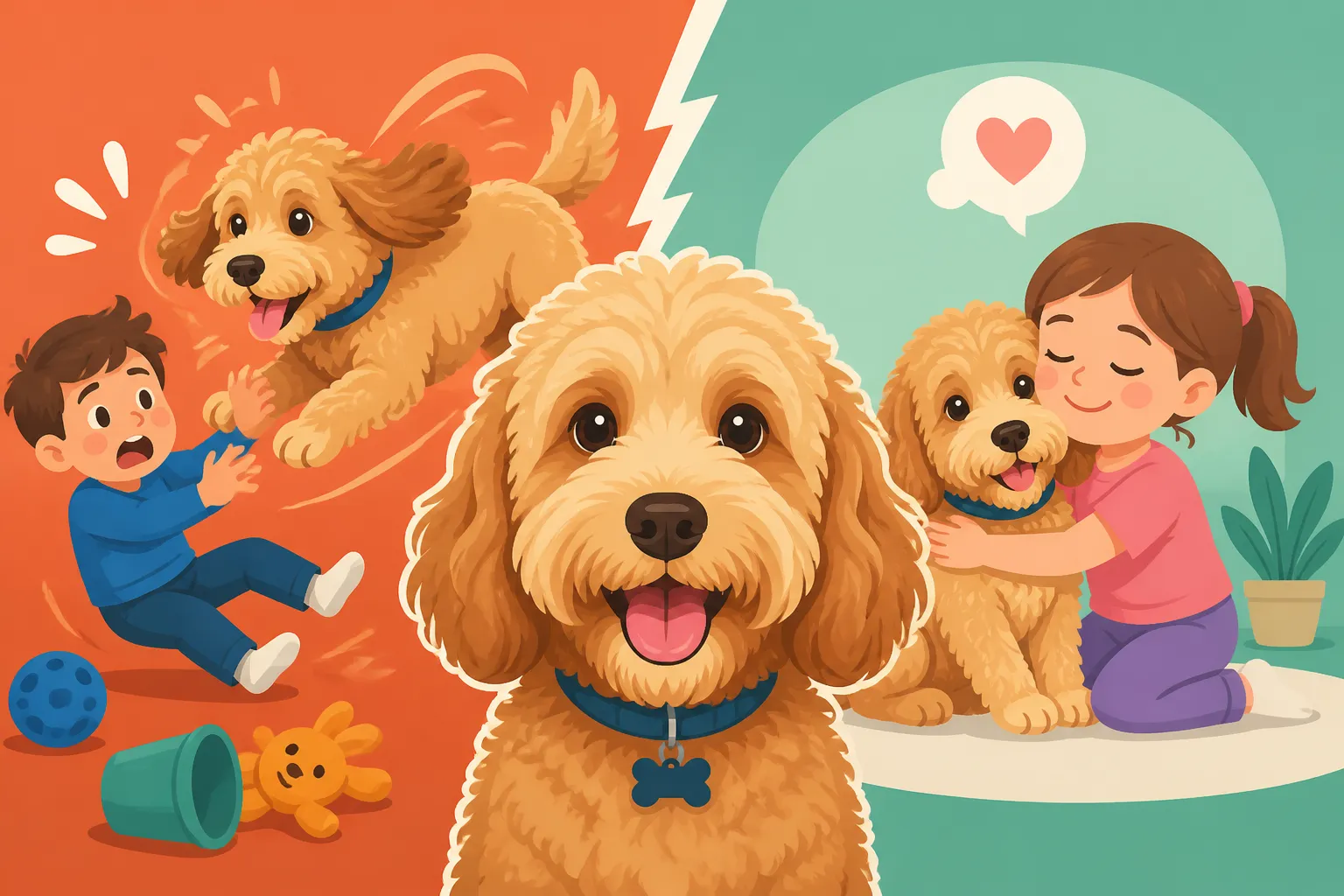
A Cockapoo greeting a toddler may jump up, paw at them, lick their face, or grab a sleeve in play. The dog may mean no harm, but a small child can be knocked over or frightened. Puppies also explore with their mouths, and their needle-sharp teeth can hurt even when they are playing normally. A toddler who cries or waves their arms may unintentionally make the game more exciting.
The same mismatch can happen during play. A Cockapoo may chase a child who runs across the room, tug at a toy the child is holding, or follow them closely when they are trying to get away. Adults sometimes read this as the dog being “protective” or especially fond of the child. It may simply be play or excitement—and it still needs calm, consistent management.
For a broader look at how to set expectations and build a good relationship, see A Cockapoo With Children. If the main question is specifically about very young kids, Whether a Cockapoo Is Gentle With Toddlers is another useful topic to explore.
Puppy energy and adult temperament are different considerations
A young Cockapoo may have short bursts of intense activity followed by long periods of rest. During those busy spells, jumping and mouthing are common puppy behaviors, not proof that the dog will always be unmanageable. But puppies need regular sleep, patient training, and an adult who can step in before play becomes too rough. A tired, overstimulated puppy may be less able to settle than one whose day includes suitable activity and quiet breaks.
An adult Cockapoo may be more predictable, but age alone does not guarantee a calm family companion. Some adults remain lively and enthusiastic; others are relaxed at home but uncomfortable with sudden movement or noisy play. A dog’s past experiences, individual temperament, training, health, and the way the household is managed all matter. Raising a Cockapoo Puppy covers the early routines that can help a puppy learn household skills.
Size can influence the practical risks, too. A small dog can still jump, nip, or trip a child, while a larger Cockapoo may be able to knock a toddler off balance without meaning to. Choosing a size does not replace supervision or training. It is more useful to think about the specific dog’s behavior and the family’s ability to manage that behavior safely.
How to judge whether the match will work
No breed description can tell you exactly how one Cockapoo will behave with your child. Instead, look at the dog’s behavior in realistic situations and be honest about how much supervision and training your household can provide. A family with an adult home much of the day may find it easier to teach calm interactions than a household where everyone is rushing between work, school, and activities.
Notice how the dog responds to everyday child behavior
Children can be unpredictable from a dog’s point of view. They may squeal, run, drop objects, move suddenly, or get close to the dog while it is eating or sleeping. Observe how the Cockapoo responds to ordinary household sounds and movement without asking a child to provoke or test the dog.
Look for whether the dog can disengage and settle. Does it move away from noise, respond to a familiar cue, or relax behind a gate? Or does it keep jumping, barking, chasing, or grabbing at clothing even after adults redirect it? A dog that can recover from excitement and settle with support may be easier to manage than one that stays highly aroused for a long time.
Also pay attention to body language. Turning away, trying to leave, freezing, lip licking, or repeatedly avoiding contact can mean the dog needs space. Do not insist that the dog tolerate hugging, face-to-face contact, or being followed. A dog’s ability to step away safely is part of a good child-and-dog arrangement.
Match the dog’s needs to your household
A busy dog needs more than a quick backyard visit and a child’s attention. Daily walks, sniffing opportunities, training, rest, and appropriate play all help provide structure. That does not mean tiring the dog out with constant activity; a Cockapoo that is kept excited all day may have trouble settling. Short training sessions, food-search games, and quiet rest periods can be more helpful than nonstop stimulation.
Ask yourself who will handle the dog’s routine. Small children should not be responsible for exercise, feeding, or correcting unwanted behavior. Adults need to manage walks, prevent unsafe interactions, and make time for training. If that sounds unrealistic during a particularly hectic stage of family life, waiting or considering a calmer adult dog may be the kinder choice for everyone.
| Situation | What may be challenging | Helpful adult response |
|---|---|---|
| Toddler running indoors | Chasing, jumping, or nipping at clothes | Use a gate or lead the dog to a calm activity before play escalates |
| Child holding a toy | Tugging or grabbing | Provide separate toys and teach the dog to release and redirect |
| Dog resting or eating | Startling, guarding, or avoiding the child | Keep children away and give the dog a quiet, protected space |
| Noisy family gathering | Barking, pacing, or difficulty settling | Offer a quiet room or gated area with water and a familiar bed |
| Puppy after active play | Mouthing and frantic behavior | End play calmly and give the puppy an undisturbed rest break |
If you are weighing the wider lifestyle fit, The Household a Cockapoo Actually Suits can help you think through the dog’s needs alongside your family’s routines. For homes where noise and commotion are frequent, Whether a Cockapoo Copes in a Loud House is relevant as well.
Setting boundaries that protect children and dogs
Good management is not a sign that the dog has failed or that the child is doing something wrong. It prevents predictable problems while everyone learns. A Cockapoo should have a quiet place where children cannot follow, and children need clear, age-appropriate rules about how to behave around the dog.
Supervise closely and use barriers before trouble starts
An adult should be close enough to intervene whenever a young child and dog are together. Watching from another room, glancing up from a phone, or assuming the dog will walk away is not the same as active supervision. If an adult cannot focus on the interaction, use a baby gate, play yard, crate if the dog is comfortable with it, or separate rooms.
Teach children not to climb on the dog, hug tightly, pull ears or fur, approach the dog while it is eating, or disturb it while sleeping. Toddlers cannot reliably remember these rules, so adults must create the safe arrangement rather than expecting a child to manage it alone. Keep high-value chews and food bowls in a child-free area.
A quiet retreat is useful only if the dog can actually use it without being followed. Put bedding and water in a calm spot and make it off-limits to children. If a dog retreats there, let it rest. For families bringing a baby home, planning ahead can make transitions easier; see Introducing a Cockapoo to a Newborn.
Teach calm behavior in small, repeatable steps
Reward the dog for keeping four paws on the floor, settling on a mat, responding to its name, and moving away from a child when asked. Practice these skills when the room is quiet before relying on them during lively play. Keep sessions short and use rewards the dog values. Adults should manage the environment while training rather than asking a young child to give complex commands.
Give the dog suitable alternatives to grabbing sleeves or chasing. For example, an adult can redirect the dog to a toy, invite it to find scattered pieces of its meal, or guide it to a resting spot. Food puzzles and other enrichment can occupy a dog during a child’s playtime, but choose items that are appropriate for the dog and keep them separate from children’s toys. When comparing puzzle feeders or durable dog toys, Chewy is one place owners may browse; supervise use and remove damaged items.
Make interactions predictable. A child can toss a toy for the dog with an adult’s help, or help with a simple reward routine, but should not be expected to handle the dog unsupervised. Teaching Children to Handle a Cockapoo offers more guidance on making those interactions respectful and age-appropriate. If you need a quiet activity while the child is occupied, a supervised food puzzle sourced from a retailer such as Chewy may help the dog focus on something separate from the child.
When a Cockapoo may not be the right fit right now
Some families can make the match work with training, gates, and consistent routines. Others may find that a young, lively dog adds more pressure than they can comfortably manage. That is not a judgment on the family or the dog. Timing, support, and the individual dog matter.
Take warning signs seriously
A Cockapoo that repeatedly freezes, growls, snaps, guards food or toys, or tries to hide from a child needs more space and careful assessment. Do not punish a growl; it is a warning that the dog is uncomfortable. Separate the dog and child, prevent the situation from repeating, and speak with a veterinarian or qualified behavior professional about next steps. If the behavior is new or changes suddenly, a veterinary check can help assess whether discomfort or illness is contributing.
Likewise, ongoing chasing, hard mouthing, or jumping that adults cannot interrupt safely is a reason to change the setup—not to wait for a child to “learn to cope.” Use barriers and keep interactions controlled while you get support. A dog and child should not be left alone together, even when the dog has seemed gentle in the past. Whether a Toddler and a Cockapoo Can Be Left Together addresses that safety question directly.
Consider an adult dog or a different timeline
If your household is in a demanding phase—such as managing a new baby, a toddler who needs constant attention, or a schedule with little time for training—it may be sensible to wait. Some families do better with a mature dog whose behavior around children is already known. An adult dog is not automatically suitable, so ask about its history, triggers, comfort with children, and ability to settle in a home environment.
If you are speaking with a breeder, rescue, or foster caregiver, describe your children’s ages and daily routine plainly. Ask how the particular dog responds to movement, noise, handling, and being given space. Avoid choosing solely by appearance or promises that a Cockapoo is naturally gentle. A dog’s behavior and the adults’ ability to manage the environment are more useful than a broad breed label. What a Cockapoo Asks of a First Time Owner can help you assess the day-to-day commitment.
Enrichment may make family routines easier, but it is not a substitute for supervision or a safe retreat. If you are comparing treat-dispensing toys or sniffing games, Chewy may offer a range of options to consider; check that a toy suits your dog’s size, chewing style, and feeding needs. And if a child’s toy keeps becoming the target, store it away and give the dog a separate, clearly defined option rather than relying on constant correction.
Disclaimer
This article is for general informational purposes only and does not constitute professional advice. Laws, prices and regulations vary by location and change over time. Consult a qualified professional for guidance on your specific situation.