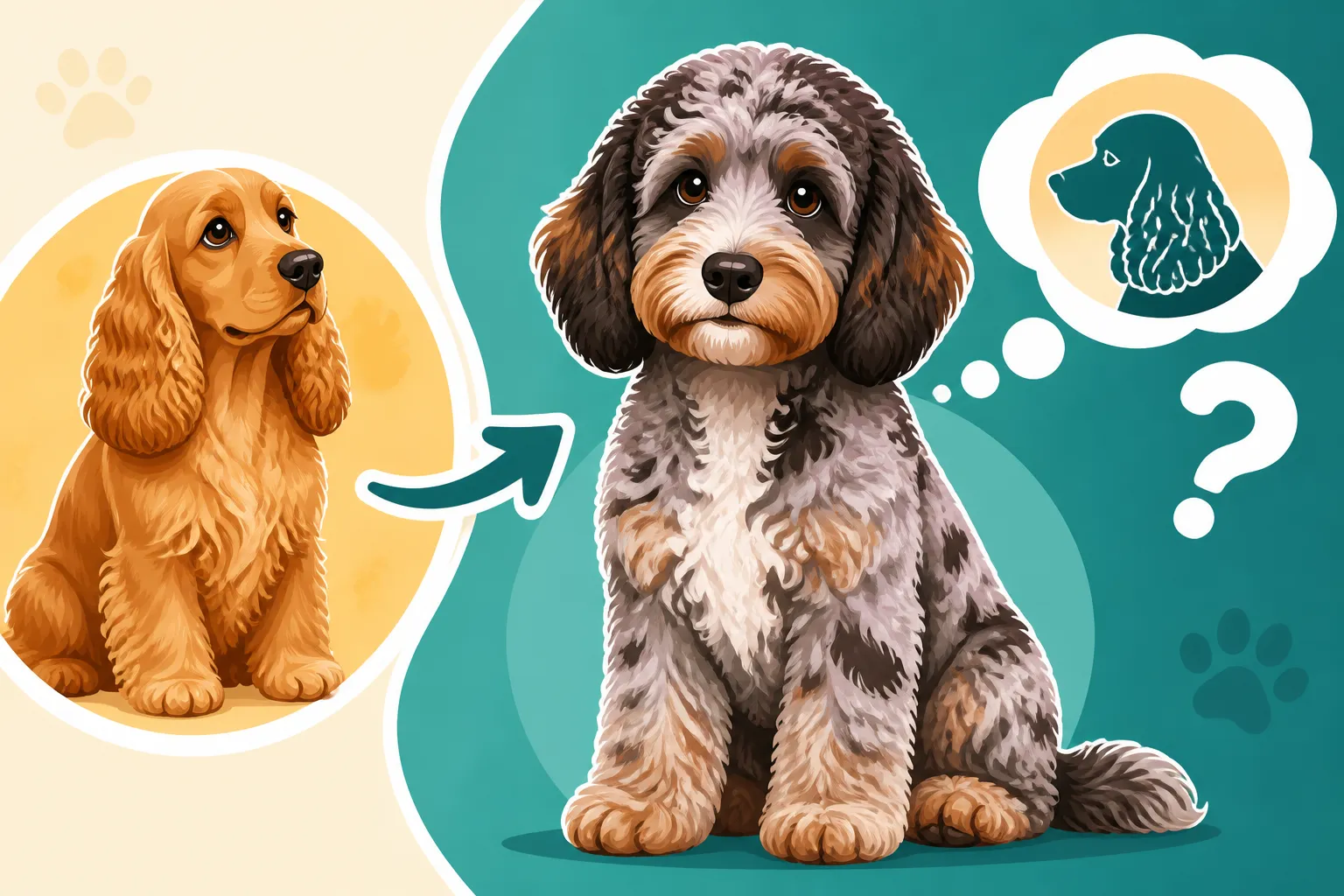
Whether a Roan Cockapoo Comes From the Cocker
A roan Cockapoo can look speckled, softly mottled, or almost solid from a distance, which makes it easy to mistake the pattern for something else. The Cocker Spaniel is a familiar source of roan coloring, but a puppy’s pattern depends on inherited coat genes, not just its breed label. Here’s how to tell what roan means and what to ask a breeder.
What roan means on a Cockapoo
Roan is a pattern, not a single coat color
A roan coat has colored hairs mixed through areas that would otherwise appear white. The result can look like fine flecks, an even sprinkling, or a denser blend of color and white. A blue roan dog, for example, usually has black hairs mixed with white, creating a blue-gray impression from a few steps away. Other roan combinations can look brown, orange, or red-toned.
The pattern may be easiest to see on the body, legs, or face, depending on how the dog’s coat is marked. Some areas can look heavily colored while others remain mostly white. That unevenness is part of why two dogs described as roan may look quite different.
Roan is not a separate base color. It describes how colored hairs and white hairs appear together. If you’re comparing possible colors, The Colors a Cockapoo Comes In gives a broader look at the shades and patterns that can appear in the mix.
Roan is not the same as ticking or merle
Roan and ticking can look similar because both can produce colored flecks on a white background. People often use the terms loosely in everyday conversation, and a puppy’s curl or length of coat can make the distinction harder to see. In general, ticking refers to individual colored spots on white areas, while roan often looks more evenly blended across a larger area. The pattern may not be obvious from a quick glance, especially on a young, fluffy puppy.
Merle is different again. It creates irregular patches of diluted and darker pigment, often with a marbled appearance. A dog with a roan-like coat should not automatically be called merle, and a merle pattern should not be assumed to be roan just because it includes pale areas. If a breeder uses these labels, ask them to explain what they mean and what they know about the puppy’s parentage and coat genetics.
A clear description matters because “speckled,” “blue,” “parti,” and “roan” can be used imprecisely in puppy listings. Photos can help, but lighting, coat length, and camera settings can make colors look quite different. Ask for natural-light photos of the puppy and, if possible, its parents.
The coat can disguise the pattern
A Cockapoo’s coat texture changes how color appears. Loose waves may show individual hairs and flecks clearly, while a tight curl can bunch the hairs together and make the pattern seem more blended. A long, fluffy puppy coat can also hide the precise boundary between colored and white areas.
That’s one reason a young puppy’s coat can be difficult to judge by sight alone. You may see white hairs mixed into a dark patch, but it can be hard to tell whether you’re looking at roan, ticking, or a temporary effect of puppy fluff. The Three Cockapoo Coat Types and Their Upkeep explains how coat texture affects appearance as well as everyday care.
Does roan come from the Cocker Spaniel?
The Cocker is a familiar source of roan
Cocker Spaniels are well known for roan patterns, so the Cocker side is a plausible source of roan coloring in a Cockapoo. If a puppy has a Cocker parent with a clearly roan coat, it is reasonable to ask whether that parent passed on the pattern-related traits.
But a Cockapoo’s appearance is not a simple copy of one parent. Coat patterns depend on inherited combinations, and the puppy’s family history can include traits that are not immediately visible in its parents. A Cocker parent may be roan, but that alone does not tell you exactly how every puppy in the litter will look.
It is also too strong to say that every roan Cockapoo must have received the pattern directly from its Cocker parent. A Cockapoo has both Cocker Spaniel and Poodle ancestry, and the label “Cockapoo” does not, by itself, identify which ancestor contributed each visible coat trait. For a specific puppy, the breeder’s records and knowledge of the parents are more useful than assumptions based on the cross alone.
A parent’s appearance does not guarantee a matching puppy
Even when one parent is visibly roan, littermates may have different colors and patterns. One puppy might have a strong mix of white and colored hairs, another may have larger white patches, and a third may appear mostly solid. Inheritance is not a promise that each puppy will copy the same parent in the same way.
That variation can surprise families who chose a litter based on a photo of the sire or dam. A parent’s coat is useful context, but it cannot reliably tell you exactly how a particular puppy’s coat will develop. Whether Two Cockapoo Littermates Look Alike explores why puppies from the same litter can grow into noticeably different-looking dogs.
Generation can also affect how predictable a Cockapoo’s traits seem. An F1 Cockapoo has one Cocker Spaniel parent and one Poodle parent, while later-generation crosses may have different combinations of Cockapoo and parent-breed ancestry. Those labels describe ancestry, not a guarantee of a particular coat pattern. What the Cockapoo Clubs Mean by F1 and F1b explains what common generation terms mean.
Ask about family history rather than relying on a label
If roan matters to you, ask the breeder what they have observed in both parents and in related dogs. Useful questions include whether either parent is roan or ticked, whether similar patterns appear in earlier litters, and how the breeder distinguishes roan from other markings. A breeder who can discuss the family’s coat variation in a specific, practical way is giving you more useful information than someone who simply promises a certain look.
You can also ask what testing, if any, was done and what the results actually cover. A coat panel may report some coat-related traits, but it does not necessarily predict every detail of a Cockapoo’s adult appearance. What a Cockapoo Coat Panel Actually Reports is a helpful companion if you are reviewing genetic test results.
How roan may change as a Cockapoo grows
Puppy coats can make color hard to read
At eight weeks, a Cockapoo’s coat is soft, fluffy, and often much shorter than its eventual adult coat. That can make a roan pattern appear faint or uneven. A puppy photographed indoors may look darker than it does outdoors, while wet or freshly brushed fur can show a different mix of hairs again.
As the coat grows, the pattern may become easier to notice—or the texture may make it look more blended. The change does not necessarily mean the dog has gained or lost the pattern. It may simply be that the hair length and curl have altered how the colors sit together.
Color can also shift during the transition from puppy coat to adult coat. Some Cockapoos lighten, darken, or develop a different overall impression as they mature. Whether a Cockapoo Puppy's Color Holds covers why a puppy’s early shade may not be its final-looking shade, and Whether a Cockapoo's Coat Is Final at Three is useful for keeping expectations realistic as the dog matures.
Grooming affects visibility, not the underlying pattern
A shorter trim can make white and colored hairs easier to distinguish. A longer coat may soften the contrast and give the dog a more blended look. Neither haircut changes the genetic pattern, but the way the coat is styled can make roan look more or less obvious in photographs and in daily life.
Regular brushing is especially helpful for a Cockapoo with a longer or curlier coat. Mats can clump hairs together and obscure the pattern; they can also be uncomfortable and difficult to remove gently once they tighten. If you are planning a grooming routine, The Comb That Finds Mats a Slicker Misses offers a useful explanation of why a comb can reveal tangles that a brush alone may not catch.
Do not confuse coat change with a health problem
A coat that looks different after a trim, a seasonal shed, or a puppy-to-adult transition is not automatically a cause for concern. However, sudden patchy hair loss, irritated skin, persistent itching, or a change in coat condition deserves attention from a veterinarian. Those signs are different from ordinary variation in color or pattern.
If the coat seems greasy, unusually dry, or smells unpleasant even after a suitable bath, consider the skin as well as the color. A roan pattern does not explain ongoing skin discomfort. Whether a Cockapoo's Coat Sits Greasy or Dry discusses coat feel and skin condition, while a veterinarian can assess symptoms that persist or worsen.
How to assess a roan Cockapoo before choosing a puppy
Use more than one photo
Ask to see photos of the puppy in natural daylight, ideally from several angles. A close-up of the coat can show whether white and colored hairs are mixed together, while a full-body photo helps you understand how the pattern is distributed. If the breeder can share photos of the parents and adult relatives, those may provide helpful context too.
Photos are still only a guide. Camera exposure, indoor lighting, and coat length can all alter how a pattern appears. If you can meet the puppy, look at the coat in person and ask the breeder to describe what they believe the pattern is. A careful answer may include some uncertainty; coat labels can be difficult to confirm from appearance alone.
| What you notice | What it may suggest | What to ask |
|---|---|---|
| Fine colored hairs mixed through white areas | Roan-like or ticked pattern | How does the breeder describe the pattern, and what is known about the parents? |
| Larger, clearly separated colored and white patches | A patched or parti-style appearance may be more likely | Are the markings present in relatives or earlier litters? |
| Irregular diluted and darker patches | Merle may be worth asking about | What does the breeder know about the pattern and the dogs’ ancestry? |
| A pattern that looks different in different photos | Lighting, coat length, or curl may be changing its appearance | Can the breeder provide natural-light photos from more than one angle? |
The table is a starting point, not a way to diagnose coat genetics from a picture. When the distinction matters, ask for the breeder’s explanation and the records they have, rather than relying on a color name in an advertisement.
Be cautious about guarantees
A breeder can describe the puppy’s current coat and explain the parents’ known traits, but promising a precise adult color or pattern is a different matter. Cockapoo coats can change in texture and appearance as they grow. Even a detailed description cannot remove all uncertainty about how the adult coat will look.
A responsible conversation should focus on what is known: the puppy’s current markings, the parents’ coats, relevant family history, and any testing the breeder has actually performed. Ask for written results if testing is mentioned, and check what those results measure. Whether a Breeder Can Guarantee a Cockapoo's Coat gives more context on why a confident prediction is not the same as a guarantee.
Choose the dog, not just the pattern
It is understandable to have a favorite look. Roan can be striking, and families often picture a particular coat when they start searching. Still, color is only one small part of choosing a puppy. Temperament, health information, early handling, and whether the dog’s needs fit your household will matter far longer than the exact balance of white and colored hairs.
A good breeder should be willing to talk about the puppy as an individual, not just as a rare or attractive color. Ask how the puppies are being raised, what the breeder has learned about their temperaments, and what health information is available for the parents. If the conversation keeps returning to coat color while practical questions go unanswered, take your time before making a decision.
For everyday care, choose grooming tools and coat products based on your Cockapoo’s texture and skin needs rather than its color. Chewy can be one place to look for routine supplies such as brushes, combs, and dog shampoo, but ask your groomer or veterinarian if your dog has sensitive skin or a persistent coat problem. Chewy may also be useful when you are comparing basic grooming options; the right tool depends on the coat in front of you, not simply the word “roan.” Check product details and suitability for your dog before buying.
Disclaimer
This article is for general informational purposes only and does not constitute professional advice. Laws, prices and regulations vary by location and change over time. Consult a qualified professional for guidance on your specific situation.