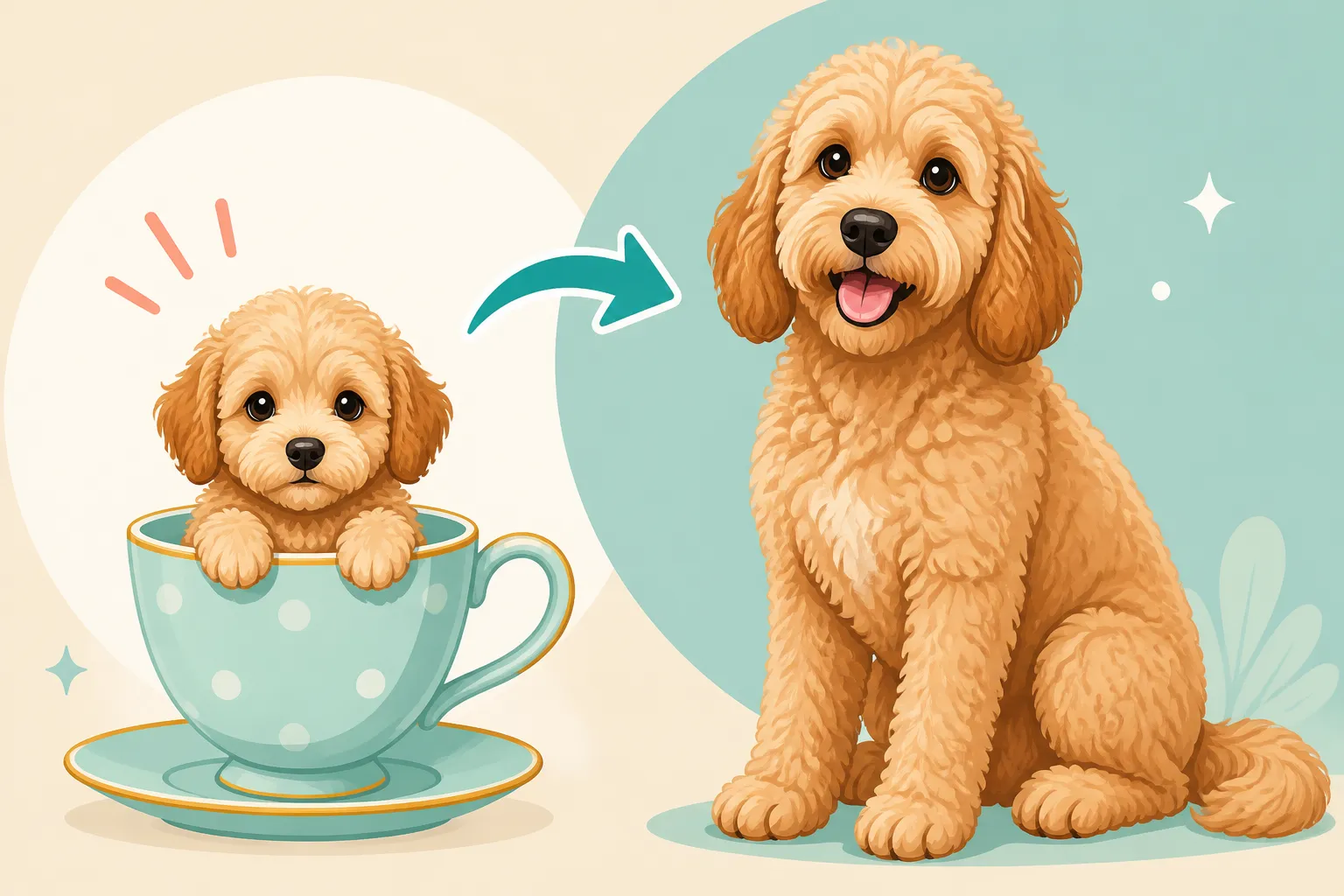
How Big a Teacup Cockapoo Stays
A tiny Cockapoo can look nearly full-grown when it first comes home, which makes it easy to assume it will stay that small. But “teacup” is not a standardized Cockapoo size, and adult weight can be difficult to predict in a crossbreed. This guide explains the likely size range, what affects growth, and how to prepare for a very small dog.
How big does a teacup Cockapoo usually get
What “teacup” means for a Cockapoo
“Teacup Cockapoo” is a marketing term, not a universally agreed size category. Different breeders may use it for dogs they expect to be smaller than a toy Cockapoo, and there is no single official height or weight limit that makes a Cockapoo a teacup. That means two breeders can use the same label for puppies expected to grow to noticeably different sizes.
As a rough guide, a dog sold as a teacup Cockapoo may be expected to weigh somewhere around 5 to 10 pounds as an adult, but some may finish below or above that range. Height estimates are also approximate; a small dog might stand around 8 to 10 inches at the shoulder, but body proportions and the way a breeder measures can vary. Treat these numbers as a ballpark, not a guarantee.
The distinction between teacup and toy is especially blurry. Some breeders use “teacup” to describe the smallest puppies in a toy-sized litter; others use it for a planned cross involving particularly small parents. For a broader look at common size categories, see The Four Cockapoo Sizes and How Big a Toy Cockapoo Gets.
Why an adult-size estimate is never exact
A Cockapoo inherits traits from both a Cocker Spaniel and a Poodle, and puppies in the same litter can grow differently. The size of the Poodle parent matters, but it does not tell the whole story: inherited body structure, the Cocker parent’s size, and the puppy’s own growth pattern all play a part. Even two small parents can have puppies that do not end up exactly alike.
A breeder may offer an estimate based on parent sizes, past litters, and the puppy’s growth to date. That is useful information, but it is still a forecast. Ask what range the breeder expects rather than relying on a precise number, and ask how they arrived at that estimate. A thoughtful breeder should be comfortable explaining the uncertainty instead of presenting a very small adult weight as a promise. For more on the limits of those predictions, read Whether a Cockapoo Breeder Can Promise a Size.
| What to ask or check | Why it helps | What to keep in mind |
|---|---|---|
| The adult weights and heights of both parents | Gives useful context for the puppy’s likely build | A puppy may still grow outside the parents’ exact measurements |
| Adult sizes of earlier puppies from the same pairing | Shows how this particular line has developed | Previous litters are clues, not guarantees |
| The puppy’s growth records | Helps your veterinarian assess whether growth is progressing appropriately | One weight measurement cannot predict final size by itself |
| How the breeder defines “teacup” | Clarifies what the label means in that program | The term has no single universal size standard |
| Health screening and veterinary records | Helps you evaluate care and inherited risks, not just appearance | Small size alone does not indicate good health |
What affects a teacup Cockapoo’s growth
Genetics, parents, and puppy development
The most useful starting point is to learn about both parents. Ask for their adult weights and, if possible, their heights and general build. A petite Poodle parent does not automatically mean every puppy will be tiny; the Cocker side contributes to the mix too. Puppies can also inherit different combinations of traits, so littermates may end up with different frames and adult weights.
A puppy’s age and current weight can offer additional clues, but they should be interpreted with care. Growth charts and online calculators can give a rough estimate, yet they are not a substitute for the puppy’s medical history or a veterinarian’s assessment. A puppy that is unusually small because of poor growth or illness should not be treated as a desirable “teacup” size.
Ask the breeder when they expect the puppy to approach adult height and weight, and whether the estimate reflects actual adult dogs from the same line. Cockapoos do not all finish growing at the same point. For related guidance, see The Age Each Cockapoo Size Finishes Growing and Whether a Cockapoo Outgrows Its Size Class.
Age, nutrition, and health
Small dogs can appear to change quickly in the early months: a little weight gain can make a visible difference on a tiny frame. That does not mean you should try to make a puppy grow faster or keep it unusually small. Feed a complete food appropriate for the puppy’s life stage, follow your veterinarian’s advice on portions, and keep track of body condition as well as the number on the scale.
A healthy puppy should not be deliberately underfed to preserve a petite size. If you can easily feel the ribs but they are not sharply visible, your veterinarian can help you judge whether the puppy’s condition is appropriate. A very small puppy that is lethargic, struggling to eat, failing to gain as expected, or having repeated digestive problems needs veterinary attention—not a smaller food portion or a home growth formula.
The feeding routine may need to account for a small stomach and an individual puppy’s needs. Ask your veterinarian how often to feed and what signs would call for prompt advice. Feeding a Teacup Cockapoo and Whether a Teacup Cockapoo Needs More Frequent Meals cover the practical questions owners often have. Chewy can be one place to compare food formats or find basic feeding supplies, but a retailer’s product listing is not a substitute for nutrition guidance from your vet.
Living with a very small Cockapoo
Everyday safety matters more than the label
A tiny dog can be easier to lift and carry, but its size also makes everyday hazards more serious. A jump off a sofa, a tumble down stairs, or rough play with a much larger dog can be a bigger concern for a small puppy than for a sturdier dog. Use gates where needed, provide stable steps or ramps only when they are safe and appropriate, and supervise interactions with children and other pets.
It helps to teach everyone in the household how to handle the puppy. Support the chest and hindquarters when lifting, and do not let children carry the dog around without an adult. Keep small objects, medications, and foods that may be unsafe for dogs out of reach; a tiny puppy can get into spaces that seem harmless simply because they are close to the floor.
For walks, choose a properly fitted harness and check that the puppy cannot back out of it. A collar with identification can be useful, but avoid attaching a leash to a collar if your veterinarian or trainer recommends a harness for your dog. Chewy may offer a convenient way to compare harness sizes and other basic gear, but fit the item carefully and check it as the puppy grows.
Health and breeding choices deserve close attention
The promise of an exceptionally small dog should never outweigh health and temperament. Breeding for ever smaller bodies can bring welfare concerns, particularly when very small size is pursued at the expense of sound structure or the health of the parent dogs. Ask whether the parents have been screened for relevant health issues, request records, and make time to meet the puppy’s mother when possible. A seller’s use of the word “teacup” is not evidence that the puppy is healthy or that its adult size is predictable.
Be cautious if a breeder focuses heavily on a puppy’s tiny weight while avoiding questions about veterinary care, parent health, or how the dogs are raised. A responsible breeder should be willing to talk about the puppies’ needs, provide health documentation, and explain what support is available if your puppy grows larger than expected. For more on the trade-offs behind breeding for very small size, see What Breeding Ever Smaller Costs a Cockapoo.
If your puppy seems much smaller or less active than expected, contact your veterinarian rather than assuming that is simply its natural size. Regular checkups allow the vet to track growth, assess body condition, and discuss feeding and safety as the dog develops. Chewy may help with routine supplies such as a scale or feeding equipment, but health concerns and growth problems belong in a conversation with a veterinary professional.
How to plan when the adult size is uncertain
Prepare for a range rather than a single number
Before bringing a puppy home, plan for the possibility that it may grow beyond the breeder’s estimate. Choose a crate, carrier, harness, and bed that are safe and adjustable, and check fit as the puppy develops. For equipment that needs to fit closely—especially a harness—avoid buying a large supply in advance. A small dog can outgrow puppy-sized gear, even if it remains petite as an adult.
Budget and household routines should also account for the dog you actually have, not only the size you hope for. A Cockapoo that finishes at the upper end of a “teacup” estimate may still be a small companion, but it may need different equipment and handling than the tiniest puppy in its litter. If you are choosing between size classes, How Big a Miniature Cockapoo Gets can help put those expectations in context.
Questions to ask before choosing a puppy
A few clear questions can reveal whether a breeder is giving a realistic estimate or simply leaning on a catchy label:
- What are the adult weights and heights of both parents?
- What adult size range do you expect for this puppy, and what is that estimate based on?
- How large were adult puppies from previous litters with the same parents?
- Can I review the puppy’s veterinary records and the parents’ health information?
- How do you define “teacup,” and what happens if the puppy grows larger than that estimate?
- What support do you provide after the puppy goes home?
A breeder may not be able to answer every question with certainty, but should be able to answer honestly and show appropriate records. Be wary of pressure to pay quickly or claims that a puppy is guaranteed to stay below an exact weight. An estimate is useful; a promise about a growing dog’s final size is not.
A small Cockapoo can be a lovely companion, but “teacup” should be treated as a loose description rather than a dependable prediction. Focus on the puppy’s health, the parents’ records, and the breeder’s transparency, then work with your veterinarian as the dog grows. That approach is more helpful than chasing a precise adult-weight number.
Disclaimer
This article is for general informational purposes only and does not constitute professional advice. Laws, prices and regulations vary by location and change over time. Consult a qualified professional for guidance on your specific situation.