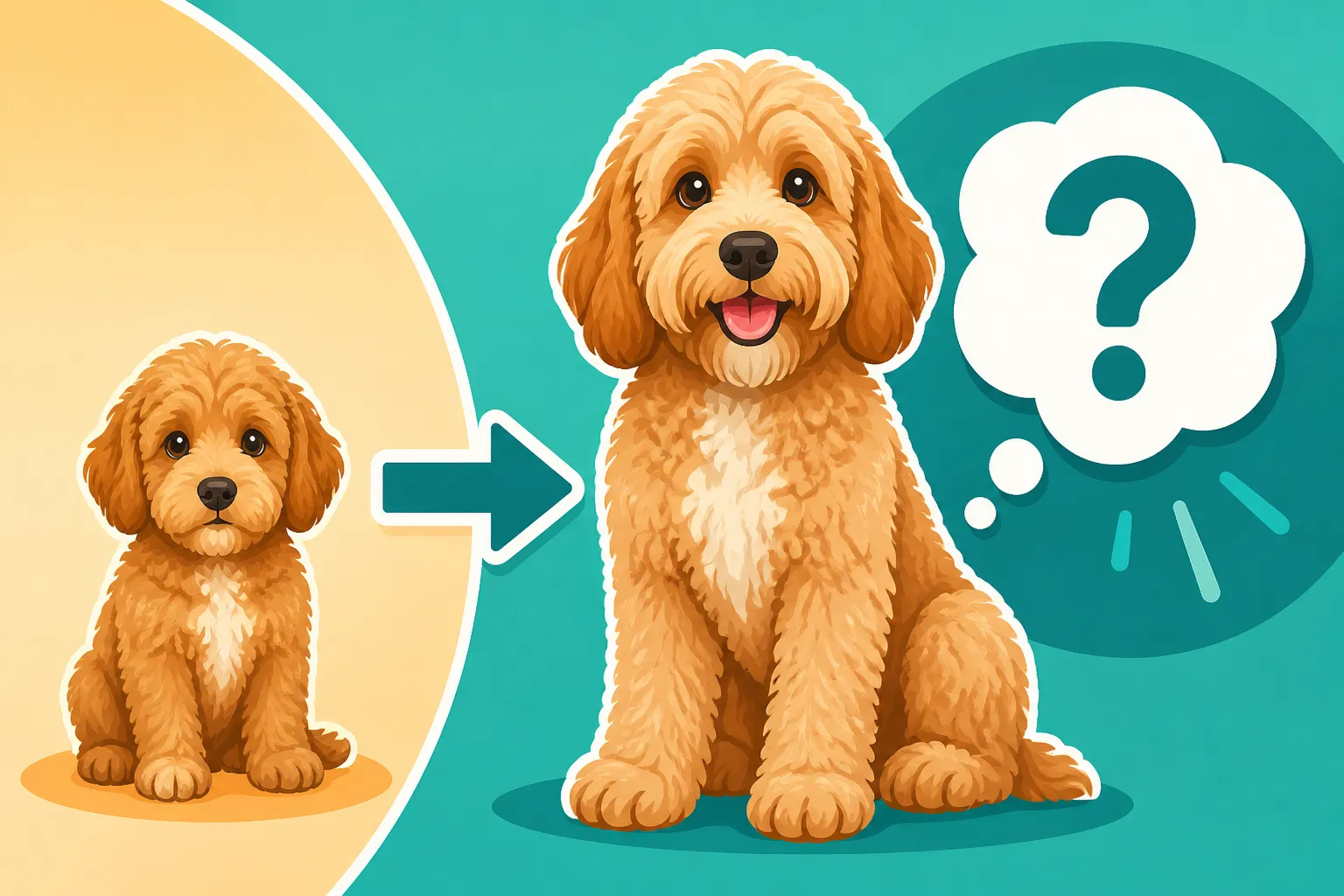
Whether a Cockapoo Outgrows Its Size Class
A Cockapoo can end up larger than the size label used when the litter was advertised, especially when its parents differ in size or its adult weight was only an estimate. That does not necessarily mean anything is wrong. This guide explains why size classes are inconsistent, how to track growth sensibly, and when a surprising change deserves a conversation with your veterinarian.
Why a Cockapoo Can Outgrow Its Size Class
Cockapoo size labels are not universal
“Toy,” “miniature,” and “maxi” are useful shorthand, but they are not guaranteed adult-size categories with one agreed set of boundaries. Different breeders and organizations may use different cutoffs, and some sellers use labels informally. As a result, two breeders might describe similar-sized puppies in different ways.
That makes a size label a starting point, not a promise. A puppy sold as a miniature Cockapoo may grow heavier or taller than the buyer expected and still be a healthy, proportionate dog. Before choosing a puppy, it can help to ask exactly what the breeder means by each size term and what adult weight range they expect for that particular litter. For more context, see The Four Cockapoo Sizes.
| Common label | What it generally suggests | Why it is not a guarantee |
|---|---|---|
| Teacup | A very small Cockapoo | The term is used inconsistently and may not describe a recognized, fixed size class |
| Toy | A smaller Cockapoo | Adult size depends on the parents and the puppy’s inherited traits |
| Miniature | A small-to-medium Cockapoo | The label’s weight or height range can vary between breeders |
| Maxi | A larger Cockapoo | It does not guarantee a specific adult weight or height |
These are informal descriptions, not universal breed measurements. Ask the breeder for the actual adult-size range they expect, and ask how they arrived at it. A clear answer should include information about both parents and, if available, adult relatives—not just a size label on an advertisement.
A Cockapoo inherits a mix of traits
A Cockapoo is a cross between a Cocker Spaniel and a Poodle, but the Poodle parent can vary in size. Even when a breeder plans a particular size pairing, puppies within a litter can inherit different combinations of growth-related traits. One puppy may take after a smaller parent, while a littermate grows taller or heavier.
Generations and pairings can add to the uncertainty. A puppy’s generation label alone does not tell you precisely how large that individual dog will become. For a closer look at the parent traits involved, read What a Cockapoo Inherits From Each Parent and Which Poodle Size Is Used in a Cockapoo.
Parents are useful clues, but they are not a mathematical guarantee. A smaller Cockapoo can come from parents that are not identical in size, and a puppy’s adult build may not be obvious from its appearance at eight weeks. The breeder’s estimate is best treated as a reasoned forecast rather than a contract about the dog’s final dimensions.
Advertised estimates can sound more certain than they are
It is easy to mistake a breeder’s predicted size for a promise, especially when you are comparing listings and trying to picture a puppy in your home. But an estimate is based on limited information: the puppy is still growing, and inheritance does not always produce a predictable blend of its parents.
Ask whether the estimate refers to adult weight, height, or both. A Cockapoo can be within an expected weight range but look taller or longer than you pictured, or appear compact while weighing more than expected because of its build. Whether a Cockapoo Breeder Can Promise a Size covers why even a careful breeder cannot forecast every puppy’s finished size exactly.
How to Tell Whether Your Cockapoo Is Really Growing Beyond the Estimate
Track the pattern, not one weigh-in
A single number on the scale rarely tells the whole story. Weighing your puppy regularly—using the same scale when possible and writing down the dates—helps you see the overall trend. You can also note body condition, appetite, activity, and how the puppy’s harness or collar fits.
At home, a household scale may be awkward with a wriggly puppy. If you are comparing equipment or planning how to measure your dog, Chewy’s size guides may help you understand what measurements a harness or other item requires; follow the individual product’s measuring instructions rather than guessing from weight alone. A brief note in a phone or calendar is often enough to make growth easier to discuss at a veterinary appointment.
Try not to interpret a quick increase as proof that your puppy will become unusually large. Growth can happen unevenly, and a puppy’s weight may change from one check to the next for ordinary reasons. If the trend seems surprising, bring your dated records to your veterinarian so they can assess the puppy’s overall development rather than judging by a single reading.
Compare your puppy with its parents and relatives
If your puppy is growing beyond the breeder’s estimate, ask for the adult weights and heights of both parents. If the breeder knows the size of adult siblings, grandparents, or puppies from related litters, that information can add useful context. It is not a guarantee, but it may help explain why a puppy is tracking toward the larger end of a broad range.
You can also ask the breeder what they observed in the litter. Were several puppies larger than expected, or is yours the outlier? Did they estimate size based on the parents, earlier litters, or a general label? A thoughtful breeder should be willing to talk through the estimate and any uncertainty without treating a normal variation as a problem.
For a sense of how much adult size can vary, Whether a Cockapoo Breeder Can Promise a Size and The Age Each Cockapoo Size Finishes Growing are useful related reads. A puppy’s growth timeline is not always the same as the time when its body has reached its mature shape, so ask your veterinarian what is reasonable for your dog’s age and development.
Pay attention to body condition as well as size
A bigger number does not automatically mean a puppy is overweight. Some dogs are naturally taller, longer, or more heavily built than others. On the other hand, a puppy can be heavier than expected because it is gaining excess body fat, not simply because it has inherited a larger frame.
Your veterinarian can assess body condition and explain how to check your dog’s shape under its coat. This matters with a Cockapoo because a fluffy or curly coat can make it difficult to judge the outline of the body by sight. Avoid cutting food sharply or trying to slow growth on your own in response to a size concern; ask for individual feeding guidance instead.
If you are ordering a harness through Chewy or another retailer, use the dog’s current measurements and check the item’s own fit instructions. A size label such as “small” or “medium” can mean different things across products, just as Cockapoo size labels can vary between breeders.
What to Do if Your Cockapoo Is Larger Than Expected
Recheck the original estimate and your dog’s measurements
Start with the simplest explanation: confirm what the original size estimate meant. Was it a weight range, a height estimate, or just a label? Ask the breeder to clarify and, if possible, provide the parents’ measurements. Then compare those details with your puppy’s growth records and current build.
Measure consistently. For height, your veterinarian or breeder can show you where to measure from and how to keep your puppy standing naturally. For equipment, follow the manufacturer’s instructions, since harnesses may rely on chest and neck measurements rather than height. If an item no longer fits, replace it based on the dog’s present measurements rather than waiting for the next projected size.
When browsing Chewy for a replacement harness or other fitting gear, check the product’s measurement chart and allow for safe adjustment. A harness that is too tight can rub or restrict movement; one that is too loose can shift or allow a dog to back out. The important question is not whether your Cockapoo still fits the original listing’s size label, but whether the equipment fits the dog in front of you.
Keep feeding and exercise decisions individualized
A Cockapoo that grows larger than predicted does not automatically need a different diet or a special exercise routine. Food portions depend on factors such as age, current weight, body condition, activity, and the specific food—not simply whether the dog is called a toy, miniature, or maxi.
If your puppy’s size is changing quickly, ask your veterinarian to review its diet and growth together. This is especially helpful if you are unsure whether to change portions or move from puppy food to adult food. Chewy can be one place to compare food labels and feeding directions, but packaging guidance is general; your veterinarian can help interpret it for your individual dog.
Exercise should likewise suit the puppy’s age, health, and comfort. You do not need to push a puppy into strenuous activity because it is growing into a larger class, nor should you restrict ordinary play just because you expected a smaller dog. If the puppy tires unusually quickly, seems uncomfortable, or has a change in how it moves, ask your veterinarian what activity is appropriate.
Adjust your home plans without assuming something is wrong
Sometimes the practical surprise is more noticeable than the number on the scale. A Cockapoo expected to fit easily in a small carrier may outgrow it, or a dog anticipated to be easy to lift may become too heavy for one person to carry comfortably. Revisit plans for travel equipment, a crate, car restraint, and sleeping space as your dog grows.
If stairs, furniture access, or car entry are part of your daily routine, observe how your dog manages them rather than assuming a larger size will automatically cause difficulty. Make changes where they improve safety and comfort, and ask your veterinarian if you have concerns about movement. Whether a Cockapoo Outgrows Its Size Class is a question about expectations, not a diagnosis: a healthy dog can simply mature into a different size than the label suggested.
For a broader understanding of why adult size can be difficult to forecast, see Whether Generation Changes a Cockapoo’s Size and How Big a Miniature Cockapoo Gets. The key is to plan around your dog’s actual measurements as they develop, not to hold onto a prediction that was never exact.
When a Size Change Deserves Veterinary Advice
Growth alone is different from a health concern
A Cockapoo becoming larger than its advertised class is not, by itself, a sign of illness. But a sudden change in weight, a marked change in appetite, low energy, or difficulty moving is worth discussing with a veterinarian. The same goes for a puppy that seems to be losing weight or whose development worries you, even if its size still matches the breeder’s estimate.
Bring specific observations rather than relying on “he seems bigger.” Record weights with dates, note any changes in food or activity, and describe when you first noticed a difference. Photos taken from the side and above can sometimes help you compare body shape over time, although they cannot replace an examination.
Your veterinarian can interpret growth in light of your Cockapoo’s age, frame, and general health. If the dog is simply growing into a larger build, the likely next steps may be practical adjustments to equipment and feeding guidance. If something else is affecting its weight or condition, an examination can help identify what needs attention.
Use the breeder’s estimate as context, not a verdict
A mismatch between the predicted and actual size can be frustrating, particularly if you chose a puppy because you had limited space or needed a dog you could lift. It is reasonable to ask the breeder how the estimate was made and to discuss what you were told. Keep the conversation focused on the facts: the promised range, the puppy’s current measurements, and any relevant details about its parents.
At the same time, a size estimate cannot eliminate the natural variation that comes with a crossbreed. A larger-than-expected Cockapoo may still be perfectly healthy and a good fit for your household. Your job is to understand the dog’s real needs now and make sensible adjustments as it grows.
If you are still choosing a puppy, meeting adult Cockapoos from the same breeder or related lines can give you a more grounded picture than a label alone. Whether a Cockapoo Breeder Can Promise a Size can help you frame the questions to ask before you commit. And if you already have your puppy, a growth log, an open conversation with the breeder, and a veterinary check when needed are more useful than worrying over the class name.
Disclaimer
This article is for general informational purposes only and does not constitute professional advice. Laws, prices and regulations vary by location and change over time. Consult a qualified professional for guidance on your specific situation.