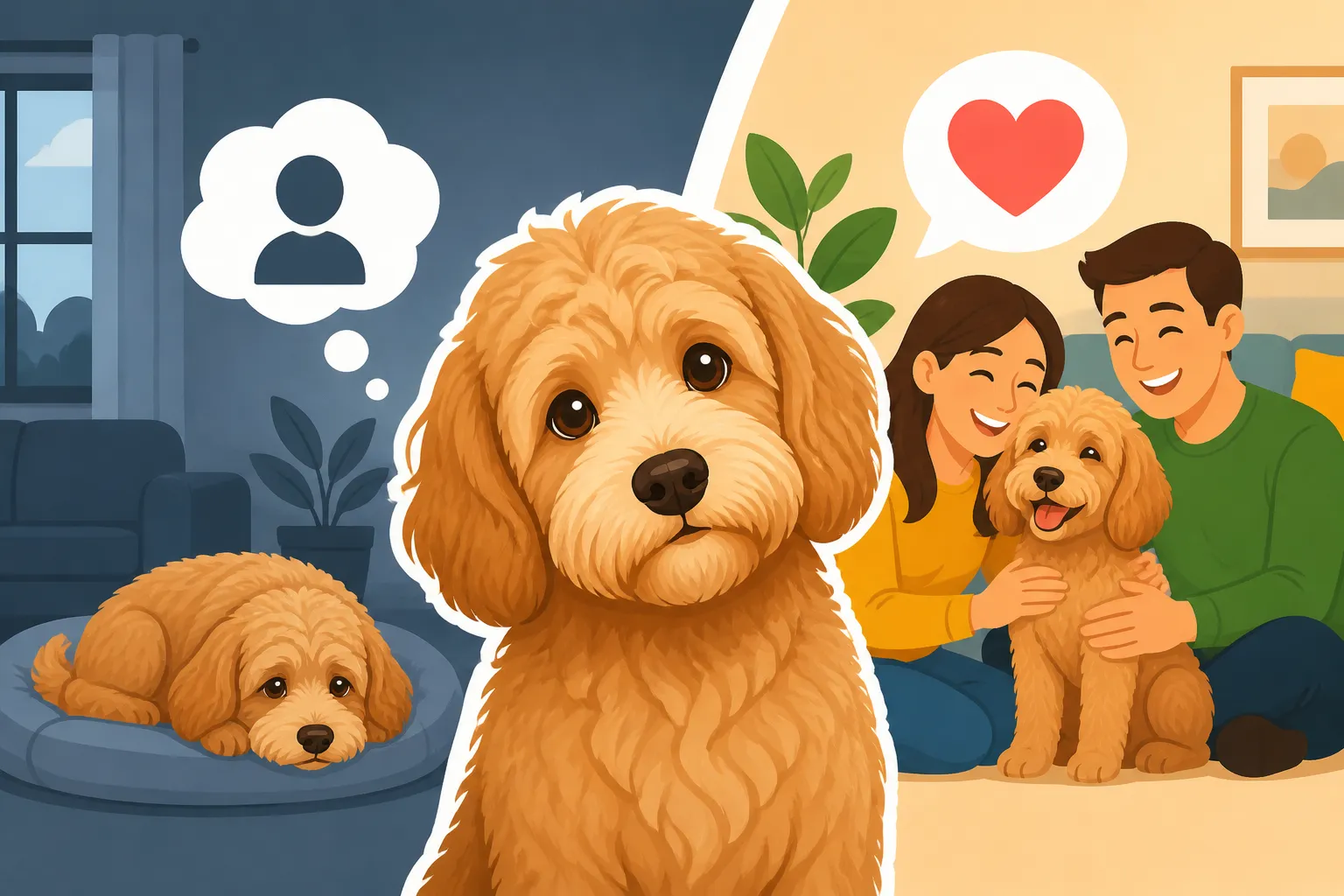
Whether a Cockapoo Needs Company Most of the Day
A Cockapoo may follow you from room to room, then struggle when the house goes quiet. That does not automatically mean you must be home all day or get another dog, but it does mean alone time deserves a plan. This guide explains how much company Cockapoos tend to need, how to spot distress, and how to build a routine that feels safe.
Do Cockapoos need company most of the day
Why many Cockapoos want to be near their people
Cockapoos are often social, people-focused dogs. Their Cocker Spaniel and Poodle backgrounds can both contribute to a dog that enjoys interaction, learns household routines quickly, and notices when its favorite person leaves. Some are content to snooze nearby while you work; others trail you from the kitchen to the bathroom and look unsettled as soon as a door closes.
That affection can be lovely, but it can also make everyday tasks feel complicated. You might be answering emails while a dog paws at your chair, or trying to run an errand after a morning spent together and wondering whether leaving will upset them. A Cockapoo that likes company is not necessarily anxious, though. The important question is whether the dog can relax when you are unavailable.
Breed tendencies are only a starting point. Temperament, early experiences, age, health, exercise, and previous time alone all matter. One Cockapoo may settle for a quiet morning in a familiar room; another may need more gradual practice and help from a person during longer absences. Even dogs from the same litter can respond differently.
If your dog follows you constantly at home, that alone does not prove it has separation anxiety. Some dogs simply enjoy being close. Look at what happens when you leave, and whether your Cockapoo can settle without watching you every moment. A Cockapoo That Follows You Room to Room explores that clingy-at-home behavior in more detail.
A companion is not the same as a cure
It is tempting to think a second dog will solve a Cockapoo’s loneliness. Sometimes another compatible dog provides company, but it does not guarantee that the first dog will feel comfortable when you leave. A dog distressed by separation from its person may still bark, pace, or panic even with a canine housemate present.
A second dog also brings its own needs: introductions, training, exercise, veterinary care, and time alone practice. If you are considering another pet, make that choice because you want and can care for both dogs—not as a quick fix for a problem that may need individual support. A new puppy can add energy and disruption rather than calm, especially if your Cockapoo is already unsettled.
Company can also mean a trusted person checking in, a dog walker, a neighbor, or a suitable daycare arrangement. The right option depends on your dog’s temperament and the length of your absence. For some dogs, a quiet visit and a walk are more helpful than an unfamiliar, busy group setting.
How long can a Cockapoo be left alone
Age and experience make a real difference
A young puppy needs more frequent care and supervision than a settled adult dog. Puppies are still learning where to toilet, what is safe to chew, and how to cope with brief separation. Expecting a newly arrived puppy to manage a long stretch alone before it has learned those skills can lead to accidents, distress, and habits that are harder to change.
An adult Cockapoo may handle some time alone after gradual training, but “adult” does not automatically mean “comfortable for a full workday.” A dog that has always had people nearby may find a sudden change difficult. A rescue dog may also need time to learn that departures are temporary and that the new home is safe.
Senior dogs can have different needs again. They may need more frequent toilet breaks, medication, easier access to water, or help coping with changes in hearing, vision, or mobility. If a previously easygoing older dog becomes distressed when left, consider health changes as well as routine changes and discuss the behavior with a veterinarian.
A practical way to think about time alone
There is no single number that suits every Cockapoo. Instead of treating a maximum duration as a target, assess what your own dog can handle calmly. Look for relaxed behavior: lying down, resting, or quietly engaging with a safe activity. Barking that continues, frantic movement, destructive attempts to escape, or toileting despite being house-trained can signal that the absence is too difficult.
This table can help you choose a starting point for planning. It is a guide to what affects the decision, not a promise that every dog in a category will cope the same way.
| Cockapoo situation | What to plan for | Signs the plan may be too much |
|---|---|---|
| Newly arrived puppy | Very short practice absences, frequent toilet breaks, and close supervision | Persistent crying, panic, repeated accidents, or unsafe chewing |
| Adult learning alone time | Gradual practice that stays below the dog’s distress threshold | Barking, pacing, destructive behavior, or inability to settle |
| Dog accustomed to being alone | A predictable routine, suitable exercise, and a safe resting area | A sudden change in behavior or distress after a routine change |
| Senior dog or dog with health needs | Breaks and care adjusted to mobility, toileting, and medical needs | New restlessness, accidents, confusion, or signs of pain |
If your schedule requires a long absence, build in support rather than hoping your dog will simply get used to it. A midday visit, a dog walker, or help from someone the dog already knows can break up the day. How Many Hours a Cockapoo Can Be Left offers related guidance on planning absences around a dog’s needs.
Signs your Cockapoo is struggling when alone
Watch what happens after you leave
Some signs of distress are easy to miss because they happen when nobody is home. A neighbor may mention repeated barking, or you may return to find a chewed door frame, scratched flooring, or an overturned water bowl. These behaviors can have different causes, so avoid assuming your dog is being “naughty” or trying to punish you.
A camera can help you understand the pattern, provided you use it to observe rather than repeatedly speak through the device if that seems to upset your dog. Notice how soon the behavior starts, how long it lasts, and whether your Cockapoo eventually settles. Brief vocalizing followed by rest is different from prolonged, escalating panic.
Other signs may include pacing, panting when the room is not warm, drooling, trembling, repeated attempts to escape, or refusing a food toy that the dog normally enjoys. Toileting indoors can also happen when a dog is distressed, though medical issues or incomplete house training should be considered too.
If your Cockapoo’s behavior changes suddenly, or you see signs of injury, severe panic, or repeated attempts to break through doors or windows, contact your veterinarian. A health check can help rule out medical contributors, and a qualified behavior professional can help build a plan.
Tell boredom apart from separation distress
Boredom and separation-related distress can overlap, but they are not identical. A bored dog may investigate a bin, chew an accessible object, or make its own entertainment after being left without enough activity. A distressed dog may show fear before you have even gone, remain agitated through the absence, or focus on doors and windows as if trying to reach you.
The difference matters because the solution differs. More exercise and enrichment can help a dog that lacks stimulation, but simply tiring out a dog does not reliably resolve panic. Likewise, giving a dog a food puzzle may help occupy it, but a dog that is too distressed to eat will need a more gradual behavior plan.
Consider the full pattern: Does your Cockapoo become worried when you pick up your keys? Does it settle after a short warm-up, or does the distress intensify? Does it behave differently when another familiar person stays? Notes about these details can help your veterinarian or trainer understand what is happening. Signs a Cockapoo Is Anxious Rather Than Bored looks at this distinction further.
Helping a Cockapoo get comfortable alone
Practise small, calm departures
Start with absences so short that your dog can remain relaxed. That might mean stepping behind a baby gate, closing an interior door briefly, or going outside and returning before your Cockapoo becomes upset. The point is not to test how long the dog can endure. It is to teach that separation is predictable and temporary.
Increase the challenge in small steps, and vary the practice so your dog does not learn that every departure follows the same sequence. If your Cockapoo starts pacing, whining, or fixating on the exit, make the next practice easier. Progress is not always linear; a noisy day, a change in routine, or a particularly exciting event can make a previously manageable absence feel harder.
Keep departures and returns low-key. You do not need to ignore your dog or make greetings cold, but a dramatic goodbye can make the moment feel more significant. Give your Cockapoo a comfortable, dog-safe resting area with water and a familiar bed, and remove anything it might swallow or use to injure itself.
A crate is not automatically the answer. Some dogs find a crate reassuring after positive training, while others become more distressed when confined. Never use a crate as a way to force a panicking dog to endure a long absence. Whether Crate Time Settles a Cockapoo can help you think through when confinement may or may not suit your dog.
Make the routine supportive, not exhausting
Before leaving, offer a toilet break and an age-appropriate chance to move and sniff. A relaxed walk or a few minutes of scent games may help your Cockapoo settle, but avoid turning every departure into an exhausting workout. Dogs still need rest, and a dog who is overtired or overstimulated may have a harder time winding down.
Provide safe enrichment if your dog can use it calmly. A familiar chew or food toy can make an absence more pleasant, but introduce it while you are home first. Check that the item is appropriate for your dog and cannot be chewed into dangerous pieces. Chewy may be one place owners browse for food puzzles or enrichment toys, but choose based on safety, fit, and your dog’s habits—not on the assumption that any toy will prevent distress.
If you are searching for suitable activities, a snuffle mat, a simple scatter feed, or a stuffed food toy may offer gentle mental engagement. Try each option under supervision before leaving your dog alone with it. Some Cockapoos enjoy working for food; others ignore it when they are worried, which is useful information rather than a reason to keep adding more toys.
When an absence is longer than your dog currently manages, arrange human support. A familiar visitor can provide a toilet break and companionship; a dog walker can add exercise; daycare may suit a dog that enjoys other dogs and busy environments. It is fine if daycare is not the right fit. Some Cockapoos would rather rest at home after a one-to-one walk. For enrichment ideas that can be used outside the home, see Scent Games a Cockapoo Never Tires Of.
Get help when practice is not enough
If your Cockapoo panics even during very short separations, repeatedly injures itself, or cannot settle despite careful gradual practice, involve your veterinarian. A veterinary professional can assess health concerns and discuss whether referral to a qualified behavior professional is appropriate. For serious separation-related distress, a tailored plan is usually more useful than trying a string of generic tips.
Do not punish barking, chewing, or accidents after you return. Your dog will not connect a punishment hours later with the behavior, and it can make departures and reunions more stressful. Focus instead on preventing situations that trigger panic while you work on a gradual plan.
It may also help to review the household routine. Has someone recently returned to an office, moved out, or changed work hours? Has a new baby or pet altered where the dog sleeps? A Cockapoo that once managed well may need retraining after a major change. For broader context on the breed’s need for interaction, The Household a Cockapoo Actually Suits and A Cockapoo That Cannot Be Left are useful related reads.
Disclaimer
This article is for general informational purposes only and does not constitute professional advice. Laws, prices and regulations vary by location and change over time. Consult a qualified professional for guidance on your specific situation.