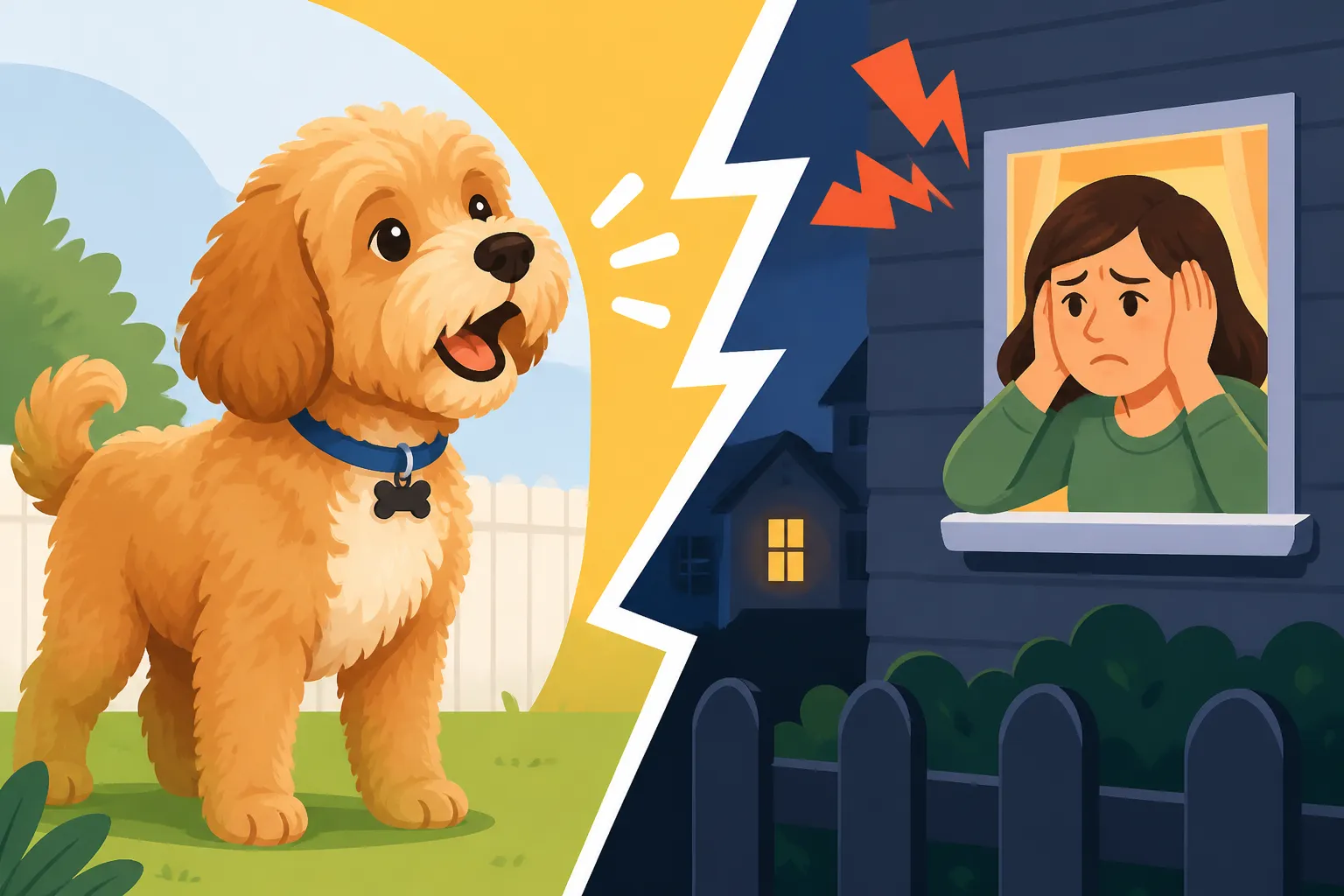
Whether a Cockapoo Barks Enough to Annoy Neighbors
A Cockapoo barking at delivery drivers, hallway sounds, or the dog across the street can quickly become a neighbor problem, especially in an apartment or closely spaced homes. Cockapoos can be vocal, but they are not all constant barkers. This guide explains what tends to set them off, how to judge whether the barking is excessive, and what you can do to reduce it.
How much do Cockapoos bark
There is no reliable rule that every Cockapoo will be quiet or noisy. A dog’s barking depends on temperament, early experiences, daily routine, what it has learned gets a response, and how easily it is startled or frustrated. The Cocker Spaniel and Poodle traits in a Cockapoo can both include alertness, so barking at a sound or movement is not unusual.
That does not mean a Cockapoo is destined to bark all day. Many bark briefly when someone approaches the door and then settle. Others may repeatedly bark at passersby, visitors, or noises from neighboring homes. The difference matters: a few alert barks are not the same as prolonged barking that disrupts sleep or makes you dread leaving home.
Common reasons a Cockapoo barks
Cockapoos may bark to alert you to a person outside, invite attention, express excitement, or signal that they want something. Some bark during play or when they see dogs and people through a window. A Cockapoo left without enough activity may also bark because it is bored or frustrated, although barking alone does not prove that boredom is the cause.
Consider a dog that runs to the window every time someone walks past. If barking makes the person disappear from view, the dog may learn that barking “worked,” even though the passerby was simply continuing down the sidewalk. Similarly, if a dog barks and you immediately talk to it, pick it up, or offer a treat, it may come to expect a response whenever it makes noise.
Anxiety is another possibility, especially if barking happens when the dog is alone or separated from you. A dog that barks, howls, paces, scratches at a door, or cannot settle when left may need help beyond a quick distraction. For a closer look at the signs, see Signs a Cockapoo Is Anxious Rather Than Bored and Whether a Cockapoo Howls When Left.
Is Cockapoo barking louder or more frequent than expected
The useful question is not simply “Does my Cockapoo bark?” It is “How often, for how long, and in what situations?” A short burst when a visitor knocks is different from repeated barking for much of the afternoon. Neighbors may be especially affected by barking that happens early in the morning, late at night, or while the household is away.
Keep a simple record for several days. Note when barking starts, how long it lasts, what was happening just before it began, and what helped it stop. If you are unsure what occurs when you are out, a home camera or a trusted neighbor’s observations can help reveal whether the barking is tied to departures, outside activity, or particular noises. Avoid assuming the dog is quiet just because you do not hear barking from another room.
| Barking pattern | Possible trigger | First thing to check |
|---|---|---|
| A few barks at the door | Visitor or delivery | Can the dog settle once the person comes in or leaves |
| Repeated barking at the window | People, dogs, or moving objects | Does blocking the view reduce the behavior |
| Barking when you leave | Distress, frustration, or learned routine | Does it continue after you are out of sight |
| Barking during play | Excitement or difficulty calming down | Can the dog pause and respond to a cue |
| Barking at household noises | Startle response or alerting | Is the sound predictable, and can the dog recover quickly |
Breed tendencies can offer context, but they cannot predict an individual dog’s behavior. If you are comparing the Cockapoo with a Cocker Spaniel, Whether a Cockapoo Barks More Than a Cocker discusses why individual lines and home routines matter alongside breed background.
When barking may become a neighbor problem
Even friendly, well-loved dogs can create tension when sounds carry through thin walls or across a small yard. The issue is often not a Cockapoo’s occasional alert bark. It is a pattern that continues without a break, happens when nobody is home, or regularly interrupts people nearby.
A neighbor’s complaint can feel embarrassing or unfair, particularly if you have not heard the barking yourself. Try to treat it as useful information rather than a judgment of your dog or your care. Ask for specifics: the approximate time, how long it lasted, and whether it seemed to happen in response to a particular sound. Those details can help you identify the trigger instead of trying random fixes.
Situations that deserve attention
Repeated barking at a window can become a cycle. A dog spots movement, barks, and stays on alert for the next passerby. If that happens throughout the day, moving the dog away from the window or using a barrier to block the view may help more than repeatedly calling its name from across the room.
Barking that starts shortly after you leave deserves a different response. A dog may be reacting to isolation, a change in routine, or distress about being separated. In that situation, leaving a radio on or giving a toy may not address the underlying cause. A veterinarian or qualified behavior professional can help determine whether separation-related anxiety is involved and suggest a gradual plan.
It is also worth acting promptly if barking is new, sharply increased, or paired with signs such as restlessness, pain, confusion, or changes in appetite. Sudden changes in behavior can have more than one explanation. A veterinary check is sensible when the change is unusual for your dog or appears alongside other health concerns.
Keep the neighbor conversation practical
If someone raises a concern, acknowledge it and ask for details without promising an instant fix. You might say that you are tracking the barking and ask them to let you know if it happens at a particular time again. A calm, practical conversation can make it easier to cooperate while you work out what is going on.
Do not rely on punishment because you feel under pressure. Shouting can add noise and excitement, and a dog may interpret your attention as part of the interaction. Bark collars and other aversive tools can also create fear or discomfort without teaching the dog what to do instead. Focus on reducing triggers, rewarding quiet behavior, and making the dog’s routine more manageable.
If you live in a rental or shared building, check the relevant noise and pet rules rather than guessing what counts as a violation. Keep records of the steps you take, including changes to the dog’s environment and training. The aim is not to prove that the dog never makes a sound; it is to show that you are addressing a repeated disruption responsibly.
How to reduce barking in everyday life
Start by changing the circumstances that lead to barking, then teach the behavior you want. A Cockapoo that cannot see every person passing the living-room window has fewer chances to rehearse window barking. A dog that gets a comfortable rest area away from the front door may be less likely to rush toward every hallway sound.
Management is not a shortcut or a failure. It gives your dog fewer opportunities to repeat an unwanted habit while you build new skills. If barking is mainly triggered by movement outside, for example, closing the blinds during busy hours can make training easier. You can gradually reintroduce the view at a distance or for short periods while rewarding calm behavior.
Teach a quiet response without demanding silence
Choose a simple cue such as “quiet” or “thank you,” and use it consistently. When your dog notices a sound, let it give a brief alert if that is acceptable to you. Then calmly redirect it to you, a mat, or another familiar behavior and reward the pause. The goal is for your dog to learn that noticing something does not mean staying on duty indefinitely.
Practice when the trigger is mild. If your Cockapoo is already barking frantically at someone outside, it may be too worked up to learn. Start with a quieter situation, such as a faint sound from another room, and reward a glance toward you or a moment of silence. Keep sessions short and end before your dog becomes overwhelmed.
For a step-by-step approach to cues and reinforcement, see Teaching a Cockapoo to Stop Barking. For dogs that announce every arrival, Whether a Cockapoo Announces Every Visitor can help you think through door-related triggers and routines. It can also help to teach a predictable “go to your mat” behavior, so greeting the door does not become a full-volume performance.
Give the dog outlets and a calmer setup
Exercise and mental activity can help a Cockapoo settle, but more activity is not always the answer to barking. A dog that is overtired or overstimulated may become noisier, not calmer. Aim for a routine that includes walks appropriate to your dog, sniffing opportunities, play, rest, and brief training. Food puzzles and safe chew activities can give a dog something useful to do during quieter parts of the day.
If you are choosing enrichment items, Chewy is one place owners may browse for puzzle toys or food-dispensing options; choose something appropriate for your dog’s size, chewing style, and supervision needs. Introduce a new toy while you are home so you can see how your Cockapoo uses it. A puzzle that is too difficult can frustrate a dog, while a toy that is easy to empty may only occupy the first few minutes.
A predictable resting spot can help too. Set up a bed or crate in a quiet area, if your dog is comfortable there, and reward relaxed behavior. If you are shopping at Chewy for a mat or enrichment item, consider whether it fits the space where your dog will actually settle rather than choosing something simply because it looks appealing. The best setup is one your dog can use safely and consistently.
What to do if barking happens when your Cockapoo is alone
Barking during absences is stressful because you may be at work, in a meeting, or trying to handle errands while worrying about what neighbors hear. It is important not to treat every dog that barks alone as having separation anxiety, but prolonged distress should not be dismissed as misbehavior. The pattern, intensity, and other signs all matter.
Look for the whole pattern
Try to find out what happens before, during, and after you leave. Does barking begin as soon as you pick up your keys? Does it start only after a person walks past the window? Does your dog settle after a few minutes, or continue for most of the absence? Does it also pace, drool, scratch at exits, refuse food, or have accidents despite being house-trained?
A camera can help clarify the timeline, but it should be used to understand behavior rather than to keep checking anxiously every few minutes. You can also ask a trusted person to listen or observe from outside. If the barking continues for long stretches or comes with signs of distress, discuss it with your veterinarian. A qualified behavior professional can help design a gradual absence plan.
For more on building comfort with separation, see Building a Cockapoo's Tolerance for Being Alone. If your household is away for much of the day, Whether a Cockapoo Suits a Home That Works Full Time may also help you think through supervision, company, and routine before the problem escalates.
Make departures less abrupt and training more gradual
For some dogs, it helps to practice very short departures that end before distress begins. That might mean stepping outside for a moment and returning calmly, then building up in small increments over time. The right pace depends on the dog. If your Cockapoo begins barking or panicking, the step may have been too difficult, and repeating longer absences can make the pattern harder to change.
Keep departures and returns low-key. Provide a safe, familiar resting area and make sure your dog has had a chance to toilet and move around. A food toy may be useful for a dog that can comfortably eat when alone, but it is not a substitute for gradual training when separation is the main trigger. If your dog cannot eat or settle once you leave, take that seriously rather than repeatedly increasing the duration.
Chewy may be useful when looking for basic enrichment supplies, but choosing a toy alone will not resolve anxiety. If you are considering a product there, check the size, materials, and supervision guidance, and introduce it while you are present first. For a dog whose barking reflects distress, veterinary and behavior support should guide the plan.
Cockapoos can bark enough to bother neighbors, especially when they are repeatedly reacting to outside activity or struggling with time alone. But barking is not inevitable, and it does not mean your dog is stubborn or “bad.” Pay attention to the pattern, manage the triggers you can control, and reward the calm behavior you want to see more often. If the barking is intense, prolonged, or linked to distress, seek professional guidance rather than waiting for the neighbors to raise the issue again.
Disclaimer
This article is for general informational purposes only and does not constitute professional advice. Laws, prices and regulations vary by location and change over time. Consult a qualified professional for guidance on your specific situation.