Whether a Cockapoo’s Curl Can Be Predicted at Birth
One of the biggest questions and, let's be honest, sources of anxiety for hopeful Cockapoo owners is whether their adorable little fluffball will have that signature wavy or curly, low-shedding coat. It's a common frustration to fall in love with a particular look only to find their puppy's coat is nothing like what they imagined. This guide will delve into the fascinating genetics behind a Cockapoo's curl, what breeders can tell you, and how to navigate the sometimes surprising journey of your puppy's developing coat.
The Genetic Dance Behind Your Cockapoo's Curl
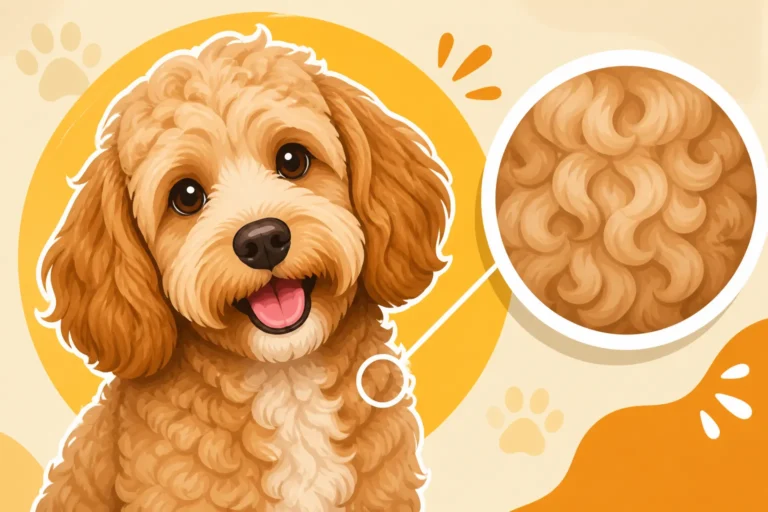
Understanding your Cockapoo's coat curl really comes down to a bit of genetic detective work, specifically involving a gene called KRT71. It sounds complicated, but think of it as a set of instructions that tells a dog's hair follicles how to grow. In Cockapoos, because they are a cross between a Cocker Spaniel (which typically has a flatter, wavy coat) and a Poodle (famous for its tight curls), the combination of these genes can result in a wide spectrum of coat types.
The KRT71 gene has different variants, and dogs inherit two copies of this gene, one from each parent. The main variants we talk about for curl are often represented as 'C' for curly and 'c' for straight or wavy. A dog with two 'C' copies (CC) will likely have a very curly coat, while a dog with one 'C' and one 'c' (Cc) will typically have a wavy coat. A dog with two 'c' copies (cc) will often have a straighter coat.
Now, here's where the early prediction gets tricky. For an F1 Cockapoo, meaning a first-generation cross directly from a purebred Cocker Spaniel and a purebred Poodle, the Cocker typically contributes the 'cc' variant (straight/wavy) and the Poodle typically contributes the 'CC' variant (curly). This means an F1 Cockapoo is almost always 'Cc' by default, resulting in that lovely, often highly sought-after wavy coat. However, even within this, there can be variations in just how wavy it is.
Things get even more complex with F1b (Cockapoo bred back to a Poodle) or multi-generational Cockapoos. If an F1 Cockapoo (Cc) is bred with a Poodle (CC), some puppies could be CC (very curly), and some could be Cc (wavy). If two F1 Cockapoos (both Cc) are bred, you could theoretically get CC, Cc, or even cc puppies. This means predicting the curl at birth purely by looking at them can be a real gamble, especially in later generations where the genetic possibilities are wider. It’s why responsible breeders are increasingly using Whether a Coat DNA Test Is Worth the Money to ensure more predictable outcomes, particularly for families seeking specific coat types for allergy reasons.
The Role of DNA Testing in Coat Prediction
For serious breeders, genetic testing of the parent dogs is the gold standard for predicting a puppy's coat type. These tests, often offered by specialized canine genetics labs, can analyze the KRT71 gene (and other coat-related genes like the furnishings gene, which affects the beard and eyebrows) of both the sire and dam. Knowing the genetic makeup of the parents allows a breeder to predict, with a high degree of accuracy, the statistical probability of each coat type appearing in a litter.
For example, if a breeder tests both parents and knows one carries two copies for curl (CC) and the other carries one curl and one wavy (Cc), they can confidently tell you that all puppies will either be very curly (CC) or wavy (Cc). There would be no straight-coated puppies in that litter. This kind of transparency is invaluable for prospective owners who might have specific preferences or needs, such as managing allergies, which are often linked to coat type.
However, many hobby breeders, especially those with F1 litters, might not run extensive coat panels. They might simply rely on the visual assessment of the parent breeds. While this works for the general F1 wavy expectation, it doesn't give precise information about the degree of curl or other important coat features like furnishings. If you're looking for a very specific coat type, asking about the parents' What a Cockapoo Coat Panel Actually Reports is a great question to put to any breeder.
What You See in a Cockapoo Puppy Is Not Always What You Get
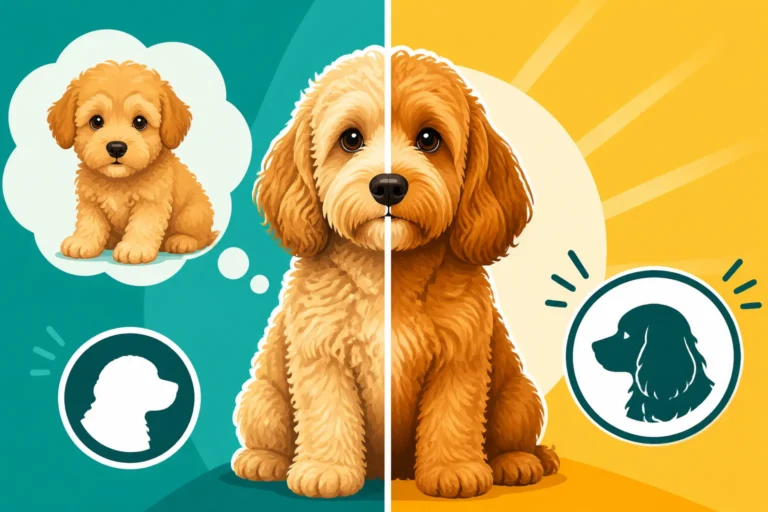
It’s incredibly tempting to look at an eight-week-old Cockapoo puppy and imagine exactly what their adult coat will look like. Their puppy fluff is utterly adorable, often soft and somewhat wispy. However, this is one of those classic "don't judge a book by its cover" situations. A puppy's coat at birth, and even up to a few months old, can be vastly different from its adult coat.
New Cockapoo owners often experience what's known as the "coat change," a period usually starting around 6-10 months of age, where their puppy's soft, easy-to-manage fur begins to transition into the more dense, adult coat. This can be a challenging time, as the maturing coat often mats very easily and requires diligent grooming. A Cockapoo's Coat Through the Ten Month Change details this challenging period. During this transition, a puppy that looked relatively straight-haired might develop significant waves, and a wavy puppy might become quite curly. The true texture and density of their adult coat won't fully emerge until they are closer to 18 months to two years old.
So, while a breeder might give you their best guess based on the parents' genetics or even the puppy's early appearance, there are no absolute guarantees for coat texture and curl tightness until the coat change has run its course. It's a bit like trying to predict a teenager's final height from their toddler years – you can get a general idea, but growth spurts and genetic factors mean surprises can happen!
Early Visual Clues and Their Limitations
When you visit a litter of Cockapoo puppies, you might notice some subtle differences in their coats even at a young age. Some might appear fluffier, some might have a straighter look, and others might show early signs of wave. However, these are merely indicators, not definitive pronouncements.
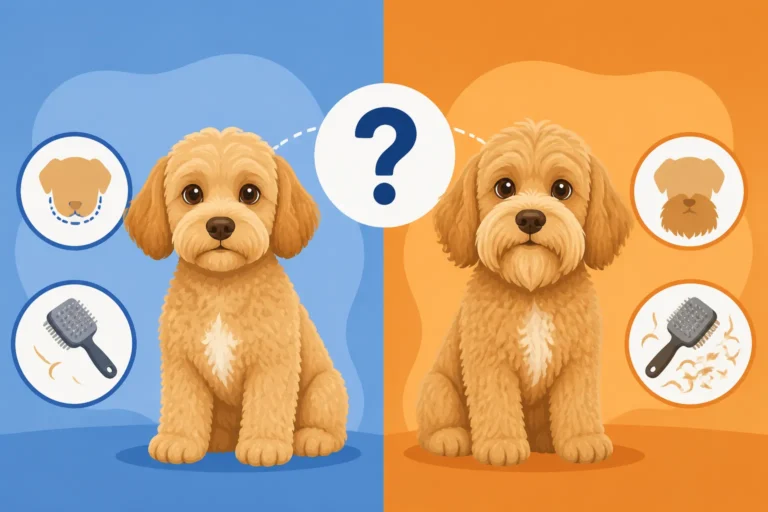
A puppy with a very flat, sleek coat at eight weeks might indeed develop into a straight or very wavy adult. Conversely, a puppy with a noticeable fluff or slight wave could deepen into a curlier coat. The main thing that’s visually indicative early on is the presence of "furnishings" – the longer hair on the muzzle, eyebrows, and legs. What Furnishings Look Like on a Cockapoo explains this in detail. If a puppy lacks these furnishings (often called an "improper coat"), it will likely shed more and have a flatter, more Cocker-like face. Furnishings are generally very apparent even in young puppies. However, furnishings are a separate genetic trait from curl, though they often go hand-in-hand with the low-shedding quality people desire.
Here’s a simple table to illustrate the general coat types and their common genetic pairings, keeping in mind that the degree of curl or wave can still vary:
| Genetic Makeup (KRT71) | Expected Curl Type | Visual Characteristics (Adult) | Shedding Tendency | Common for Cockapoos (F1, F1b, etc.) |
|---|---|---|---|---|
| cc | Straight to Mildly Wavy | Flat, sleek, less volume, may or may not have furnishings. | Moderate to High | Possible in F2+, less common in F1 |
| Cc | Wavy (Loose to Medium Curl) | Wavy, often shaggy, good volume, usually has furnishings. | Low | Most common for F1, F1b |
| CC | Curly (Tight to Very Tight Curl) | Dense, springy, tight curls, significant volume, always has furnishings. | Very Low | Common in F1b, F2+ |
Note: This table simplifies the genetics for clarity. Other genes also influence coat texture and length.
It’s important to remember that a puppy's coat is a living, changing thing. Diet plays a role in its health and shine, and good nutrition, perhaps from brands like Ollie that focus on fresh ingredients, can contribute to a healthy coat. Regular grooming from products you can find on Amazon or Chewy is also essential, regardless of the curl type, to prevent matting and keep the skin healthy.
The Long Journey to a Cockapoo's Adult Coat
The journey from a fluffy puppy to a fully grown Cockapoo with its mature coat is often a surprising one for first-time owners. As mentioned, the "coat change" is the most significant phase. This isn't just a slight adjustment; it's a profound transformation where the puppy fur gives way to the more robust adult coat. This period typically begins between six and ten months of age, and it can last for several months, often not fully settling until the dog is around 18 months to two years old.
During this time, you might notice the coat becoming denser, feeling different to the touch, and appearing either wavier or curlier than before. It's also when matting becomes a major challenge. The intertwining of the old puppy coat with the new adult coat creates prime conditions for tangles and mats that can quickly become severe if not managed daily. Many owners are genuinely caught off guard by the intensity of this grooming requirement. They might have envisioned their wavy Cockapoo as a wash-and-wear dog, only to find themselves brushing for an hour every day just to keep mats at bay. This is why The Coat Change That Ambushes a Cockapoo Owner at Ten Months is such a crucial topic.
If you are hoping for a very specific coat type, or if allergies are a significant concern in your household, it's vital to discuss this in depth with any potential breeder. A reputable breeder will be honest about the variability and the reality of the coat change. They will often share genetic test results and provide photos of past puppies from the same lines as adults, giving you a better idea of what to expect.
Managing Expectations for Your Cockapoo's Developing Coat
The best approach for any Cockapoo owner is to embrace the variety and potential for change in their dog's coat. While DNA testing can give you a strong prediction for curl, the exact look – how tight the curls are, how shaggy the waves become, or how much volume there is – will evolve.
If you're buying an F1 Cockapoo, you're usually looking at a wavy coat. The exact degree of waviness can vary. Some will have loose, flowing waves, while others will have tighter, more springy waves that approach a curl. For F1b or multi-generational Cockapoos, the possibilities expand, as discussed earlier. If you're hoping for a very curly, low-shedding dog, an F1b Cockapoo from a reputable breeder who tests for the KRT71 gene would be your most predictable option.
Ultimately, predicting a Cockapoo’s curl at birth is more art than science without genetic testing. With testing, it becomes much more scientific. But even then, the precise aesthetics of the curl or wave will become fully apparent over time, as your puppy grows and matures. The most important thing is to be prepared for the grooming commitment, regardless of the exact curl. Every Cockapoo, from the straightest to the curliest, requires regular brushing and professional grooming appointments to keep their coat healthy and mat-free. This commitment is key to a happy, comfortable Cockapoo.
Disclaimer
This article is for general informational purposes only and does not constitute professional advice. Laws, prices and regulations vary by location and change over time. Consult a qualified professional for guidance on your specific situation.