Whether a Cockapoo Will Follow a Scent Out of the Yard
A Cockapoo can follow an interesting scent beyond the yard, even if they usually stay close to you. A rabbit trail, food smell, or passing dog may be compelling enough to make a familiar boundary seem unimportant. This guide explains why it happens, how to make your yard and routines safer, and what to do if your dog slips away.
Why a Cockapoo May Follow a Scent
A good nose can outvote a familiar routine
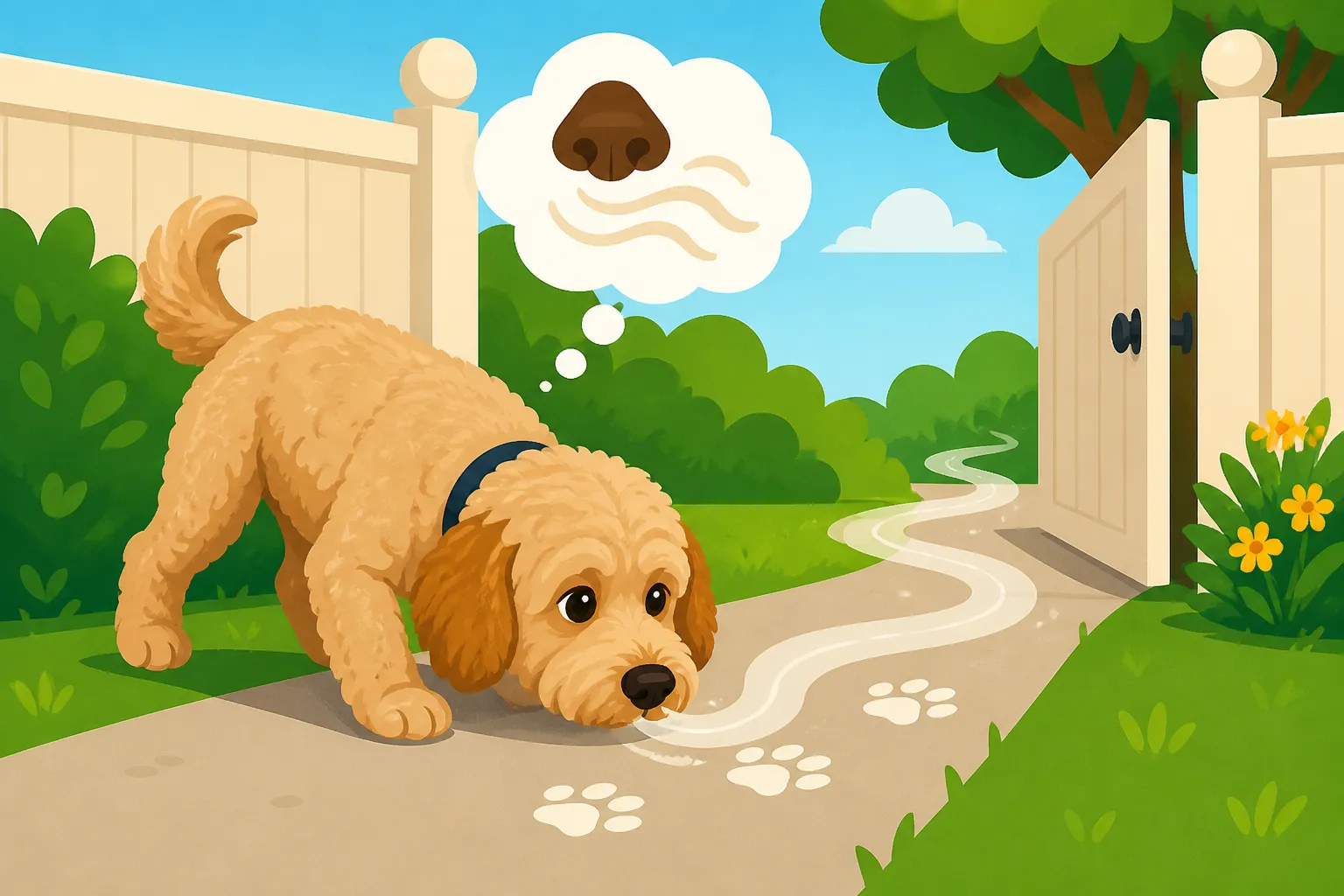
Cockapoos are a cross between a Cocker Spaniel and a Poodle, and either parent may contribute curiosity, energy, and a strong interest in the world around them. Some Cockapoos are especially quick to investigate smells. A rabbit crossing the lawn, a squirrel moving along the fence, or food left near the sidewalk can grab a dog’s attention before they have time to respond to your call.
This does not mean every Cockapoo will roam, or that a dog with a reliable recall is guaranteed to stay close. Scent-following varies with the individual, the surroundings, training, and how exciting the smell is. A dog who normally checks in may still make a poor decision when they catch a fresh trail.
You may notice the pattern on walks first: your Cockapoo lowers their nose, moves in zigzags, and becomes less responsive while investigating. That behavior connects to the spaniel side’s history of searching for game. For a closer look at that instinct, see The Flushing Drive Still Alive in a Cockapoo and Whether a Cockapoo Hunts With Its Nose Down.
A boundary is not always a boundary to a dog
People understand that a fence marks the edge of the yard. Dogs may understand the same limit when they are calm and familiar with the space, but that learned habit can compete with a sudden distraction. A scent trail may lead toward a gap under a fence, an open gate, or a spot where the dog can squeeze through.
Some Cockapoos also chase moving animals or rush to greet people and dogs. The trigger may be a scent, a sound, or a combination: a rabbit’s trail leading to the hedge, for example, or the smell of another dog near the front gate. A dog who has not previously escaped can still discover an opportunity in a moment when a gate is left ajar.
It helps to separate “usually stays in the yard” from “cannot get out.” The first describes a pattern. The second requires reliable physical safeguards, supervision, and training. If your dog’s attention drops sharply around birds, rabbits, or other distractions, Whether a Cockapoo Ignores You Once It Scents Something can help you think through that specific challenge.
Breed tendencies are clues, not predictions
A Cockapoo’s generation, size, and parent lines do not let you predict exactly how they will behave around every scent. One dog may spend most of a walk sniffing flower beds and then come back when called; another may lock onto a rabbit trail and keep going. Individual experience matters, too. Dogs who have rehearsed chasing or wandering may be more likely to repeat it.
Instead of trying to guess whether your Cockapoo is “the kind that runs,” watch what happens when they notice a smell. Do they pause and look back? Can they turn away when you call? Do they remain responsive when there is a squirrel nearby? These observations give you more useful information than a general breed label.
Treat a strong interest in scent as a training and safety consideration, not a character flaw. Sniffing is normal dog behavior. The goal is to give your Cockapoo safe opportunities to explore while making it harder for one exciting trail to turn into an escape.
How to Make the Yard Safer
Check the fence and gate as if your dog is testing them
Walk the yard at your Cockapoo’s eye level and look for routes out: loose boards, gaps beneath the fence, a damaged latch, spaces beside a shed, or places where outdoor furniture creates a launch point. Small dogs may fit through surprisingly narrow openings, while agile dogs may climb or jump more readily than you expect. Check the full perimeter rather than focusing only on the spot where your dog spends time.
Give gates special attention. Confirm that they close and latch securely, and build a household habit of checking them every time someone enters or leaves. If children, visitors, or delivery workers regularly use the gate, consider a simple routine such as asking one person to be responsible for confirming it is closed. A gate that is normally shut is still an escape route if it is sometimes left open.
Do not assume an electronic boundary will reliably stop a dog who is highly motivated by a scent. A boundary system does not block wildlife, prevent another animal from entering, or physically keep your Cockapoo inside. For a dog with a history of chasing or slipping away, a secure physical enclosure and adult supervision provide a more dependable foundation.
Supervise outside time, especially near tempting routes
Supervision means being present and paying attention, not simply being somewhere in the house while your dog is in the yard. If your Cockapoo tends to patrol the fence, investigate shrubs, or race toward the gate, stay close enough to interrupt and redirect before they build momentum. A short, supervised yard break may be safer than leaving the dog outside alone for a long stretch.
You can also make the yard more engaging without encouraging unsupervised roaming. Scatter a portion of your dog’s daily food in a safe area for a sniffing game, hide treats in easy-to-find spots, or rotate toys. Keep activities calm and controlled near boundaries, and put away food or waste that could attract wildlife or create a new scent trail.
For supplies such as a sturdy leash, a well-fitted harness, or identification tags, Chewy is one place owners may look when comparing everyday pet essentials. Whatever you choose, check the fit and condition regularly; equipment is only useful if it stays secure and comfortable.
Use management while recall is still developing
If you are unsure whether your Cockapoo will come back when called, do not test that uncertainty by letting them roam freely in an unfenced area. Use a leash or a long line in open spaces, and keep your dog attached to you when gates are being opened. A long line gives room to sniff while preserving your ability to prevent a sudden dash.
A line should be used with care. Avoid letting it trail where it can snag on branches, furniture, or other dogs, and do not wrap it around your hand. A well-fitted harness is often more comfortable for controlled exploration than attaching a long line to a collar, but ask your veterinarian or a qualified trainer for guidance if your dog has medical or handling concerns.
Management is not a substitute for training; it prevents a dangerous mistake while training takes hold. For more detail on practicing with distance safely, see Working a Cockapoo on a Long Line. If you are deciding whether a particular setting is appropriate for off-leash time, Whether a Cockapoo Should Be Off Leash in Woods is a useful related read.
How to Train a Cockapoo to Turn Away From a Scent
Build recall in easy places before adding distractions
Start indoors or in a quiet part of the yard, where your Cockapoo can succeed. Say your recall cue once in a cheerful voice, then reward the dog generously when they turn toward you and arrive. Use something your dog genuinely values, such as a favorite treat, a brief game, or enthusiastic praise. Calling repeatedly while the dog ignores you can teach them that the cue is background noise.
Make practice short and frequent. Call from a few steps away, reward, and release your dog to resume sniffing. That release matters: it shows that coming back does not always mean the fun is over. As your dog becomes reliable, increase distance and introduce mild distractions gradually rather than jumping straight to a busy park or a rabbit-filled field.
If your Cockapoo is already absorbed in a smell, they may not be ready for the same cue they answer in the kitchen. Lower the difficulty: move closer, use an upbeat voice, and reward the smallest sign of turning back. A dependable recall is built through repetition and good timing, not by expecting one command to overcome every distraction.
Reward check-ins and teach a cue for turning away
Reward your dog whenever they look back at you on a walk without being called. This teaches the useful habit of checking in, rather than waiting until they are already far away. Keep the reward meaningful, and sometimes let your dog return to sniffing after checking in. That balance makes staying connected worthwhile without removing the pleasure of exploring.
You can also teach a separate cue that means “leave that and come with me.” Begin with a mild distraction at a distance. Say the cue, encourage your dog to turn, and reward them as soon as they disengage. Gradually practice around stronger smells while using a leash or long line so your dog cannot rehearse bolting after the scent.
Do not punish your dog for returning, even if you feel frustrated about the escape. If the dog comes back and then gets scolded, they may hesitate to return next time. Instead, reward the return, secure them safely, and adjust the setup so the same escape is less likely. For a step-by-step approach to recall practice, see Building a Recall a Cockapoo Answers and Teaching a Cockapoo to Check In on a Walk.
Use realistic practice around wildlife and outdoor distractions
Training around scent is not just practicing when nothing is happening. Once your Cockapoo has a foundation, work at a distance from manageable distractions. Your dog might watch a bird across a field while still being able to turn toward you. Reward that choice. If they cannot respond, you are too close or the distraction is too intense; increase distance rather than repeating the cue louder.
Do not use a live animal as a test. A rabbit or squirrel can move unpredictably, and a chase can become dangerous for your dog, wildlife, and nearby road users. Practice around less intense distractions first, keep your dog on leash or long line, and gradually build their ability to notice a smell without being pulled toward it.
Be especially cautious in unfenced areas near roads, parking lots, waterways, or livestock. A dog who has a strong interest in wildlife may be better suited to a secure exercise area than an open field, even after training. For another common trigger, read Whether a Cockapoo Bolts After Birds.
What to Do if Your Cockapoo Gets Out
Stay calm and make returning feel safe
If your Cockapoo runs off, your instinct may be to chase. That can turn the situation into a game or push the dog farther away, especially if they are already focused on a scent. If it is safe, stay calm, use a familiar upbeat recall, and move in the opposite direction or crouch down to encourage your dog to come toward you. Avoid shouting in a way that may frighten or further excite them.
Do not run into traffic or follow your dog into unsafe terrain. Ask another adult to watch the gate or stay near the last place the dog was seen, while someone else checks nearby paths and likely routes. If your Cockapoo is wearing a collar with current contact details, keep your phone available and answer unfamiliar calls.
Once your dog is back, check them for cuts, limping, burrs, ticks, or signs of overheating or distress. Contact a veterinarian if they appear injured, ill, unusually tired, or may have eaten something unsafe. After the immediate situation, look for the escape route and change the setup before allowing another unsupervised yard visit.
Make identification and a recovery plan part of prevention
A secure collar with current contact details and a registered microchip can improve the chances of being reunited if your dog gets loose. Check that the contact information is accurate and that the collar fits properly. Keep a clear, recent description of your Cockapoo, including identifying markings, so you can share accurate details quickly if needed.
If your dog is missing, contact local animal shelters, veterinary clinics, and animal-control services, and share a recent photo with nearby community groups. Include the exact area and time last seen, along with a phone number that someone will answer. Ask people not to chase the dog if they spot them; a sighting location and calm approach may be more useful.
You can find identification supplies and other everyday pet items through retailers such as Chewy, but the important step is making sure information is current and equipment is actually worn. A tag in a drawer cannot help someone reach you. Build the recovery plan before you need it, and keep a leash near the door or gate so you can secure your Cockapoo promptly.
| Situation | Safer response |
|---|---|
| Your dog sniffs intensely in the yard | Supervise closely and redirect before they reach a boundary |
| You are unsure about recall outdoors | Use a leash or long line in open areas |
| A gate is being opened | Secure the dog away from the opening first |
| Your dog notices wildlife | Increase distance, reward attention back to you, and prevent chasing |
| Your Cockapoo gets out | Stay calm, avoid chasing, call in a familiar voice, and check nearby risks |
| Your dog is found after roaming | Check for injury, secure them, and inspect the escape route |
Disclaimer
This article is for general informational purposes only and does not constitute professional advice. Laws, prices and regulations vary by location and change over time. Consult a qualified professional for guidance on your specific situation.