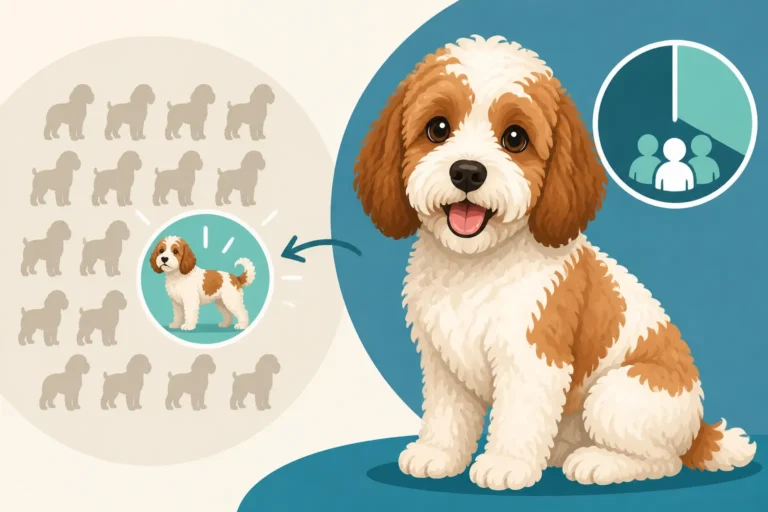
Whether Generation Changes a Cockapoo’s Size
A Cockapoo’s generation can offer clues about its likely adult size, but it cannot tell you exactly how big your puppy will get. An F1, F1b, or multigenerational label describes ancestry, not a guaranteed height or weight. This guide explains what those labels mean, why parent size matters more, and how to make a sensible estimate without treating a guess as a promise.
What Cockapoo generations can and cannot tell you
F1, F1b, and multigenerational labels describe ancestry
An F1 Cockapoo is generally the first-generation cross between a Cocker Spaniel and a Poodle. An F1b is usually a Cockapoo crossed back to a Poodle, although breeders may use generation labels differently. “Multigen” commonly refers to Cockapoos bred across several generations, but the exact family tree behind that term can vary.
These labels can help you understand which dogs appear in a puppy’s recent ancestry. They do not specify whether a Toy, Miniature, or larger Poodle was used, and that detail can make a substantial difference to expected size. A small Poodle in the background does not automatically mean every puppy will be small, just as an F1 label does not guarantee a midpoint between the parents.
If you are comparing litter descriptions, ask the breeder what each generation label means in that particular mating. A clear explanation of the parents and grandparents is more useful than the label on its own. For a closer look at the terminology, see What the Cockapoo Clubs Mean by F1 and F1b.
A higher Poodle percentage does not automatically mean a smaller dog
It is easy to assume that an F1b Cockapoo will be smaller because the puppy has more Poodle ancestry. But “more Poodle” says nothing by itself about the Poodle’s size. A Cockapoo bred back to a Toy Poodle may have a different size outlook from one bred back to a Miniature Poodle.
The same caution applies to multigenerational Cockapoos. Breeding over several generations can give a breeder more information about the dogs in their own lines, but it does not create a universal size rule. One breeder’s multigen dogs may come from consistently small parents, while another’s may include a wider range of sizes.
Generation may be relevant to coat or other inherited traits, but adult size still depends on the specific parents and relatives. If you want to understand how Poodle size enters the picture, Which Poodle Size Is Used in a Cockapoo is a useful related read.
| Cockapoo description | What it tells you | What it does not guarantee |
|---|---|---|
| F1 | The puppy is from a first-generation Cocker Spaniel and Poodle cross | A precise adult weight or height |
| F1b | The puppy usually comes from a Cockapoo crossed back to one parent breed | That the puppy will be smaller, or that every breeder uses the term identically |
| Multigen | The puppy has Cockapoo ancestry across multiple generations | A uniform size or identical results across breeders |
| Toy, Miniature, or Maxi | A size category used by a breeder or organization | A universally agreed boundary for every Cockapoo |
Why the parents matter more than the generation
The size of both parents is the best starting clue
When estimating a puppy’s likely adult size, start with the actual parents rather than the generation label. Ask for the adult height and weight of the Cocker Spaniel and Poodle used in the mating, and ask whether those figures reflect a healthy, fit body condition. Weight alone can be misleading: a tall, lean dog and a shorter, heavier dog may weigh similarly while having very different builds.
The size of a puppy’s grandparents and other close relatives can add helpful context. This matters particularly when the parents are young and have not finished growing, or when one parent is an unusual size for the line. A breeder who has raised several litters from related dogs may be able to describe the range their puppies tend to reach, rather than offering just one reassuring number.
Even with that information, a puppy is not a mathematical midpoint between its parents. Littermates can inherit different combinations of genes, so one may take after the smaller side of the family while another develops a taller frame. That variation is one reason responsible estimates should be presented as a range, not a firm promise.
Cockapoo size labels are not a single universal measuring system
You may see labels such as Toy, Miniature, and Maxi used to describe Cockapoos. These categories can help people compare dogs, but the boundaries are not always identical from one breeder or organization to another. One breeder’s “Miniature” might overlap with another’s “Toy” or “Maxi,” so ask for measurements rather than relying on the name alone.
A useful conversation includes both predicted adult height and weight, plus the parent measurements that informed the estimate. Ask how the breeder’s previous puppies from similar pairings developed. If you are considering a particular size category, these guides offer more detail: How Big a Toy Cockapoo Gets, How Big a Miniature Cockapoo Gets, and How Big a Maxi Cockapoo Gets.
Size can also affect practical choices at home. A larger adult dog may need more room in a crate, carrier, or car restraint than a puppy’s early appearance suggests. When browsing supplies at Chewy or another retailer, check the product’s actual measurements and fit guidance rather than choosing based on a “small dog” label. That simple habit can prevent the frustration of buying equipment your puppy quickly outgrows.
How to estimate a Cockapoo puppy’s adult size
Gather the details that make an estimate more useful
Before choosing a puppy based on expected size, ask the breeder for a few specific details:
- The adult height and weight of both parents. Ask how those measurements were taken and whether each dog is at a healthy body condition.
- The size of close relatives. Parents, grandparents, and older siblings from similar pairings can show whether the line tends to be consistent or variable.
- The expected adult range. A thoughtful estimate should allow for natural variation instead of guaranteeing a single number.
- How the breeder reached the estimate. Ask whether it is based on the parents, earlier litters, veterinary growth records, or a general rule of thumb.
- Whether the parents have finished growing. A still-growing parent makes a size prediction less settled.
A breeder may also talk about a puppy’s current weight or paw size. Those clues can be interesting, but they are not reliable guarantees on their own. Puppies grow at different rates, and a large-looking paw or a heavy weigh-in does not establish an exact adult size.
Be wary of certainty without supporting details. If someone says that an F1b will definitely stay below a particular weight, ask what the Poodle parent’s size is and how the breeder’s past puppies from comparable pairings turned out. A confident label is not the same as a well-supported estimate.
Track healthy growth instead of chasing a target number
Once your puppy is home, routine weigh-ins can help you and your veterinarian follow growth over time. Try to use the same scale and similar conditions, and record the date alongside the measurement. A notebook or a simple phone note works well; the goal is to see the overall pattern, not to worry over every small fluctuation.
At checkups, ask your veterinarian whether your puppy’s growth and body condition look appropriate. A thick or curly coat can make it harder to judge a Cockapoo’s shape by eye, so a hands-on assessment is useful. You should not try to make a puppy grow faster or stay smaller by changing food portions without veterinary guidance.
Food amount affects healthy condition, but feeding too much is not a safe way to produce a larger adult dog, and underfeeding is not a responsible way to keep one small. If you buy food or feeding supplies through Chewy or another retailer, use the food’s feeding guidance as a starting point and confirm portions with your veterinarian, especially as your puppy grows. For more on the size categories and development, see The Age Each Cockapoo Size Finishes Growing.
Common size surprises and how to plan for them
A Cockapoo can grow beyond the expected category
A puppy may eventually sit outside the size category its breeder predicted. This does not necessarily mean anyone misrepresented the puppy: mixed-breed inheritance is variable, and category labels can overlap. But if adult size is a major factor in your decision, ask the breeder to explain the range they have seen, including puppies that grew larger or smaller than expected.
Planning for a little uncertainty is more practical than building your whole decision around a precise prediction. Think about the adult dog you could comfortably care for, not only the smallest outcome you hope for. Consider how a larger dog might fit into your car, travel plans, daily exercise routine, and available indoor space.
If the puppy’s size matters because of stairs, mobility, or a small living space, discuss those constraints honestly with the breeder. You can also compare the puppy’s likely adult measurements with equipment specifications before buying. Chewy product listings, like listings at other retailers, should be checked for dimensions and weight guidance rather than treated as proof that a particular item will suit a puppy at every stage. For further context on changing size expectations, read Whether a Cockapoo Outgrows Its Size Class.
Choose for the adult dog you can welcome, not just the puppy you see
Puppies are small, soft, and easy to imagine carrying everywhere. It can be harder to picture the same dog as a fully grown companion who needs adult-sized equipment, exercise, training, and veterinary care. Try to make the decision based on the likely range and the temperament and needs of the individual dog, not on the appeal of a tiny puppy.
If your household needs a dog to remain within a strict size limit, be candid about that before committing. A breeder cannot make genetics behave like a measurement guarantee. You may want to wait for a pairing with a clearer family history, consider an adult Cockapoo whose size is already apparent, or talk with a veterinarian about whether your expectations are realistic. The article Whether a Cockapoo Breeder Can Promise a Size explores why responsible size predictions have limits.
Ultimately, generation gives you useful background, but it is not a size calculator. The most grounded estimate combines the actual parents’ measurements, information about relatives, the breeder’s experience with similar litters, and a willingness to allow for variation. Keep your plans flexible, track growth calmly, and ask your veterinarian for help judging healthy development rather than trying to steer the puppy toward a particular number.
Disclaimer
This article is for general informational purposes only and does not constitute professional advice. Laws, prices and regulations vary by location and change over time. Consult a qualified professional for guidance on your specific situation.